Rolex Service History and the Records That Matter
Published October 12, 2026 · Last updated October 17, 2026 · By Lume Wrist Watches Editorial Team
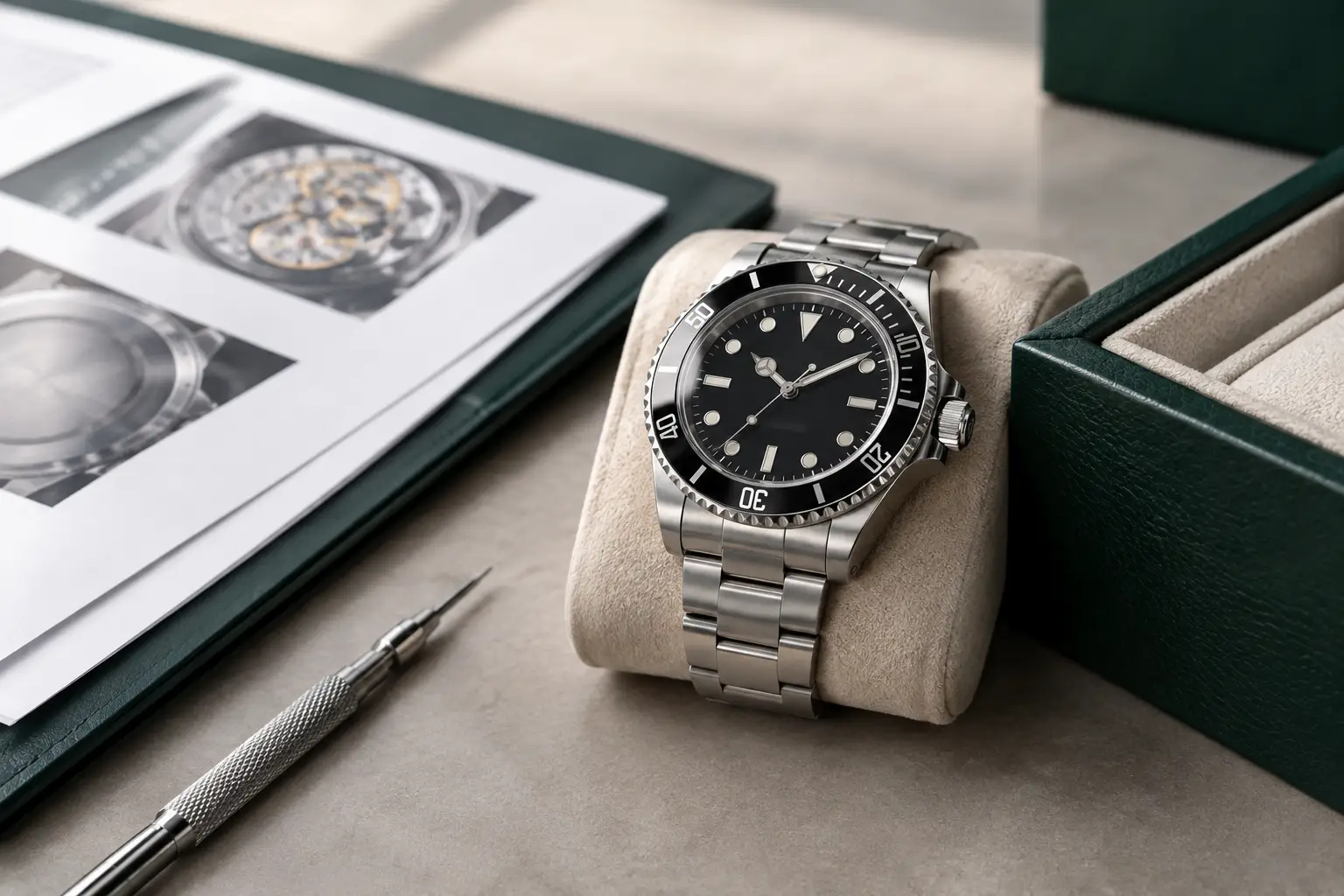
A Rolex service history is more than a folder of receipts. For a pre-owned watch, it can explain how the movement has been maintained, whether major components may have been replaced, and how confidently a buyer can assess condition beyond photographs. It is valuable evidence, but it is not the only evidence that matters.
For collectors and first-time Rolex buyers alike, the right question is not simply, “Does this watch have papers?” It is whether the available service documentation aligns with the watch itself: its reference, serial-era characteristics, dial, bezel, bracelet, movement condition, and stated condition. A complete record can add clarity. Its absence does not automatically make a Rolex a poor purchase.
What Rolex Service History Actually Shows
A service record generally documents work performed on the watch at a particular point in time. Depending on where the work was completed and how thoroughly it was recorded, it may identify the reference number, serial number, service date, work performed, and parts replaced. An official service invoice or service card is usually the most useful form of documentation because it creates a dated record from a known service channel.
Mechanical Rolex watches are built for long-term ownership, but lubricants age, seals wear, and daily use eventually affects timing and water resistance. A proper service commonly includes movement disassembly, cleaning, lubrication, regulation, replacement of worn functional components where needed, testing, and renewal of water-resistance components. The precise scope depends on the model, its condition, and the work authorized by the owner.
That context helps explain why a recent service can be meaningful. It may reduce the likelihood that a buyer faces immediate maintenance needs after purchase. It does not, however, establish every aspect of the watch’s history or guarantee that no future service will be required.
Why Service Records Matter to a Rolex Buyer
Service history is most useful when it answers practical questions. Was the watch maintained at reasonable intervals? Was it recently pressure-tested if it is being considered for water exposure? Were components replaced? Is there a record of a movement issue being corrected?
For modern Rolex models intended for regular wear, documented maintenance may be a straightforward advantage. A buyer considering a Submariner, GMT-Master II, Datejust, or Daytona often wants assurance that the watch is functioning properly and has not been neglected internally. The service record gives useful context alongside current timing performance, condition inspection, and authentication.
For vintage and highly collectible references, the calculation is more nuanced. Collectors may place significant importance on original dials, hands, bezels, bracelets, and case profiles. Service work can preserve a watch mechanically while also altering features that contribute to its period character. A replacement dial or handset may be perfectly legitimate and professionally installed, yet less desirable to a buyer focused on originality.
This is why “recently serviced” should never be treated as a universal verdict. It is positive when the work is transparent and appropriate to the watch. It deserves closer review when the documentation is vague or when the watch’s current components do not appear consistent with its stated configuration.
Official Records, Independent Receipts, and Verbal Claims
Not every document carries the same weight. An official Rolex service record is generally the clearest form of evidence because it is tied to a defined service event. Detailed invoices from a qualified independent watchmaker can also be helpful, particularly when they specify the work completed, parts used, and the watch’s identifying details.
A receipt that says only “watch repair” offers less value than an itemized invoice. Likewise, a seller’s statement that a watch was serviced without supporting documentation should be treated as a claim, not as proof. It may be accurate, but a careful buyer should evaluate the watch based on its present condition rather than assign a premium to undocumented work.
Service documentation also differs from the original warranty card, sale receipt, box, or booklet set. Those materials relate to the watch’s original sale and ownership trail. Service history relates to maintenance after that sale. A Rolex can have one without the other, and each contributes different information to the overall provenance picture.
What to Look for on a Service Document
When records are available, check that the date, reference or serial information, and watch description reasonably correspond to the piece being offered. Review whether the invoice identifies replaced components, polishing or refinishing, water-resistance testing, or movement work.
A record that notes replacement parts is not necessarily a concern. It simply gives the buyer a clearer basis for evaluating originality. On a contemporary daily-wear Rolex, factory replacement of worn functional parts can be entirely appropriate. On a vintage collector piece, it may affect desirability depending on which component was changed and whether the original part accompanies the watch.
Service History and Case Condition Are Separate Questions
One of the most common misunderstandings is assuming that a service record confirms an untouched case. It does not. During service, a case and bracelet may be cleaned, refinished, or polished if authorized. These processes can improve the cosmetic presentation of a regularly worn watch, but repeated or aggressive polishing may soften edges, reduce the definition of lugs, and change the visual character of certain references.
This is especially relevant for collectors evaluating vintage Rolex sports models. Clear photographs and a careful physical assessment are essential. Look at lug shape, bezel fit, crown guards where applicable, bracelet stretch, clasp condition, and the consistency of finishing. Service paperwork is useful context, but it cannot replace direct condition review.
The same principle applies to bracelets and clasps. A Rolex may have received a replacement bracelet during its life, or it may retain its original bracelet with signs of age. Neither outcome is automatically right or wrong. The key is accurate disclosure and a price that reflects the complete configuration and condition.
How Much Service History Is Enough?
There is no single standard because a Rolex’s age, reference, use pattern, and collecting purpose all matter. A ten-year-old watch with one documented service and strong current performance may be entirely reasonable. A much older vintage watch may have gaps in its paper trail simply because service records were not retained over decades.
For a current-production Rolex, buyers often value a recent, documented service when the watch is being purchased for frequent use. For a vintage reference, a long history with transparent details can be desirable, but untouched original components and correct period features may matter even more.
A lack of service records should prompt better questions rather than an automatic rejection. Has the movement been evaluated? Is the watch keeping acceptable time? Are the crown and seals functioning as expected? Is there evidence of moisture damage, corrosion, or poor prior repair work? A knowledgeable seller should be prepared to address these points clearly.
Questions to Ask Before You Buy
Before committing to a pre-owned Rolex, ask whether service documents are included and whether they identify the specific watch. Ask what work was performed, whether any parts were replaced, and whether the case or bracelet was polished. If water resistance matters to your planned use, ask whether it has been tested recently and understand that no pre-owned watch should be assumed suitable for water exposure without appropriate verification.
You should also ask how the seller authenticated the watch and assessed its condition. Service records support confidence, but they do not substitute for a careful inspection of the movement, case, dial, bracelet, and serial-era consistency. Documentation is strongest when it is part of a broader, disciplined evaluation.
At Lume Wrist Watches, pre-owned timepieces are authenticated and in-house certified before sale, with free insured US shipping, a 30-day return window, and a two-year warranty. Those safeguards matter when documentation is complete, and they matter just as much when a watch’s age means its historic records are naturally limited.
A Rolex service history should help you understand the watch you are buying, not distract from it. The best purchase is one where the records, condition, configuration, and seller disclosures tell a consistent story - and where you know exactly what that story means for the way you plan to own the watch.