How to Authenticate a Rolex Serial Number
Published August 13, 2026 · Last updated October 17, 2026 · By Lume Wrist Watches Editorial Team
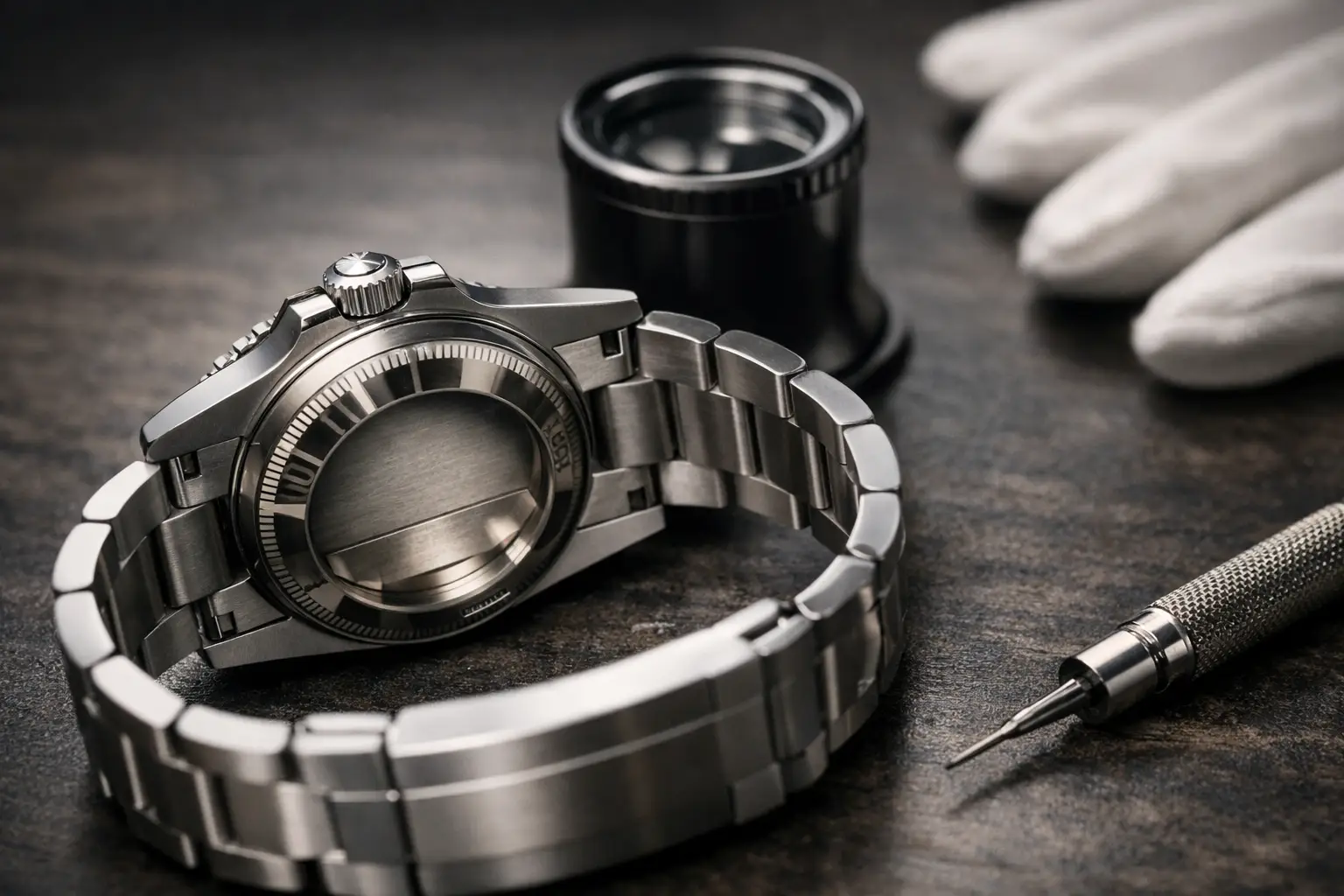
A Rolex serial number can be useful evidence, but it is not a standalone certificate of authenticity. Buyers who want to authenticate a Rolex serial number should treat it as one part of a broader inspection that considers the case, movement, dial, bracelet, reference number, and supporting documentation. A genuine-looking number on a watch with incorrect components is not enough to establish confidence in the piece.
For a high-value purchase, the right question is not simply, “Does this serial number look real?” It is, “Does every identifying detail agree with the watch in front of me?” That distinction protects both collectors pursuing a specific reference and first-time buyers looking for a Rolex they can wear with confidence.
What a Rolex Serial Number Can Tell You
Rolex assigns a unique serial number to each watch case. On many older Rolex watches, the serial number is engraved between the lugs at the 6 o’clock side of the case, beneath the bracelet. The reference number is typically located between the lugs at 12 o’clock.
On later models, Rolex moved the serial number to the inner bezel, also called the rehaut, where it is laser-etched around the dial near 6 o’clock. Depending on the production period, a serial number may help establish an approximate manufacturing era. Earlier watches generally use sequential numbering, while newer production uses randomized serials that cannot be reliably dated from the number alone.
A serial number may support several useful checks. It can be compared with the reference number, the expected case configuration, the dial style, and the production characteristics associated with that Rolex model. It may also be recorded on paperwork supplied with the watch. These comparisons help identify inconsistencies that deserve a closer look.
What it cannot do is confirm that every component is original, that the movement is correct, or that the watch has not been altered. It also does not establish condition, service history, or ownership history on its own.
How to Authenticate a Rolex Serial Number Properly
Start with the serial number’s placement and execution. On an older case, the engraving should be clean, appropriately positioned, and consistent with the case’s age and wear. Over-polishing, corrosion, or damaged lug surfaces can soften or obscure an original engraving. Conversely, unusually fresh engraving on a heavily worn case can raise questions.
For rehaut-engraved serials, inspect the quality under proper magnification. The lettering should be precise and aligned with the inner bezel’s other markings. However, visual inspection alone still has limits. A convincing serial engraving can appear on a watch that includes an incorrect movement, replacement dial, or non-original bracelet.
The most reliable authentication process examines the watch as a complete system:
- The case reference and serial number should correspond to the expected model family and production period.
- The dial, hands, bezel, crystal, and bracelet should be appropriate for the reference, while allowing for documented service replacements where applicable.
- The movement should be correct for the model and show the expected Rolex finishing, markings, and construction.
- The case construction, engravings, and hallmarks should be evaluated for signs of alteration, excessive polishing, or replacement parts.
- Any card, warranty document, receipt, or service record should be reviewed for consistency with the watch, not accepted as proof by itself.
This is why serious authentication generally requires handling the watch, not evaluating a few photographs or a serial number provided in a listing. High-resolution images can help identify obvious concerns, but they do not replace a physical inspection by a qualified professional.
Serial Numbers and Production Dates
Collectors often use Rolex serial number charts to estimate a watch’s production period. These charts can be helpful context for older sequential serials, but they should be treated as approximate. Rolex production, distribution, and sale dates do not always align. A watch may have been manufactured in one period, delivered later, and sold at retail later still.
Randomized Rolex serial numbers add another limitation. Introduced on modern production, these numbers do not follow the older public sequence patterns. A seller who claims to determine an exact year from a random serial should be approached with caution.
For vintage and collectible Rolex watches, dating also requires attention to dial variants, case details, bracelet codes, movement characteristics, and known production changes. The serial number is useful supporting evidence, not the final answer.
Why a Serial Number Alone Is Not Enough
A serial number is attached to a case, not to the complete watch history. A valid number may appear on a case that has been paired with incorrect components over time. Some changes may be legitimate service replacements. Others can materially affect collectibility, originality, and value.
There is also no public Rolex database that allows a buyer to enter a serial number and receive a definitive authentication result. Be wary of online tools or informal claims that promise a complete answer based on a number alone. At best, they may provide broad production context. They cannot inspect the movement, verify the dial, or determine whether the case and bracelet belong together.
A missing, heavily damaged, or altered serial number deserves careful attention. It does not automatically establish wrongdoing, particularly on an older watch with significant wear or past case work. Still, it is a material issue that should be disclosed, evaluated by a professional, and reflected in a buyer’s decision.
Documentation Helps, but It Must Match the Watch
Original Rolex cards, papers, service records, and receipts can strengthen provenance when they match the reference and serial number of the watch. They may also help a buyer understand prior service or ownership history. Yet paperwork is not a substitute for inspecting the watch itself.
Cards and documents can be separated from a watch, altered, or incorrectly paired. A complete set is valuable only when its details align with the physical timepiece. A watch without papers is not necessarily inauthentic, especially in the vintage market, but it should receive the same disciplined review of its physical characteristics and serviceability.
If a watch has undergone Rolex service, ask what was replaced and whether any original components were retained. Service hands, a replacement dial, or a replacement bezel may be appropriate for a watch intended for daily wear. For a collector-focused purchase, those details can matter significantly.
A Safer Way to Buy a Pre-Owned Rolex
When buying a Rolex, favor a process that provides accountability before and after delivery. Clear images, an accurate reference description, documented condition details, and a stated authentication process should be standard. The seller should also be direct about whether the watch includes its original box, card, papers, bracelet links, and service history.
Purchase protections matter because authenticity is only one part of the transaction. Insured shipping reduces transit risk. A defined return window gives the buyer time to inspect the watch upon arrival. Warranty coverage provides an additional layer of confidence if a mechanical issue emerges after purchase.
Lume Wrist Watches offers in-house certified timepieces, free insured US shipping, a 30-day return window, and a two-year warranty. Those protections are designed for buyers who want professional validation and a clear path to resolution rather than the uncertainty of an informal transaction.
Questions to Ask Before You Commit
Before finalizing a purchase, ask whether the serial and reference numbers have been physically inspected, whether the movement was reviewed, and whether any replaced or non-original components are known. Request a precise condition description, including case polishing, bracelet stretch, crystal condition, and timing or service information when available.
You should also confirm what is included with the watch and understand the return and warranty terms before payment. A professional seller should be comfortable answering direct questions about authentication, condition, and the purchase process.
The serial number is a meaningful part of a Rolex’s identity, but confidence comes from the evidence around it. A careful inspection, consistent documentation, and clear post-purchase protections will tell you far more than a string of digits ever can.