Cartier Ballon Bleu in Gold, Two-Tone and Diamonds
Published August 3, 2026 · Last updated October 21, 2026 · By Lume Wrist Watches
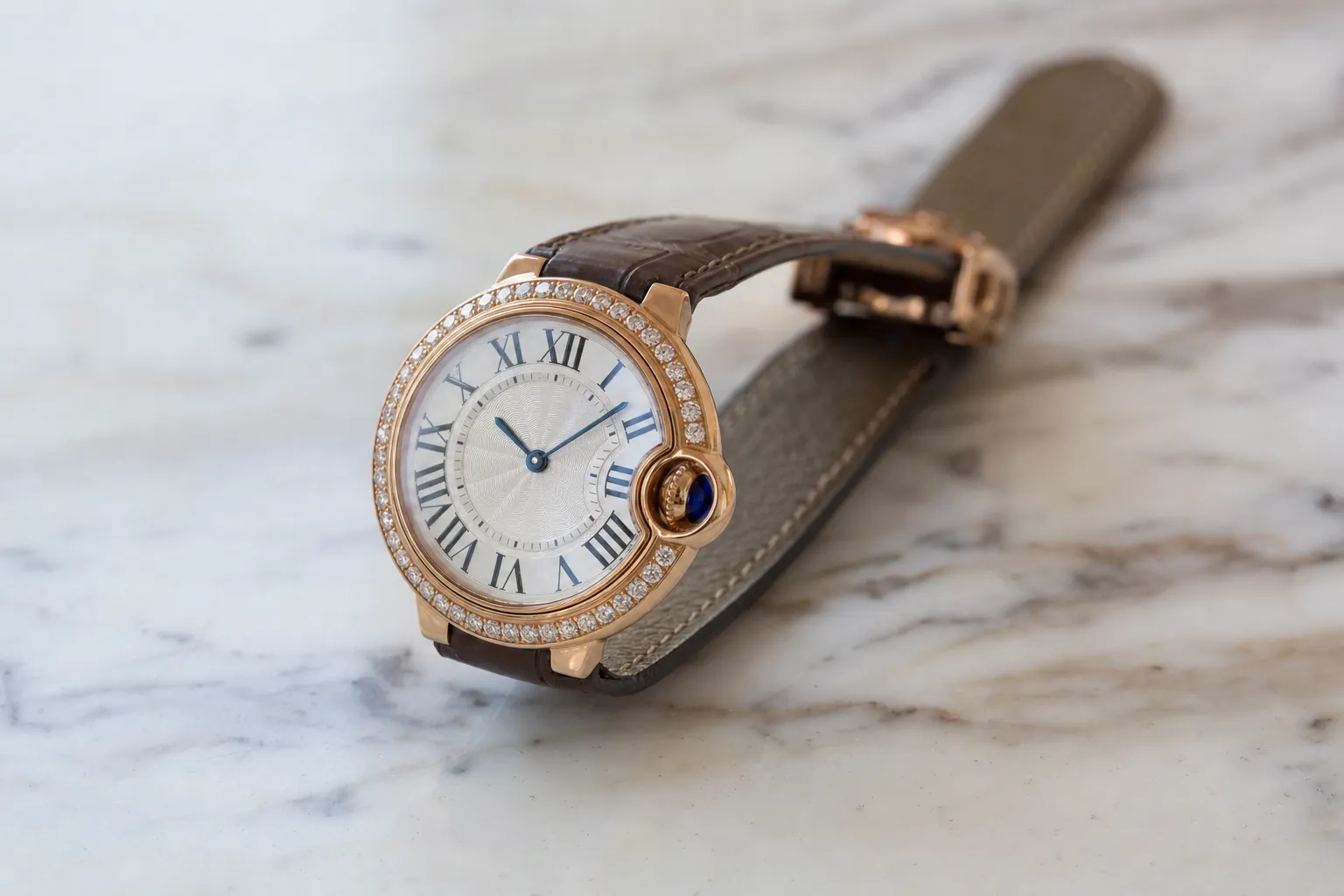
Selecting a luxury timepiece meant to endure across generations demands an evaluation that extends far beyond surface aesthetics into metallurgy, mechanical longevity, and provenance. For discerning collectors, the Ballon Bleu presents a distinct balance of historic maison design and sculptural case engineering. When evaluating a womens cartier ballon bleu gold reference or its bi-metal counterparts on the secondary market, understanding specific production nuances ensures your acquisition remains an enduring personal staple and a seamless heirloom handover.
Enduring Appeal of Cartier's Curved Silhouette
The architecture of the Ballon Bleu represents an intentional departure from traditional watchmaking conventions. While classic round watches typically feature flat case backs and protruding winding crowns, this silhouette is defined by complete convexity. Both the front sapphire crystal and the solid case back arc smoothly outward, creating an organic, pebble-like profile that rests flush against the wrist.
``` +-------------------------------------------------------------+ | Double-Convex Pebble Profile | | | | (--- Sapphire Crystal Curved Outer Profile ---) | | [================ Case Midsection ================] ===(*) | | (----- Case Back Arc Flush to Wrist Profile -----) Crown | | Guard | +-------------------------------------------------------------+ ```
Tactile Geometry and Convex Case Architecture
This double-convex design is not merely a visual triumph; it dictates how the watch interacts with the skin. By distributing its mass across a rounded undercarriage rather than concentrating weight along flat case edges, the watch avoids localized pressure points. For watches rendered in dense precious metals, this structural balance prevents top-heavy pivoting.
The sapphire crystal mimics the curve of the case seamlessly. Because the glass extends to the absolute periphery of the bezel without an aggressive drop-off, the watch glides effortlessly beneath tailored cuffs. Collectors prioritize this ergonomic flow because it minimizes friction and impact risk during decades of regular wear.
The Protective Crown Arc and Cabochon Integration
The hallmark feature of the collection is the integrated crown guard. Rather than affixing a separate bridge to the exterior of the case, Cartier engineers sculpted a hollowed channel directly into the case flank. Nested inside this protective tunnel is a fluted winding crown set with a synthetic or genuine blue cabochon.
This design choice provides significant structural protection. In conventional timepieces, the winding stem remains vulnerable to lateral shearing forces and accidental impacts. By enclosing the crown within an unbroken precious metal arc, Cartier eliminated a primary point of mechanical failure without sacrificing the tactile pleasure of winding the watch.
Choosing Between Solid Gold and Two-Tone Cases
Material selection is the foundational decision when acquiring a womens cartier ballon bleu gold model. Cartier crafts these pieces from proprietary 18k alloys alongside two-tone configurations that merge industrial durability with classical luxury. Navigating the nuances of our curated /brands/cartier selection requires a close look at how these metals hold up over decades of continuous wear.
The Weight and Purity of 18k Rose and Yellow Gold
Solid gold Ballon Bleu references offer a tactile presence unmatched by lighter alloys. Cartier utilizes standard 750/1000 purity across its gold production, alloyed with silver and copper to achieve specific color profiles. Solid yellow gold, primarily featured in earlier production runs, delivers a rich, vintage warmth that aligns with classic mid-century Cartier design codes.
In contrast, 18k pink (or rose) gold features a higher copper proportion, offering a softer blush tone that complements a broad range of skin tones. Solid gold cases develop a natural patina over time. Fine surface micro-abrasions coalesce into a softened luster rather than an unkempt scratch pattern, a characteristic cherished by collectors who view minor wear as the personal signature of an heirloom watch.
Practical Versatility of Two-Tone Construction
Two-tone references—combining 316L stainless steel with 18k gold—provide an exceptionally practical alternative for daily personal wear. In these references, the high-wear outer zones of the case and the bracelet's exterior links are typically rendered in steel, while the center links, crown architecture, and bezel present solid gold accents.
This structural composition offers distinct physical advantages: Enhanced Scratch Resistance: The harder stainless steel components absorb the majority of desk-diving abrasions and corner impacts. Reduced Overall Mass: The combination provides precious metal warmth on the wrist without the substantial physical weight of a full-gold bracelet. * Styling Flexibility: Bi-metal construction pairs effortlessly with either white gold, platinum, or yellow gold fine jewelry.
For collectors planning multi-generational handover, two-tone references offer structural longevity with lower vulnerability to external friction.
Factory Diamond Bezels and Gem-Set Dials
Gem-set Ballon Bleu models merge haute joaillerie craftsmanship with functional horology. However, the pre-owned market features both factory-set creations and aftermarket modifications. Discerning collectors reference our comprehensive /buying-guide to avoid post-factory diamond applications, which compromise case integrity and void manufacturer support.
Distinguishing Factory Stones from Aftermarket Settings
Cartier's gem-setting division adheres to strict tolerances. Factory diamonds are rigorously selected for high color (typically F–G) and clarity (VVS), ensuring brilliant internal reflection. Each diamond is calibrated to precise millimeter tolerances and seated into a grain or bead setting that is integral to the bezel casting.
``` Factory Setting: [Bezel Metal] -> [Pave Grain] -> (Diamond) <- [Pave Grain] <- [Bezel Metal] (Stones are set flush, symmetrical, with uniform metal beads and intact case markings)
Aftermarket Setting: [Drilled Bezel] -> [Thin Prongs] -> (Irregular Stone) <- [Drilled Bezel] (Drill holes penetrate water seals, obscure factory hallmarks, and display uneven spacing) ```
Aftermarket settings, conversely, involve drilling into an existing standard gold or steel bezel. This third-party machining weakens the bezel's structural stability, damages water-resistant seals, and often results in stones of disparate color and cut. Furthermore, aftermarket jewelers frequently polish away original factory engravings on the case back during assembly.
Fluted Bezels vs. Diamond Track Variations
Cartier has introduced several gem-set variations across the Ballon Bleu timeline. Understanding the reference taxonomy prevents confusion when evaluating dials and bezels:
| :--- | :--- | :--- | :--- | :--- |
|---|---|---|---|---|
| WJBB0033 | 18k Rose Gold | Silvered Guilloché | Single-row Factory Diamond Bezel | 33mm |
| WE902073 | Stainless Steel | Silvered Opaline | Factory Diamond Hour Markers (11) | 28mm |
| WE9002Z3 | 18k Yellow Gold | Sunray Lacquered | Factory Diamond Hour Markers (11) | 28mm |
| WJBB0058 | 18k Rose Gold | Silvered Sunray | Full Double-Row Factory Diamond Bezel | 36mm |
| W2BB0008 | Two-Tone Steel/Gold | Silvered Guilloché | Factory Diamond Hour Markers (11) | 33mm |
A factory diamond dial will retain Cartier's characteristic guilloché stamping without distorted concentric lines around the gem-setting chatons. When inspecting diamond hour markers, ensure the underlying hour markers utilize high-polish gold settings that anchor each stone securely.
Automatic Calibers Suited for Decades of Wear
A long-term heirloom requires a mechanical heart capable of perpetual serviceability. While Cartier incorporates highly dependable quartz movements in its smaller 28mm and select 33mm iterations, collectors focused on mechanical preservation typically favor automatic iterations found in 33mm, 36mm, and larger cases.
Caliber 076: Proven Architecture and Workhorse Reliability
For over a decade, mid-sized automatic Ballon Bleu models relied primarily on the Cartier Caliber 076. Based upon the architecture of the ETA 2671, this compact, self-winding movement operates at 28,800 vibrations per hour (4 Hz) with approximately 38 hours of power reserve.
The enduring merit of Caliber 076 lies in its universal serviceability: Standardized component geometry means independent master watchmakers can service it indefinitely. Readily available replacement components (mainsprings, balance staffs, escapement wheels) prevent movement obsolescence. * It features an exceptionally robust winding system well-suited to consistent daily use.
Caliber 1847 MC: Cartier's Modern In-House Standard
Beginning around 2015, Cartier introduced its manufacture movement, the Caliber 1847 MC, to the Ballon Bleu range. Designed and produced at the ValFleurier manufacture, this 25.6mm caliber delivers 42 hours of power reserve and incorporates modern horological technology.
The 1847 MC integrates non-magnetic nickel-phosphorus escapement components and a soft-iron inner shield. This construction protects the balance from the pervasive magnetic fields generated by modern smartphones, laptop enclosures, and magnetic handbag clasps. For an heirloom intended to transition into an increasingly digitized future, the anti-magnetic architecture of the 1847 MC represents an exceptional technical foundation.
Bracelet Durability Across Metal Variations
The Ballon Bleu bracelet is an intricate assembly of individually machined convex links designed to wrap comfortably around the wrist. Because precious metals possess differing levels of hardness, the longevity of these bracelets depends significantly on their metallurgical construction.
Pin Integrity and Link Stretch in Gold Alloys
Gold is a relatively soft, ductile metal. Over decades of wear, fine dust and skin oils penetrate the internal hinge channels of the bracelet. Combined with wrist movement, these microscopic contaminants act as an abrasive paste that slowly wears down the interior gold links and their connecting pins.
This internal erosion leads to what collectors term "bracelet stretch"—a gradual loosening and lateral sagging of the entire link structure. To mitigate this: 1. Regular Cleaning: Ultrasonic cleaning of the unmounted bracelet removes abrasive grit from the link pin junctions. 2. Correct Sizing: Sizing the bracelet to avoid excessive lateral slack minimizes torsion on the pins. 3. Pin Inspection: Periodic inspection ensures the internal friction pins or screws remain seated without deformation.
Deployant Clasp Tension and Everyday Security
Cartier fits the Ballon Bleu metal bracelets with a hidden double-folding deployant butterfly clasp. This mechanism features spring-tempered blades that snap into locked position beneath a central link cover.
Maintaining correct tension across these blades is essential. Over years of use, repeated opening and closing can slightly flatten the arc of the internal folding leaves, reducing locking friction. A qualified watchmaker can easily recalibrate this spring curve, restoring that reassuring, audible click upon closure.
Key Details Collectors Check in Accompanying Papers
When acquiring a high-grade timepiece through a platform like our online /shop, documentation serves as the historical ledger of the watch. Original packaging and paper trails confirm authenticity and preserve historical provenance for the next generation.
``` +-----------------------------------------------------------+ | Cartier Documentation Checklist | +-----------------------------------------------------------+ | [ ] Case Back Hallmark Inspection (Au750, St. Bernard) | | [ ] Deep-Engraved 8-Digit Serial / 4-Digit Model Number | | [ ] Certificate of Origin with Correct Matching Serial | | [ ] Red Presentation Box with Matching Era Interior | | [ ] Service Records Validating Official Maintenance History| +-----------------------------------------------------------+ ```
Hallmarks, Case Backs, and Reference Numbers
Solid gold Ballon Bleu references feature specific Swiss precious metal control marks. Modern 18k gold cases carry the head of a St. Bernard dog hallmark alongside the scales of balance stamp indicating "750" purity. These marks should appear crisp, deeply struck, and undeformed by aggressive over-polishing.
Beneath the hallmarks, the case back displays an engraved four-digit model number (such as 3009, 3489, or 3765) indicating the specific case architecture, accompanied by an individual eight-digit serial number.
Authenticating the Red Certificate Booklet
Cartier's warranty documentation has evolved across production eras. Older references were accompanied by a red, bound certificate booklet containing a physical "Certificate of Origin." Modern references feature an electronic, credit-card-sized plastic warranty card accompanied by an alphanumeric reference label.
Collectors examine these records to ensure: The serial number printed or written on the card exactly matches the engraving on the case back. An authorized retailer stamp is present with an intact initial date of sale. * Accompanying service receipts document any factory intervention, which confirms that internal components, hands, and dials remain authentic to the reference's original specification.
Frequently Asked Questions
### Is an automatic or quartz Ballon Bleu better for long-term ownership? An automatic movement is widely preferred for long-term mechanical longevity because its components can be machined, repaired, and serviced indefinitely by master watchmakers. Quartz movements offer exceptional everyday grab-and-go convenience and a slimmer case profile, but integrated circuit components may eventually face obsolescence decades down the line. For a watch intended as a multi-generational heirloom, an automatic mechanical caliber remains the standard collector choice.
### How can you verify that Ballon Bleu diamond settings are factory original? Factory diamond settings can be verified by matching the specific case reference number against Cartier's official catalogs, as gem-set variations have unique numerical designations. Under high magnification, factory diamonds exhibit precise stone symmetry, flawless bead-setting alignment, and consistent top-tier color and clarity. Any signs of drilled holes obscuring case-back hallmarks or rough metal edges around stones indicate aftermarket alterations.
### Which case diameter offers the most balanced proportions on smaller wrists? The 33mm Ballon Bleu is widely considered the most proportional and versatile choice for wrists measuring between 5.5 and 6.5 inches. Because the lugless case architecture terminates cleanly at the perimeter without elongated horns, it wears more compactly than its diameter suggests. For individuals desiring a delicate jewelry-like presence, the 28mm model sits flush and understated, while the 36mm provides a slightly bolder visual footprint.
### Does Cartier still produce yellow gold Ballon Bleu models? Cartier has largely shifted its modern precious-metal Ballon Bleu catalog toward 18k pink (rose) gold and white gold alloys. While yellow gold remains a pillar of collections like the Santos and Panthère, yellow gold Ballon Bleu references are predominantly found on the pre-owned market. These earlier yellow gold production runs remain highly sought after by collectors who prefer traditional golden tones.
### How often does a mechanical Cartier Ballon Bleu require complete servicing? A mechanical Ballon Bleu should undergo a complete service every five to seven years to ensure mechanical components remain lubricated and water-tight. During this procedure, the movement is completely disassembled, cleaned, re-lubricated, and regulated, while all case seals and gaskets are replaced. Regular maintenance prevents premature friction wear on internal pivots, ensuring the movement operates faithfully across decades of wear.