Cartier Santos-Dumont vs. Santos de Cartier
Published October 13, 2026 · Last updated October 14, 2026 · By Lume Wrist Watches Editorial Team

The Santos-Dumont, often found through searches for “santos dumont cartier,” is the slimmer, strap-focused option; the medium and large Santos de Cartier are bracelet-led daily watches with automatic movements. Choose the Dumont for a low-profile dress watch and the Santos de Cartier for greater water resistance and a more substantial presence.
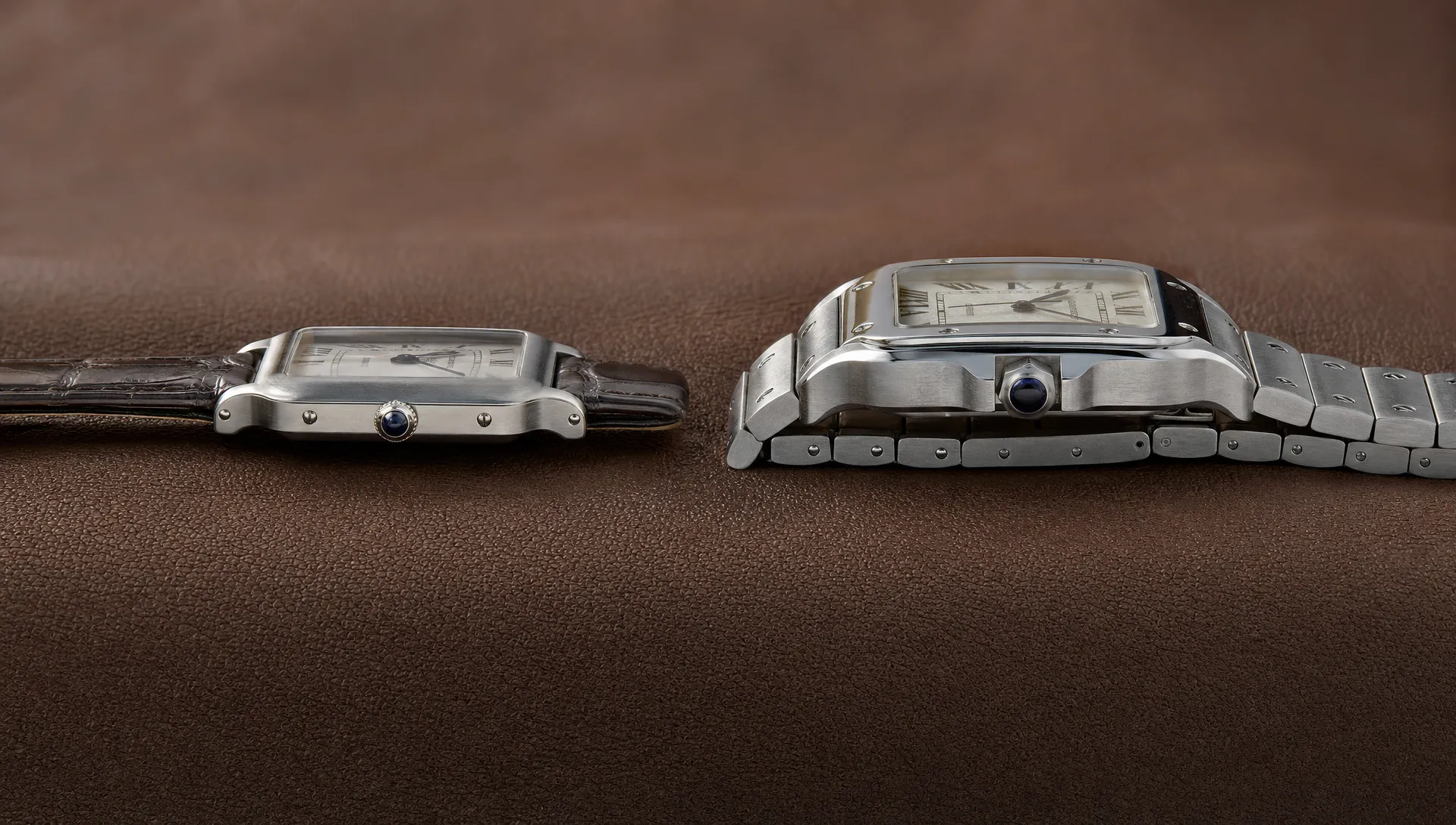
Both have square cases, exposed bezel screws and Roman numerals. Those shared details can make them look interchangeable online. On the wrist, their proportions and ownership requirements are quite different.
What “santos dumont cartier” refers to
The correct collection name is Cartier Santos-Dumont. It shares its origins with Santos de Cartier, but the two names identify distinct modern watch families.
Both trace their history to the wristwatch Louis Cartier created for aviator Alberto Santos-Dumont in 1904. The modern Dumont emphasizes the early design’s slim case, compact proportions and leather strap. Santos de Cartier develops that design into a more substantial everyday watch, usually associated with its screw-decorated bracelet.
Neither collection has just one movement or size. In particular, do not assume every Santos-Dumont is quartz or every Santos de Cartier is automatic. This comparison focuses on familiar steel Dumont references and the medium and large automatic Santos de Cartier.
For context across the brand, our guide to Cartier’s shaped-case watches explains how these square designs differ from Cartier’s rectangular and curved cases.
Reference numbers and dimensions compared
The references below are useful starting points when comparing pre-owned listings. They are representative models, not a statement of current inventory.
| Model | Steel reference | Case length × width | Thickness | Movement | Rated water resistance |
|---|---|---|---|---|---|
| --- | --- | --- | --- | --- | --- |
| Santos-Dumont Small | WSSA0023 | 38 × 27.5mm | 7.3mm | Quartz | 30m |
| Santos-Dumont Large | WSSA0022 | 43.5 × 31.4mm | 7.3mm | Quartz | 30m |
| Santos-Dumont XL | WSSA0032 | 46.6 × 33.9mm | 7.5mm | Hand-wound 430 MC | 30m |
| Santos de Cartier Medium | WSSA0029 | 41.9 × 35.1mm | 8.83mm | Automatic 1847 MC | 100m |
| Santos de Cartier Large | WSSA0018 | 47.5 × 39.8mm | 9.08mm | Automatic 1847 MC | 100m |
Cartier’s product specifications for the large Santos-Dumont WSSA0022 and medium Santos de Cartier WSSA0029 provide manufacturer reference points. Confirm the exact reference before applying these specifications to another watch.
Small, large and XL are collection labels, not equivalent sizes across both families. The large Dumont is narrower than the medium Santos de Cartier. Comparing the labels alone can lead to the wrong purchase.
Which one fits your wrist better?
Santos-Dumont: thin, but not necessarily small
The Cartier Santos-Dumont sits low against the wrist. Its thin case slips easily beneath a shirt cuff, while the leather strap gives it less visual weight than a steel bracelet.
Case length still matters. The XL measures 46.6mm from end to end, so its modest 33.9mm width does not guarantee a compact fit. Look at whether the lugs remain within the flat upper surface of your wrist and whether the strap bends down naturally.
On a 6.5-inch (165mm) wrist, the large quartz Dumont is a sensible starting point for a restrained fit. The XL may also work, depending on wrist shape and your preference for coverage. Neither measurement is a universal sizing rule.
Santos de Cartier: the bracelet changes the impression
The medium Santos de Cartier has a 35.1mm-wide case, but its square dial and broad bracelet give it more presence than that number suggests. It is worth trying before assuming you need the large.
The large adds width, length and a date window at six o’clock. Choose it because the proportions suit you, not because the listing calls it a men’s size.
If both square cases feel too broad, an elongated design such as the Cartier Tank Américaine 1713 offers a different direction to consider. Compare its actual measurements rather than assuming a rectangular watch will automatically fit better.
Quartz, manual winding or automatic?
Quartz Dumont: straightforward daily ownership
The small and large steel Dumont references above use quartz movements. You do not need to wind them, and they are convenient when rotating between several watches.
A battery-powered Cartier Santos-Dumont is not an inferior version of a mechanical watch. It is a different ownership choice. You get the slim case and recognizable design without a daily winding routine.
Battery replacement should include appropriate gasket inspection and water-resistance checks. Quartz watches still need maintenance, particularly when their service history is unclear.
Manual Dumont: a more deliberate routine
The XL WSSA0032 uses the hand-wound 430 MC. There is no automatic winding rotor, so wearing it does not replenish its power reserve. Expect to wind it regularly according to the movement’s instructions.
This is the better fit if you specifically want a thin mechanical Dumont and enjoy interacting with the movement. It is less suitable if you expect a watch to remain running after several days off the wrist.
Automatic Santos de Cartier: convenient for regular wear
The medium WSSA0029 and large WSSA0018 use the automatic 1847 MC. Wrist movement winds the mainspring during wear, although an unworn watch will eventually stop.
The medium’s no-date dial is especially balanced. The large’s date display adds utility but also means another setting to correct after the watch has stopped. These practical differences matter more than a general claim that one movement type is “better.”
Bracelet, straps and water resistance
The bracelet is a major reason to choose Santos de Cartier. The modern medium and large references discussed here feature Cartier’s QuickSwitch attachment system and SmartLink bracelet adjustment. These make strap changes and link removal more accessible than on many conventional bracelets.
Do not assume the same features apply to every older Santos reference or to the Dumont. For any pre-owned example, confirm which bracelet, straps, clasp and spare links are actually included.
The Cartier Santos-Dumont references above have a 30m water-resistance rating. Treat them as watches to keep away from immersion, particularly on leather. The Santos de Cartier’s 100m rating provides a stronger starting point for water exposure, but an older watch’s present condition matters more than its original specification.
Before swimming with a pre-owned watch, request a recent pressure-test result and confirm suitability with the seller or watchmaker. Keep leather straps out of water regardless of the case rating.
What to inspect before buying pre-owned
Case geometry and refinishing
These designs depend on clean edges and distinct transitions between brushed and polished surfaces. Examine the bezel corners, screw recesses, case sides and lugs in clear photographs.
Polishing is not automatically disqualifying. The question is how much material was removed and whether the original geometry remains convincing. “Excellent condition” is a seller’s condition description, not a substitute for asking about refinishing, scratches and replaced parts.
On a bracelet-equipped Santos, also inspect the clasp, link articulation and fit between bracelet and case. Ask whether the supplied links will accommodate your wrist.
Reference, originality and service documentation
For a Cartier Santos-Dumont, confirm that the reference agrees with the case size, material, dial and movement. Distinguish a sales reference such as WSSA0032 from other numbers engraved on the case; they serve different identification purposes.
Box and papers help document a watch’s history, but they do not independently prove authenticity. Conversely, missing papers do not establish that a watch is counterfeit.
Ask what authentication involved, what servicing was performed and whether any dial, hands, crown or movement components were replaced. A service replacement is not automatically a problem, but it should be disclosed when known. Request written warranty and return terms before paying.
Comparing prices without comparing the wrong watches
There is no useful single price for “a Santos.” Reference, metal, movement, condition and included accessories all change what you are evaluating. An older Santos Galbée, a modern automatic Santos de Cartier and a quartz Dumont are not direct substitutes simply because a listing uses the Santos name.
Compare actual available listings rather than mixing historic retail prices with current asking prices. Without verified, reference-specific inventory, a numerical price range would imply more precision than the evidence supports.
| --- | --- |
|---|---|
| Exact configuration | Matching reference, metal, size, dial and movement |
| Physical condition | Refinishing history, visible damage and bracelet condition |
| Included components | Correct clasp, suitable strap, spare links and stated accessories |
| Near-term ownership costs | Documented service, battery needs, strap replacement or missing links |
| Buyer protections | Authentication process, return terms and written warranty coverage |
A Cartier Santos-Dumont with an exhausted strap and uncertain service history may require immediate spending. A Santos de Cartier with too few bracelet links can create a different expense. Obtain those costs before deciding which listing offers better value.
Buy either watch because it suits your use. Future resale proceeds are uncertain and should not be treated as a promised return.
Frequently asked questions
Is the Santos-Dumont the same as the Santos de Cartier? No. They share design origins, but the modern Dumont emphasizes a thin, strap-focused case. The medium and large Santos de Cartier discussed here offer automatic movements, bracelets and higher rated water resistance.
Does every Santos-Dumont have a quartz movement? No. The small WSSA0023 and large WSSA0022 are quartz, while the XL WSSA0032 uses the hand-wound 430 MC. Other references require their own specification checks.
Which is better as a first Cartier? The medium automatic Santos de Cartier is a strong starting point for someone wanting a bracelet watch for frequent wear. The large quartz Dumont makes more sense for someone prioritizing thinness, dress use and minimal winding-related upkeep.
Can either watch be worn every day? Yes, if the choice matches your routine. The Dumont suits everyday office wear, but its leather strap and lower water-resistance rating require more care around moisture. The modern Santos de Cartier is the more versatile choice for varied daily use.
Choose the reference, then choose the example
Start with fit and movement: large quartz Dumont for slim simplicity, XL manual Dumont for a thin mechanical watch or medium automatic Santos de Cartier for bracelet-led versatility.
Browse Lume Wrist Watches’ pre-owned watch collection or ask about availability of your preferred Cartier reference. Lume is an independent retailer, not a Cartier authorized dealer. Its pre-owned inventory is certified authentic by Watch CSA and serviced before shipping, with free insured US shipping, 30-day returns and two-year warranty coverage. International shipping is available on request and quote.