How to Authenticate Luxury Watches Before You Buy
Published August 11, 2026 · Last updated October 17, 2026 · By Lume Wrist Watches Editorial Team
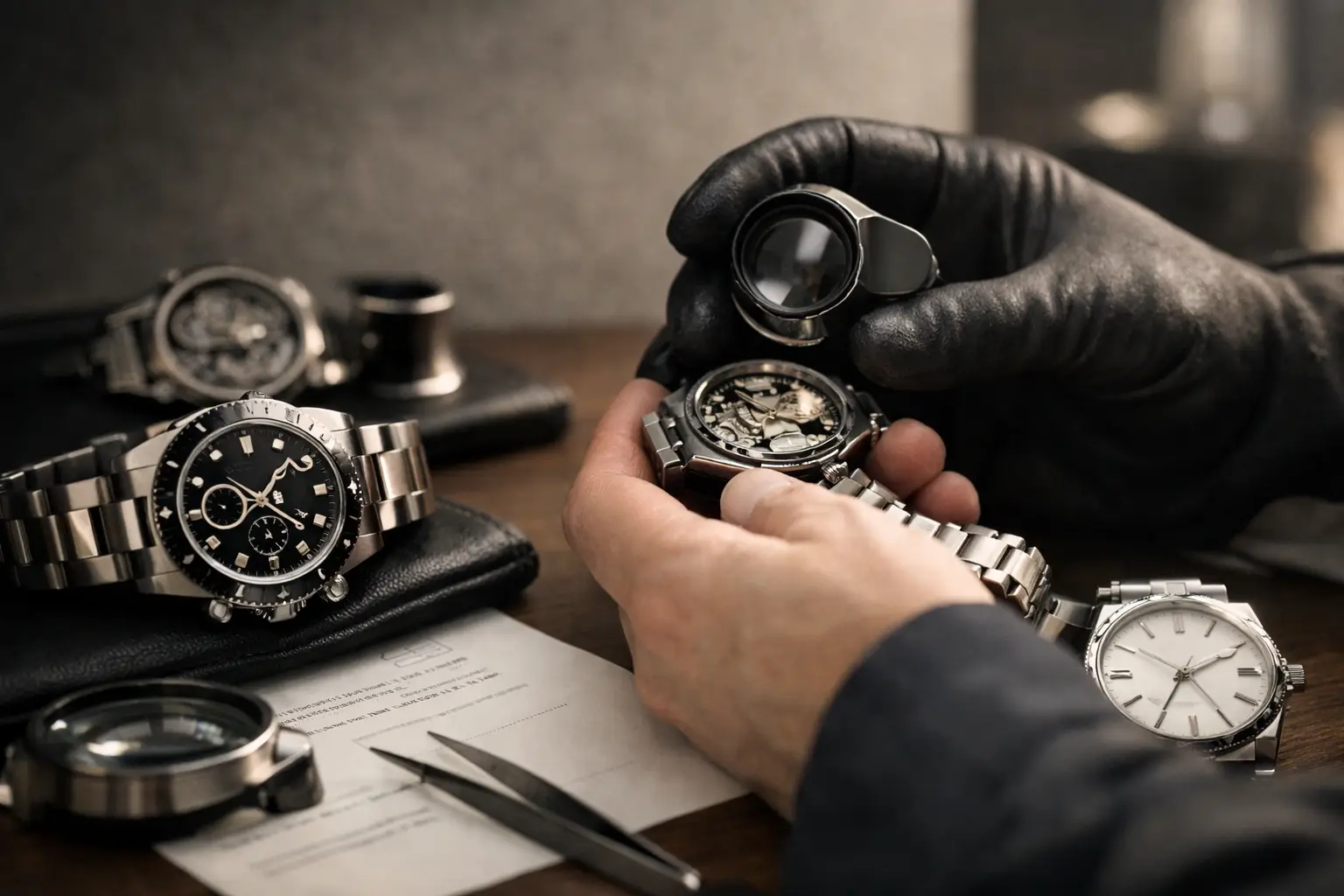
A luxury watch can look convincing in a listing photo and still fail the checks that matter. Knowing how to authenticate luxury watches means looking beyond a familiar logo, a serial number, or a box and papers. Authenticity is established through a consistent body of evidence: the correct reference details, period-appropriate components, movement quality, condition disclosure, and a seller willing to stand behind the watch after delivery.
For a Rolex, Patek Philippe, Audemars Piguet, or Omega, small inconsistencies can materially affect confidence and value. The goal is not to turn every buyer into a watchmaker. It is to recognize what you can verify yourself, understand where visual inspection stops, and choose a purchase process with meaningful safeguards.
Start With the Exact Reference
Authentication begins before the watch is in hand. Identify the precise reference number, not just the model family. A Rolex Submariner, for example, covers multiple generations with different case proportions, dial layouts, bezels, bracelets, movements, and engraving conventions. The same principle applies to a Patek Philippe Calatrava, an Audemars Piguet Royal Oak, or an Omega Speedmaster.
Compare the watch against known specifications for that reference and approximate production period. Confirm the case material, dial color and configuration, handset, bezel, bracelet or strap type, clasp, crystal, and movement designation where available. A correct-looking watch with one incorrect major component deserves closer scrutiny.
Do not treat a serial number as a standalone proof of authenticity. Serial formats can help place a watch within a production range, but numbers must be evaluated alongside the case, dial, movement, and documentation. A number that appears plausible does not establish that every part belongs to the watch or that the watch itself is genuine.
Examine the Details That Counterfeits Often Miss
High-quality counterfeit watches have made broad visual checks less useful than they once were. Weight, a sweeping seconds hand, and a logo that looks sharp are not enough. Focus on details that are difficult to reproduce consistently.
Dial printing, hands, and finishing
Under magnification, inspect the dial printing for crisp edges, correct font shapes, even spacing, and clean alignment. Hour markers should sit evenly and match the expected material and finish. On a legitimate luxury watch, hands should have consistent dimensions, polished surfaces, and precise alignment with the dial’s indexes.
Luminous material also deserves attention. Its color, texture, and aging should make sense for the watch’s era. An older watch may show natural variation, while a contemporary model should generally present a more uniform application. Neither condition is automatically good or bad - the question is whether it is consistent with the reference and the seller’s description.
Case, bezel, bracelet, and clasp
Check the quality of case finishing. Luxury manufacturers use deliberate combinations of brushing, polishing, chamfers, and sharp transitions. Soft edges, uneven brushing, poorly defined engravings, or rough metalwork can indicate a problem. Excessive polishing is not necessarily an authenticity issue, but it can reduce collector appeal and should be disclosed clearly.
The bracelet should match the reference and period where applicable. Review its link construction, end-link fit, clasp stamps, and engravings. Pay particular attention to the fit between the bracelet and case. Poor gaps, incorrect finishing, or a clasp that does not correspond to the watch’s generation can signal a mismatch.
Bezel inserts and bezels require the same care. Numeral font, pip construction, scale alignment, and color tone vary across references and production years. A replacement service component may be legitimate but less desirable to some collectors. The distinction matters, so ask whether components are original, period-correct, or later replacements.
The Movement Is the Decisive Inspection
A proper movement inspection is one of the strongest authentication steps, particularly for high-value watches. The movement should match the model’s expected caliber and display the manufacturer’s correct finishing, engraving, architecture, and component layout.
This is also where a professional assessment separates surface-level confidence from meaningful verification. Opening a watch without the right tools and experience risks damaging the case, gasket, or movement. It can also compromise water resistance. Buyers should not attempt it merely to satisfy curiosity.
Instead, request confirmation that the movement has been inspected by a qualified watch professional. Ask whether the caliber matches the reference, whether the movement appears original to the watch, and whether any service-related replacements or concerns were identified. For complicated Patek Philippe or Audemars Piguet references, expert evaluation is especially valuable because component originality and movement condition can be highly consequential.
Review Provenance Without Overvaluing It
Original box, papers, receipts, service records, and hang tags can support a watch’s history, but they are supporting evidence, not a substitute for inspection. Documentation can be incomplete, separated from the watch over time, or inconsistent with a particular configuration. It can also be altered or paired with the wrong watch.
When paperwork is included, make sure its details correspond logically with the timepiece. The reference should match, and any serial information should be handled carefully and compared by a professional where appropriate. Review dates, retailer stamps, service documentation, and ownership history for consistency rather than treating any single document as conclusive.
A watch without original papers is not automatically inauthentic. Many legitimate vintage and pre-owned watches circulate without their original presentation set. In that case, the quality of the technical authentication, condition reporting, and seller accountability becomes even more important.
Understand the Difference Between Authenticity and Condition
A watch can be authentic yet still be a poor fit for a buyer’s expectations. Authentication answers whether the watch is genuine and whether its components are correct or disclosed. Condition addresses wear, polishing, stretch in a bracelet, timing performance, service history, water resistance, and cosmetic damage.
Ask for clear, current photographs of the actual watch, including the dial, case sides, lugs, bracelet, clasp, caseback, and any notable wear. If the watch has been polished, serviced, or fitted with replacement components, that should be communicated plainly. A protected purchase decision depends on accurate condition information, not just an authenticity statement.
For watches intended for regular wear, recent service history and performance may matter more than perfectly untouched surfaces. For a collector pursuing a highly original example, unpolished case geometry, original dial condition, and correct period components may carry more weight. The right standard depends on the watch and your purpose for buying it.
How to Authenticate Luxury Watches Through the Seller
The seller’s process is part of the authentication. A serious luxury watch retailer should be able to explain how watches are inspected, what its certification covers, and how it handles questions after purchase. Vague assurances such as “guaranteed real” are less useful than a defined evaluation process and written buyer protections.
Before paying, confirm the watch is the specific piece shown, ask what is included, and review the return and warranty terms. Insured shipping is also essential for a high-value shipment. These safeguards do not replace technical authentication, but they provide recourse if the delivered watch does not match the represented item or condition.
Lume Wrist Watches offers in-house certified timepieces, free insured US shipping, a 30-day return window, and a two-year warranty. For buyers comparing a high-value pre-owned watch against an informal transaction, those terms help create a more accountable purchase process.
Questions Worth Asking Before You Commit
Ask whether the watch has been inspected internally, whether its movement matches the correct caliber, and whether any components have been replaced during service. Confirm whether the dial, hands, bezel, bracelet, and clasp are original or period-correct for the reference. Request a direct explanation of any visible wear, polishing, or performance issue.
You should also ask what documentation accompanies the watch, while remembering that missing papers alone do not decide authenticity. Finally, review the return procedure before the package arrives. A clear process gives you time to inspect the watch in person and compare it with the listing description.
A luxury watch should earn confidence through evidence, not urgency. When the reference details, movement inspection, provenance, condition report, and purchase protections all align, you can buy with a clearer understanding of what is on your wrist and what stands behind it.