IWC Portugieser 3714 vs 3716 Generational Guide
Published August 19, 2026 · Last updated October 21, 2026 · By Lume Wrist Watches
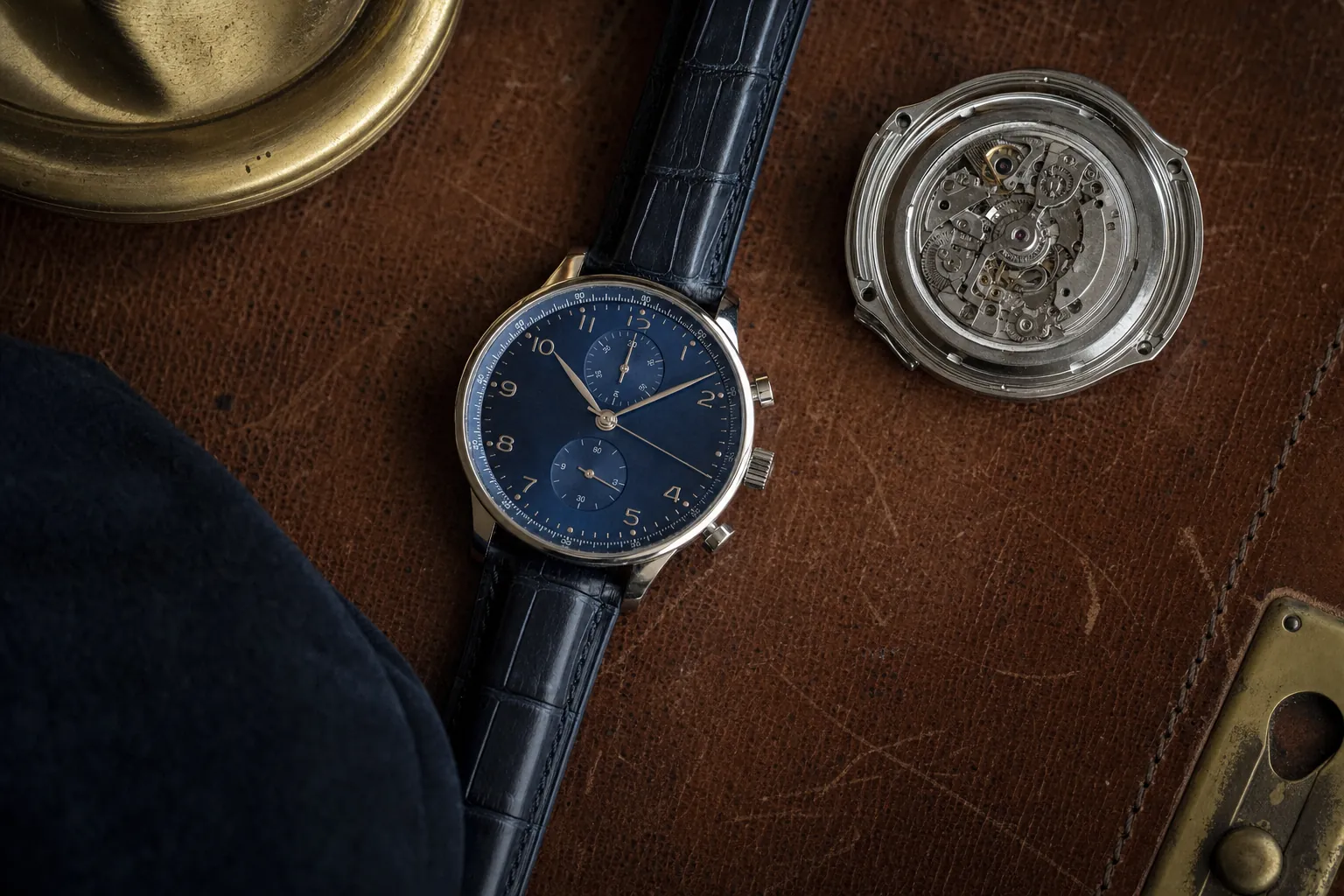
For more than two decades, the IWC Portugieser Chronograph has stood as one of the most recognizable and enduring dress chronographs in modern watchmaking. When IWC updated the iconic Reference 3714 to the in-house Reference 3716, the transition marked a pivotal moment for collectors navigating the pre-owned market. Understanding the mechanical evolutions, subtle case architecture shifts, and real-world wrist impressions of the IWC Portugieser 3714 vs 3716 is essential for choosing the iteration that best matches your collection goals.
The Shift from Modified Valjoux to In-House Power
The heart of the debate between these two generations lies beneath the dial. While both references retain the signature vertical two-register chronograph configuration—stacking the 30-minute counter at 12 o’clock and running seconds at 6 o’clock—their internal architectures represent completely different eras of watchmaking philosophy.
Calibre 79350: The Bulletproof Workhorse
Reference 3714, launched in the late 1990s, relied on the Calibre 79240 and later the Calibre 79350. These movements were built upon the foundation of the legendary Valjoux 7750 ébauche. However, calling the 79350 a simple off-the-shelf movement does a disservice to IWC's engineering team in Schaffhausen.
To achieve the Portugieser’s signature balanced aesthetic, IWC heavily modified the base architecture. Watchmakers stripped away the date mechanism and the 12-hour totalizer, re-routing the running seconds from the traditional 9 o’clock subdial down to the 6 o'clock position. Escapement components, mainsprings, and gear trains were finished and adjusted to meet exacting tolerances.
The resulting movement operates at 28,800 vibrations per hour (4 Hz) with an approximate 44-hour power reserve. It uses a traditional cam-and-lever switching mechanism, producing a stiff, authoritative, and unmistakable click when the start/stop pusher is depressed.
Calibre 69355: Modern In-House Manufacture
Introduced in limited editions for IWC’s 150th anniversary in 2018 before joining regular production in 2020, Reference 3716 houses the manufacture Calibre 69355. Developed specifically to replace outsourced chronograph bases across the brand's catalog, the 69000-calibre family represents modern technical refinement.
The Calibre 69355 utilizes a column-wheel system coupled with an oscillating pinion to govern chronograph functions. The physical actuation feels noticeably smoother and lighter under the finger than the cam-actuated 79350.
Additionally, the movement incorporates a pawl-winding system inspired by the brand’s historic Pellaton mechanism, winding efficiently in both directions to supply a 46-hour power reserve. Every example of Calibre 69355 features circular Geneva stripes, perlage on the mainplate, and an openworked rotor displaying the brand's "Probus Scafusia" medallion.
Visual Distinctions Between Reference 3714 and 3716
To the casual observer, Reference 3714 and Reference 3716 appear virtually identical from across a table. This preservation of design was deliberate; the original silhouette created by designer Hanno Burtscher in the 1990s is widely regarded as a modern design masterclass. However, several micro-details separate the two generations upon closer inspection.
Dial Text, Typography, and Proportions
Both watches utilize clean, applied Arabic numerals and feuille (leaf-shaped) hands alongside an outer flange marked with a 1/4-second precision chapter ring. On Reference 3714, the typography used for the numerals and the "IWC Schaffhausen" branding feels slightly flatter and carries the classic typesetting of the late 1990s and 2000s.
On Reference 3716, the printing on the dial exhibits greater relief, with slightly sharper, crisper pad printing across the subdial numerals. The feuille hands on Reference 3716 are subtly reshaped, featuring marginally sharper tapers toward the tips, which aligns with modern CNC machining standards.
Subdial Depth and Finishing
Both references feature recessed totalizers, but the tooling on Reference 3716 produces a slightly more pronounced snailed pattern (concentric circular grooving) inside the subdials. Under direct lighting, this texture creates higher contrast between the subdial background and the main dial surface.
The transition edge between the flat dial surface and the recessed subdials is also slightly steeper on the 3716. While minimal, these minute differences give the newer reference a slightly more technical, three-dimensional look compared to the softer, vintage-leaning warmth of early 3714 examples. Buyers exploring our curated luxury watch selection often note that these visual nuances play a major role in personal preference.
| Specification | Reference 3714 | Reference 3716 |
|---|---|---|
| :--- | :--- | :--- |
| Diameter | 40.9 mm | 41.0 mm |
| Case Thickness | 12.3 mm – 12.6 mm | 13.0 mm – 13.1 mm |
| Movement Base | Modified ETA/Valjoux 7750 | In-House IWC Calibre 69355 |
| Chronograph System | Cam / Lever | Column Wheel |
| Power Reserve | 44 Hours | 46 Hours |
| Caseback | Solid Stainless Steel | Sapphire Exhibition |
| Winding Rotor | Internal / Hidden | Skeletonized with Medallion |
Case Dimensions, Thickness, and Exhibition Casebacks
The external dimensions of the IWC Portugieser have remained remarkably stable, preserving the model’s distinctive, bezel-free appearance. Both cases feature an ultra-thin bezel ring that allows the dial to occupy almost the entire visual diameter of the watch, creating the optical illusion of a timepiece larger than its technical measurements suggest.
Reference 3714 measures 40.9 mm across, while Reference 3716 officially measures 41.0 mm—a nominal 0.1 mm variance that is imperceptible in person. The genuine dimensional difference between the generations appears in overall case height.
The 3714 features a solid caseback engraved with the standard IWC reference text and serial number, maintaining a slender total profile of roughly 12.3 mm to 12.6 mm (depending on the production era). This relatively slim height allows the watch to slide easily under dress shirt cuffs despite its broad dial presence.
Reference 3716 increases in thickness to approximately 13.0 mm to 13.1 mm. This modest increase is the direct consequence of incorporating an exhibition sapphire crystal caseback to showcase the in-house Calibre 69355. Because the sapphire display back is slightly domed and sits directly against the wrist, the case flanks themselves remain visually well-proportioned, though the vertical stance of the watch changes subtly.
Wrist Ergonomics and Strap Integration
On the wrist, both references wear with immense confidence, but differences in mass distribution and clasps create distinct tactile experiences.
Center of Gravity and Lug Geometry
Because Reference 3714 relies on a flat, solid steel caseback, its center of gravity sits closer to the wrist bone. The watch hugs the wrist contours naturally, creating a planted, stable feel even when worn on a supple leather strap.
On Reference 3716, the added thickness from the sapphire display caseback raises the watch’s center of mass slightly. While the lug curvature remains faithful to the original blueprint, individuals with smaller wrists (under 6.5 inches) may feel that the 3716 perches slightly higher on the wrist.
Clasp Evolution and Strap Compatibility
Throughout its production run, Reference 3714 saw multiple strap setups. Early models shipped with a traditional pin buckle, while later iterations (particularly after the mid-2000s) introduced a single-fold deployant clasp. This single-fold clasp was secure but sometimes caused the clasp blade to sit awkwardly off-center on smaller wrists.
Reference 3716 standardized an updated folding clasp designed to center the clasp mechanism more evenly along the underside of the wrist. Both references feature a 20 mm lug width tapering down to 18 mm at the buckle. This standardization makes finding high-quality replacement leather or textile straps straightforward across both generations.
Service Realities and Movement Longevity
When selecting a luxury chronograph, long-term maintenance is a critical factor for any buyer studying a pre-owned IWC watch catalog. The mechanical divide between the 3714 and 3716 creates two entirely different ownership trajectories regarding servicing.
Because the Calibre 79350 in Reference 3714 is derived from the ubiquitous Valjoux 7750, its architecture is intimately understood by almost every skilled independent watchmaker in the world. While IWC-specific components (such as modified plates or custom levers) must be sourced carefully, routine overhauls, balance regulation, and mainspring replacements can be performed by qualified independent workshops without relying solely on factory service networks.
The Calibre 69355 in Reference 3716, by contrast, is an exclusive in-house manufacture movement. Proprietary parts—such as the column-wheel assembly, specialized pawl components, and in-house balance assembly—are tightly controlled. While the movement offers modern construction standards, tighter manufacturing tolerances, and the visual pleasure of factory finishing, long-term servicing generally requires going directly through authorized service centers.
How to Choose Between Heritage Charm and Modern Tech
Choosing between the Reference 3714 and Reference 3716 requires weighing traditional workhorse utility against contemporary horological refinement.
Reference 3714 appeals strongly to collectors who value: - A pure connection to the 1990s neo-vintage design renaissance. - A thinner overall profile that slips effortlessly under formal cuffs. - The peace of mind that comes with an easily serviceable, universally understood base movement. - The tactile, mechanical snap of a cam-operated chronograph pusher.
Conversely, Reference 3716 is the optimal choice for buyers who prioritize: - A transparent view of modern movement finishing through an exhibition caseback. - The velvet-smooth tactile feedback of a modern column-wheel chronograph. - Upgraded factory clasps and crisp modern dial finishing techniques. - The prestige of a true in-house manufacture movement.
For collectors refining their approach to generational updates across classic models, reviewing our comprehensive watch buying guide can help clarify which features align best with your collection philosophy.
Frequently Asked Questions
### What is the main mechanical difference between the IWC 3714 and 3716? The primary mechanical difference is the movement architecture powering each chronograph. Reference 3714 uses the Calibre 79350, an extensively modified, cam-actuated movement built on a Valjoux 7750 base. Reference 3716 features the Calibre 69355, a modern in-house manufacture movement governed by a column wheel and equipped with a bidirectional pawl-winding system.
### Does the IWC Portugieser Chronograph 3716 wear thicker than the 3714? Yes, Reference 3716 wears marginally thicker on the wrist than Reference 3714. The inclusion of an exhibition sapphire caseback increases total case thickness from roughly 12.3–12.6 mm on the 3714 to approximately 13.0–13.1 mm on the 3716. While the visual profile from the front remains nearly identical, the 3716 sits slightly higher on the wrist.
### Can straps from Reference 3714 fit directly onto Reference 3716? Yes, straps are interchangeable between both generations because both models share identical lug architecture. Each reference features a 20 mm lug width at the case that typically tapers to 18 mm at the buckle. Any standard 20 mm strap paired with the appropriate spring bars will fit securely on either reference.
### Why did IWC introduce an exhibition sapphire caseback on Reference 3716? IWC introduced an exhibition sapphire caseback on Reference 3716 to display the aesthetics of its in-house Calibre 69355. Unlike the hidden Valjoux-based movement inside the solid-backed 3714, the modern manufacture movement features decorative perlage, circular Geneva striping, and a skeletonized winding rotor designed specifically to be viewed by the wearer.
### What water resistance rating does each Portugieser Chronograph generation provide? Both Reference 3714 and Reference 3716 offer a standard water resistance rating of 3 bar (approximately 30 meters). As formal dress chronographs fitted with non-screw-down pushers and pull-out crowns, neither generation is built for swimming, showering, or aquatic use. They are designed primarily to withstand minor splashes and daily ambient moisture.