High Complications in the JLC Reverso
Published August 8, 2026 · Last updated October 21, 2026 · By Lume Wrist Watches
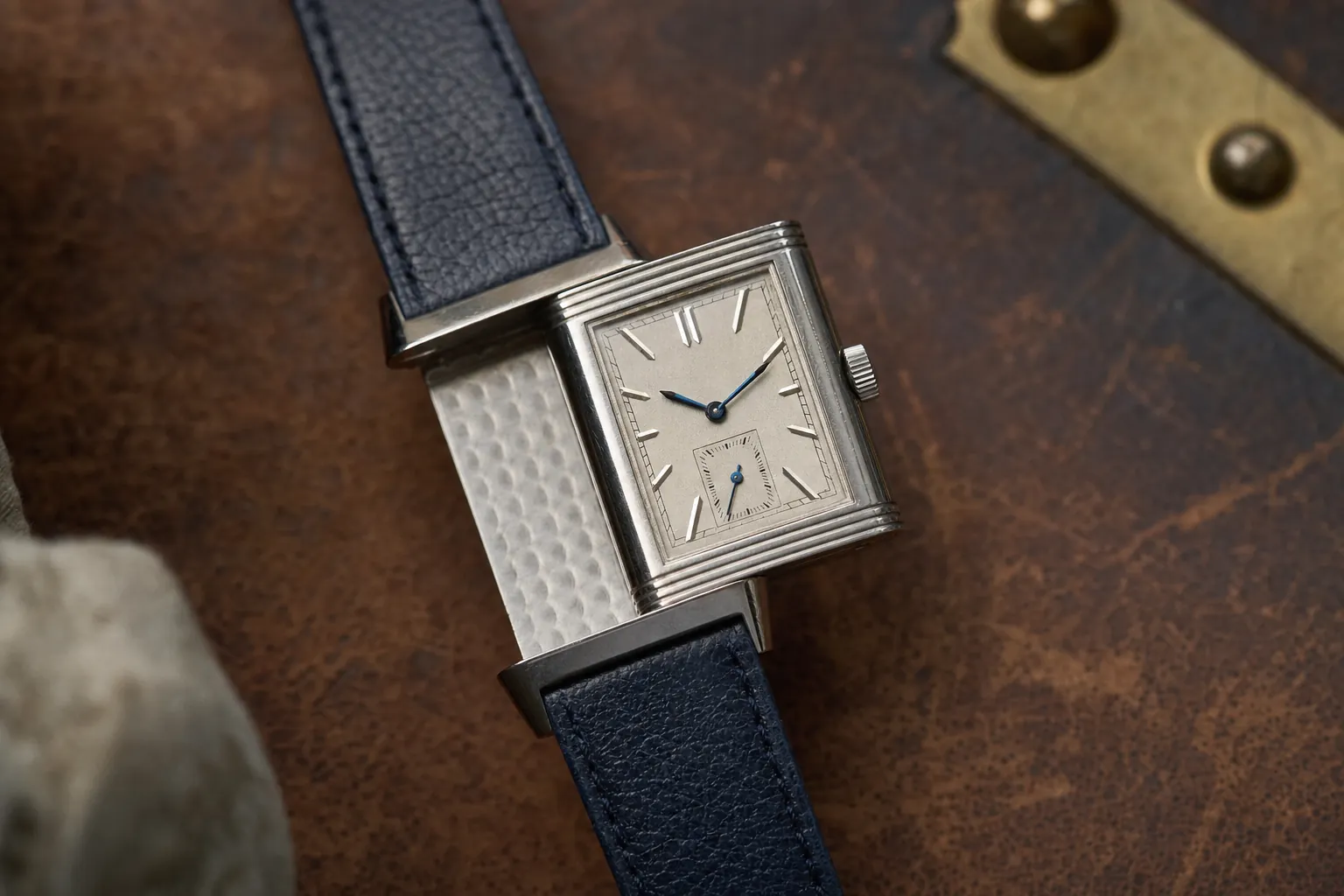
When collectors evaluate traditional haute horlogerie, round movements dominate the narrative because mechanical timekeeping relies fundamentally on rotating circular gears. Fitting complex mechanical functions into a non-round housing represents one of watchmaking's most formidable spatial puzzles. The technical trajectory of Jaeger-LeCoultre Reverso complications demonstrates how the Vallée de Joux manufacture adapted elite mechanisms—from tourbillons and minute repeaters to perpetual calendars—to the strict dimensional boundaries of a swiveling rectangular case.
The Challenge of Complications in Rectangular Calibers
Mechanical watches rely on gear trains: circular toothed wheels driving circular pinions. In a round caliber, these wheels naturally radiate outward from a central arbor or follow a sweeping circular arc that maximizes interior space.
When watchmakers force a traditional circular gear train into a rectangular casing, the corners become dead volume, while the narrow sides pinch component clearance. To achieve genuine mechanical efficiency, a manufacture cannot simply drop a small round caliber into a rectangular case with an oversized spacer ring.
``` +---------------------------+ | [Dead Space] (Wheel) | <-- Inefficient: Circular gear trains | (Wheel) (Arbor) | leave empty corners inside | (Pinion) [Dead Space] | a rectangular footprint. +---------------------------+ vs. +---------------------------+ | (Pinion)===Lever===(Rack) | <-- Calibre de Forme: Custom perimeter | (Wheel)---(Wheel)---(Cam) | routing, linear bridges, and shaped | [Mainspring] (Escapement) | gongs utilize total available volume. +---------------------------+ ```
Form Calibers Versus Modular Compromise
Jaeger-LeCoultre committed strictly to calibres de forme—shaped movements specifically engineered to match the geometry of their housings. In a shaped movement, the entire plate surface is functional.
Eliminating empty space requires designing asymmetrical wheel arrangements, serpentine bridges, and custom perimeter-hugging levers. Every gear train must be calculated with bespoke center distances, making shaped calibers significantly more resource-intensive to engineer than their round counterparts.
The Physical Penalty of the Swiveling Carriage
The Reverso architecture imposes an additional engineering hurdle rarely found in watchmaking: a two-piece case assembly. The watch movement does not sit directly against the wearer's wrist inside an outer shell. Instead, it resides within an inner chassis that slides, pivots, and docks into an outer base carriage.
This multi-component assembly consumes significant vertical and horizontal volume. The sliding rails, pivot pins, and spring-loaded ball bearings rob millimeters of internal space.
Watchmakers must design ultra-thin, highly dense mechanisms to prevent the finished timepiece from exceeding wearable wrist proportions. For buyers navigating the pre-owned market through an informed buying-guide, understanding these spatial limitations illuminates why shaped complications from the manufacture are regarded as major technical achievements.
The 1993 Reverso Tourbillon: Calibre 828
Following the quartz crisis, mechanical complications experienced a renaissance in the early 1990s. In 1993, Jaeger-LeCoultre introduced the Reverso Tourbillon (Ref. 270.2.68), housing Calibre 828. This release marked the manufacture's first tourbillon wristwatch caliber.
Rather than adapting an existing pocket watch movement, JLC developed a dedicated rectangular hand-wound caliber measuring just 3.65mm thick (excluding the tourbillon assembly). Calibre 828 operates at a frequency of 21,600 vibrations per hour (3 Hz) and incorporates 174 meticulously finished components.
``` Calibre 828 Spatial Architecture +---------------------------------------+ | [Mainspring Barrel] [Power Reserve] | <-- Top tier: 40-hour power delivery | ----------------------------------- | | [Linear Going Train: Center to 4th] | <-- Mid tier: Asymmetrical wheel train | ----------------------------------- | | [Open Tourbillon Cage: 60-Sec Spin] | <-- Lower aperture: Offset carriage +---------------------------------------+ ```
The Understated Dial and Exposed Carriage
The exterior execution reflects classic horological restraint. The front dial provides no obvious clue that a tourbillon is operating within, displaying only hours, minutes, and a subtle sector power reserve indicator at 11 o’clock.
The tourbillon cage reveals itself exclusively through the sapphire caseback on the reverse side of the chassis. This approach preserved the functional, discreet character of the Reverso while protecting the delicate balance assembly behind the solid front-facing construction.
Calibre 828 Kinematics and Escapement Architecture
The tourbillon cage completes one full rotation every 60 seconds, functioning as the subsidiary seconds indicator when viewed from the reverse. The steel carriage is hand-beveled, polished, and counterweighted with extreme precision to ensure uniform rotational inertia.
Fitting the cage into the lower quadrant of a rectangular plate required offset center-wheel gearing. Power travels from the mainspring barrel through an asymmetrical going train, delivering consistent torque down to the tourbillon pinion within an exceptionally flat profile.
The 1994 Minute Repeater: Calibre 943 Rectangular Chimes
Minute repeaters are historically round because acoustic sound waves propagate uniformly through symmetrical, circular resonance chambers. In 1994, Jaeger-LeCoultre shattered this precedent with the Reverso Répétition Minutes (Ref. 270.2.73), powered by the hand-wound Calibre 943.
Calibre 943 was the world's first rectangular minute repeater wristwatch movement. It comprises 306 individual components assembled inside a movement footprint measuring just 21.6mm by 28.5mm, with a total height of 4.37mm.
Acoustic Geometry: Bending the Gongs
Traditional repeater gongs are circular steel coils encircling the movement. To utilize the perimeter of Calibre 943, JLC engineers had to bend the gongs into a rectangular shape with distinct 90-degree corners.
Sharp angles in repeater gongs introduce acoustic flat spots and harmonic distortion. Jaeger-LeCoultre spent months refining the heat treatment, cross-sectional thickness, and corner radius of these chimes. The result was a clean, sustained two-tone strike (hours on the low chime, quarter-hours on alternating chimes, and minutes on the high chime).
Sound Transmission Across Two Cases
A minute repeater typically relies on the external case acting as a soundboard. In the Reverso, the inner chassis is separated from the wearer and the surrounding environment by the cradle and air gaps.
To overcome this acoustic barrier, JLC anchored the gongs directly to the inner case's structural heel blocks using high-tensile screws. The sound transfers directly through the chassis walls, projecting outward cleanly without being muffled by the swiveling cradle assembly. A front-dial aperture at 5 o'clock proudly showcases the strike governor spinning silently to regulate chime tempo.
Calibre 829: The 1996 Integrated Manual Chronograph
In 1996, Jaeger-LeCoultre addressed the world's most popular complication with the Reverso Chronographe Rétrograde (Ref. 270.2.69). Instead of sourcing an external movement or stacking a modular chronograph mechanism atop an existing base, the manufacture built Calibre 829 as a pure, integrated, hand-wound rectangular chronograph.
Composed of 317 components, Calibre 829 was crafted with solid rose gold plates and bridges—a rare flourish of haute horlogerie reserved for special limited editions.
Column Wheel and Horizontal Coupling in Miniature
Calibre 829 features classic high-end chronograph architecture: a traditional column wheel coordinating a horizontal gear coupling clutch. Miniaturizing these components into a rectangular shape meant positioning the column wheel and operating levers in a tight linear formation along the periphery of the plates.
The chronograph mechanism engages crisply through pushers set into the flank of the inner case. Because the movement sits within a sliding chassis, the pushers had to be engineered to interface with the internal levers without binding when the case is reversed.
The Retrograde Minute Mechanism and Dual-Face Readout
Rather than crowding the front dial with subdials, JLC split the displays across both faces of the chassis:
- Front Dial: Displays primary time, an aperture at 5 o’clock indicating chronograph operational status (running or stopped), and a subdial at 7 o’clock for running seconds.
- Reverse Dial: Dedicated entirely to the chronograph, featuring a central sweeping seconds hand and a patented 30-minute retrograde arc.
``` Reverse Dial Layout: Calibre 829 [ Retrograde 30-Min Arc ] 05 10 15 20 25 30 \ | / \ | / o <-- Retrograde Hand Snaps to Zero | | [ Center Chrono Sec ] ```
When the central chronograph second hand reaches 60 seconds, a stepped snail cam triggers an instantaneous jump of the retrograde hand. Upon hitting the 30-minute mark, the retrograde hand snaps back to zero in less than 1/100th of a second, an operation governed by an ultra-light tension spring and a micro-calibrated recoil brake.
Calibre 855: The Year 2000 Perpetual Calendar
Perpetual calendars present a labyrinth of wheels, multi-toothed cams, and long mechanical feeler levers. In round watches, these levers generally radiate from a centrally positioned 48-month or 12-month cam. For the year 2000, Jaeger-LeCoultre introduced the Reverso Quantième Perpétuel (Ref. 270.2.55), driven by Calibre 855.
Calibre 855 packages a full perpetual calendar mechanism—handling 28, 29, 30, and 31-day months, alongside the quadrennial leap year cycle—into a rectangular form caliber measuring just 3.75mm thick.
Mechanical Memory in Straight Lines
To calculate calendar irregularities without consuming excessive vertical space, the movement employs linear feeler levers that pivot along the edges of the base plate. These levers sample the profiles of intricately shaped step-cams:
- The Leap Year Cam: Features a rotating satellite that registers the four-year cycle, signaling the date wheel to accommodate February 29th.
- The Month Star Wheel: Works in tandem with an auxiliary lever to advance the date past non-existent days at the close of short months.
Synchronizing Dual-Sided Indications
The front dial maintains a clean layout with central hours and minutes, accompanied by a discreet day/night indicator and a leap year indicator aperture.
The reverse sapphire caseback reveals the comprehensive calendar suite. A broad retrograde arc across the upper register traces the date from 1 to 31, while lower subdials display the day of the week, the month, and a moon phase accurate to one day of deviation every 122 years.
Collectors searching our curated selection of timepieces for sale frequently look for these late-1990s limited runs, which established JLC's modern reputation for complex form movements.
| Model / Year | Calibre | Complication Type | Key Technical Innovation |
|---|---|---|---|
| :--- | :--- | :--- | :--- |
| Reverso Tourbillon (1993) | Cal. 828 | 60-Second Tourbillon | First wristwatch tourbillon from JLC; discreet reverse-only display. |
| Reverso Répétition Minutes (1994) | Cal. 943 | Minute Repeater | First rectangular repeater caliber; 90-degree bent acoustic gongs. |
| Reverso Chronographe (1996) | Cal. 829 | Integrated Retrograde Chronograph | Column wheel with horizontal clutch; instantaneous 30-min retrograde reset. |
| Reverso Quantième Perpétuel (2000) | Cal. 855 | Perpetual Calendar | Linear feeler-lever layout with synchronized dual-dial indications. |
Extreme Engineering: The Gyrotourbillon 2
By the late 2000s, Jaeger-LeCoultre moved beyond flat complications, entering the realm of three-dimensional multi-axis regulating organs. In 2008, the manufacture unveiled the Reverso Gyrotourbillon 2 (Ref. 233.64.20), powered by the hand-wound Calibre 174.
Calibre 174 comprises 371 parts and represents an uncompromising exercise in kinetic chronometry. The movement is housed inside a substantial reversible case constructed from solid platinum, measuring 55mm by 36mm with a thickness of 15.8mm.
``` Gyrotourbillon 2 Spherical Assembly +-----------------------------+ / Outer Aluminum Cage (60s) \ | +-------------------------+ | | / Inner Ultralight Cage \ | <-- Rotates at 18.75-second cycle | | (Cylindrical Hairspring) | | <-- True helical vertical expansion | | (14K Gold Balance) | | <-- 28,800 vph inertia regulation | \ / | | +-------------------------+ | \ / +-----------------------------+ ```
Multi-Axis Kinematics in Three Dimensions
A standard tourbillon combats gravitational errors in vertical positions, which was ideal for pocket watches resting upright in a waistcoat. A wristwatch, however, constantly changes positions throughout the day.
The Gyrotourbillon 2 addresses this by utilizing two nested, perpendicular cages:
- Outer Cage: Crafted from aircraft-grade aluminum, completing one full revolution every 60 seconds along the vertical axis.
- Inner Cage: Also aluminum, rotating along the horizontal axis at an accelerated rate of once every 18.75 seconds.
This dual-axis rotation ensures the balance wheel never remains in any single plane long enough for gravity to cause a positional rate error. Despite containing nearly 100 components, the entire spherical carriage weighs roughly 0.35 grams.
The Cylindrical Balance Spring and Isochronism
The most significant horological breakthrough within Calibre 174 was the integration of a cylindrical balance spring with terminal curves. Originally invented by English chronometer maker John Arnold in 1782 for marine chronometers, cylindrical springs had never previously been shrunk down to wristwatch scale inside a multi-axis tourbillon.
Unlike flat hairsprings that expand asymmetrically (breathing off-center and causing friction on balance pivots), a cylindrical spring breathes concentrically along a vertical axis. Operating at a high frequency of 28,800 vibrations per hour (4 Hz), the cylindrical spring provides near-perfect isochronism regardless of the mainspring's state of wind. Accommodating this spherical mechanism required a specially shaped curved sapphire crystal on both the front and reverse of the case.
Frequently Asked Questions
### Why is fitting complications into a rectangular case more difficult than a round case? Watch gear trains are naturally circular, meaning wheels rotate around central arbors and transmit energy along sweeping arcs. In a rectangular case, circular gear trains leave the corners empty and squeeze component clearance along the sides, requiring complete architectural redesigns with asymmetrical bridges and linear levers. Additionally, the Reverso’s two-piece sliding case carriage consumes substantial volume that would otherwise be available for movement components.
### Which was the first high complication introduced to the Reverso line? The first high complication introduced to the collection was the Reverso Tourbillon in 1993 (Reference 270.2.68), powered by the hand-wound Calibre 828. Produced in a limited run of 500 pieces in pink gold, it featured Jaeger-LeCoultre’s very first wristwatch tourbillon caliber. The movement kept the tourbillon discreetly hidden on the reverse side of the case, revealing it only when the chassis was swiveled.
### Does the Reverso Chronograph Calibre 829 use a column wheel? Yes, Calibre 829 is a fully integrated, hand-wound chronograph that uses a traditional column wheel system paired with a horizontal gear coupling clutch. The column wheel and its coordinating levers were engineered in a compact, linear configuration along the outer perimeter of the rectangular rose gold plates. It does not use a modular chronograph plate, ensuring all stop, start, and reset forces interact directly with the base movement train.
### How does the Reverso Minute Repeater produce sound within a swiveling case? The Reverso Minute Repeater (Calibre 943) generates acoustic resonance by anchoring its uniquely bent, 90-degree rectangular gongs directly to the structural heel blocks of the inner case chassis. Sound waves travel directly through the solid gold chassis walls into the open environment, rather than being muffled by the outer carriage. This direct mechanical coupling allows the chimes to ring out cleanly despite the air gap between the sliding inner case and its outer cradle.