Patek Philippe Calatrava Models Every Collector Should Know

Learn which Calatrava references define the collection, and how their cases, dials and movements differ. Compare eight important models with practical checks for originality, fit and pre-owned condition.
# Patek Philippe Calatrava Models Every Collector Should Know The Patek Philippe Calatrava references every collector should know are the foundational 96, the hobnail-bezel 3919 and 5119, the manually wound 5196 and 6119, and the automatic 5227, 5226G and 6007G. Together, they show how the collection spans compact vintage dress watches, restrained modern classics and more casual designs. The useful distinctions are reference-specific: case proportions, winding system, dial configuration and movement generation. Those details matter more than treating every Calatrava as the same watch in a different metal. ## The reference map: eight models worth knowing Patek Philippe traces the Calatrava collection to 1932 in its [official collection overview](https://www.patek.com/en/collection/calatrava). The table below uses introduction years, not the production year of any individual watch. | Reference | Introduced | Case diameter | Movement | Identifying feature | |---|---|---|---|---| | 96 | 1932 | Approximately 31mm (1.22 in) | Manual; varies by production period | Foundational compact case design | | 3919 | 1985 | 33.5mm (1.32 in) | Manual, 215 PS | Hobnail bezel and Roman numerals | | 5119 | 2006 | 36mm (1.42 in) | Manual, 215 PS | Larger interpretation of the 3919 | | 5196 | 2004 | 37mm (1.46 in) | Manual, 215 PS | Smooth bezel and subsidiary seconds | | 5227 | 2013 | 39mm (1.54 in) | Automatic, 324 S C or 26-330 S C | Hinged cover over the exhibition back | | 6119 | 2021 | 39mm (1.54 in) | Manual, 30-255 PS | Hobnail bezel with baton markers | | 5226G | 2022 | 40mm (1.57 in) | Automatic, 26-330 S C | Textured charcoal dial and hobnail caseband | | 6007G | 2023 | 40mm (1.57 in) | Automatic, 26-330 S C | Graphic dial with colored accents | Movement specifications need checking against the actual example, particularly for vintage watches and references that received caliber updates. Letter suffixes also matter: J denotes yellow gold, R rose gold, G white gold and P platinum. A Patek Philippe Calatrava reference number narrows the search, but its suffix and dial variant complete the identification. For broader context on the collection’s dress-watch identity, see our [Calatrava dress-watch overview](https://lumewrist.com/blog/patek-philippe-calatrava-dress-watch-benchmark). ## The foundations: reference 96 and the hobnail classics ### Reference 96: the starting point The 96 established the compact round case, restrained dial and integrated-looking lugs associated with the collection. Its approximately 31mm diameter is small by contemporary expectations, but central to its original proportions. Do not approach the 96 as a single standardized specification. Its long production history includes different metals, dials and movements. Identification requires the individual watch’s case and movement details, not merely a resemblance to auction photographs. Dial originality deserves particular attention. Refinished printing, replaced hands and altered case surfaces can change an example’s significance to a collector. An attractive restoration and an unusually original watch are different propositions, even when both run correctly. ### References 3919 and 5119: the familiar formal expression The 3919 combines a *Clous de Paris*, or hobnail, bezel with Roman numerals and small seconds. At 33.5mm, it offers a notably compact expression of the formal Calatrava. The 5119 enlarges that basic vocabulary to 36mm while retaining the manually wound caliber 215 PS. Its sapphire exhibition back also gives the owner a view of the movement. For a collector choosing between them, the decision is primarily about proportion rather than additional functionality. The Patek Philippe Calatrava 3919 feels more compact and period-specific; the 5119 provides greater dial presence without becoming a large watch. Inspect the hobnail pattern closely. Heavy polishing can soften its definition, and photographs taken only from directly above may hide wear along the bezel and lugs. ## The manually wound modern references ### Reference 5196: restrained, with important dial differences The 5196 pairs a 37mm case with a smooth bezel and caliber 215 PS. Its solid caseback keeps attention on the dial rather than the movement. The familiar gold versions use applied baton markers and subsidiary seconds. The platinum 5196P has a distinct dial treatment with applied Breguet numerals, so it should not be treated as simply another metal option. The relatively small caliber influences the placement of the seconds subdial. That arrangement is part of the reference’s character, but not every collector likes its proportions. Compare straight-on dial photographs before deciding that the case diameter alone makes this the right choice. ### Reference 6119: a larger movement and a different visual balance The 6119 retains the hobnail bezel but replaces the Roman-numeral presentation of the 3919 and 5119 with applied baton markers. Its 39mm case contains the manually wound 30-255 PS. According to [Patek Philippe’s specifications for the 6119R](https://www.patek.com/en/collection/calatrava/6119R-001), this caliber provides a minimum 65-hour power reserve. It uses two mainspring barrels and includes stop-seconds functionality for precise time setting. The Patek Philippe Calatrava 6119 is therefore more than an enlarged 5119. The movement architecture, dial layout and wearing proportions are different. Choose it for those characteristics, not because a newer reference is automatically preferable to an older one. ## The automatic references: three distinct personalities ### Reference 5227: conventional at the front, unusual at the back The 5227 combines central seconds and a date with a 39mm case. Its defining detail is the hinged dust cover over the sapphire exhibition back, a feature easily missed in front-facing photographs. Earlier examples use caliber 324 S C; later examples use 26-330 S C. Ask for confirmation of the installed movement rather than inferring it solely from a seller’s estimated year. During inspection, check the cover’s hinge, closure and fit. It is a functional case component, not just decoration. The case’s sculpted sides also deserve angled photographs because excessive polishing can weaken their contours. ### Reference 5226G: texture instead of formal restraint The white-gold 5226G has a textured charcoal-gray dial, luminous Arabic numerals and luminous hands. Its hobnail decoration runs around the caseband rather than the bezel. At 40mm, with central seconds and a date, it presents a more casual interpretation of the collection. The automatic 26-330 S C supplies the same basic functions found in several contemporary three-hand references. This is a useful model for collectors who appreciate Patek’s round-case designs but do not want Roman numerals or a strictly formal appearance. Inspect dial texture, luminous material and caseband definition separately when assessing condition. ### Reference 6007G: color and graphic detail Introduced in 2023, the white-gold 6007G combines a black dial with yellow, red or light-blue accents, depending on the full reference suffix. Its center has a carbon-style pattern, which describes the appearance rather than a carbon-fiber case. The 40mm watch uses caliber 26-330 S C, with central seconds and a date. Do not confuse it with the earlier limited-edition steel 6007A. The Patek Philippe Calatrava 6007G is the clearest departure here from the collection’s conventional dress-watch image. Compare the complete dial and strap configuration, not just the base reference number, when evaluating two listings. 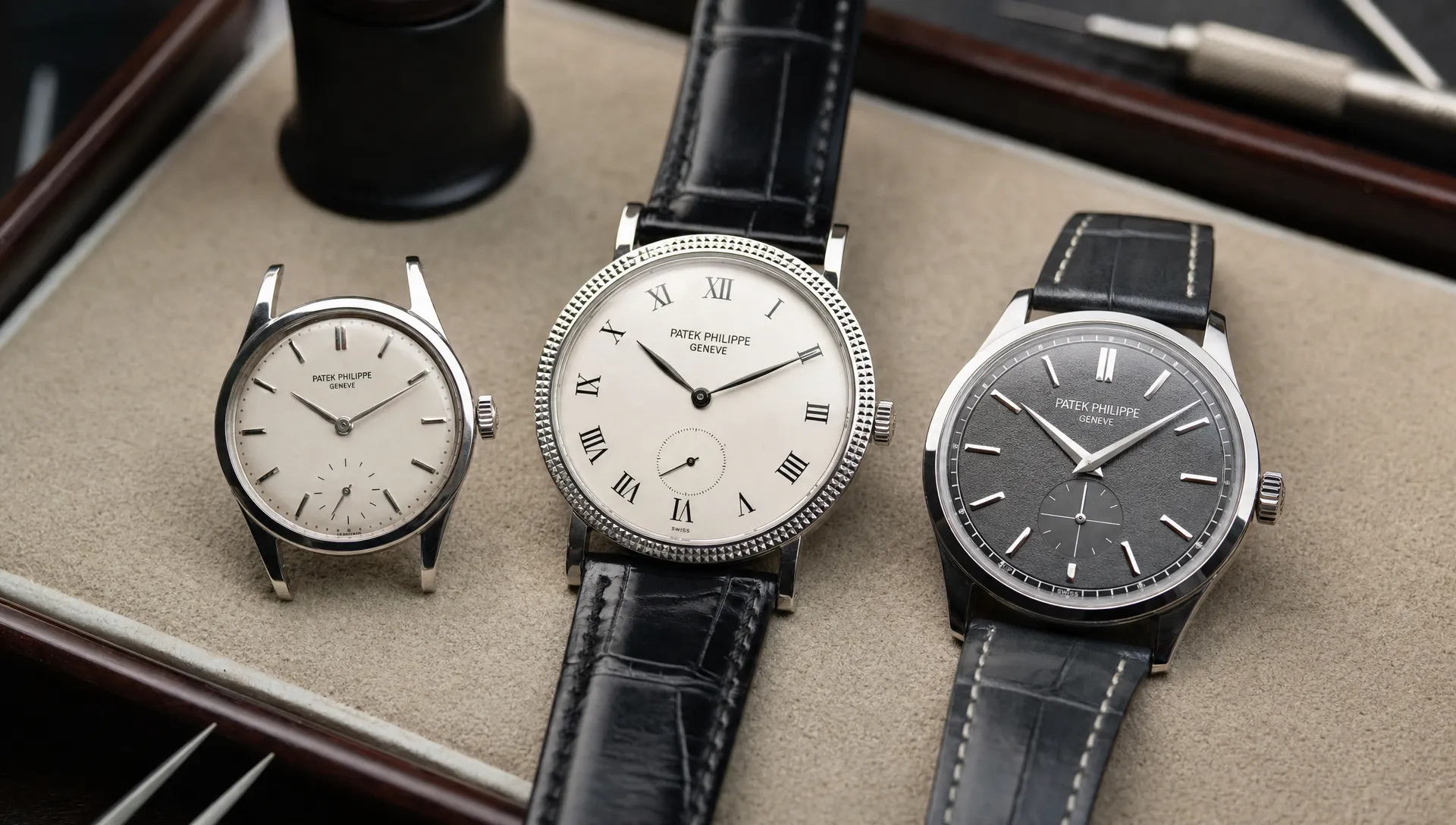 ## How to compare individual examples ### Separate originality from operating condition A watch can function properly while having a refinished dial, replacement hands or heavily polished lugs. Conversely, an original example may need mechanical service. These are separate assessments. Request clear photographs of the dial, case sides, lugs, caseback and buckle. For vintage references, ask which components are believed to be original and what evidence supports that assessment. For modern pieces, establish whether the strap and buckle match the supplied configuration. Service documentation should identify what work was performed and whether parts were replaced. “Serviced” alone does not explain dial originality, case preservation or the scope of the work. ### Choose proportions, not just diameter The Patek Philippe Calatrava range covered here spans approximately 31mm to 40mm, but diameter alone does not predict fit. Lug length, strap shape, case thickness and dial opening all affect how a watch wears. The 96 and 3919 suit buyers comfortable with compact proportions. The 5119 and 5196 occupy a middle ground. The 39mm and 40mm references provide more wrist presence, although their individual case shapes remain important. For a gift, an existing watch worn comfortably by the recipient is a better sizing reference than height or gender. Our [guide to choosing a dress watch](https://lumewrist.com/blog/dress-watches-formal-occasions-buying-guide) covers the broader relationship between fit and occasion. ### Build price ranges from comparable listings Use verified live USD listings rather than one generic price range for the entire collection. Without catalog prices for specific examples, a numerical range would imply more precision than the evidence supports. | Reference group | Basis for a meaningful USD price range | Main comparison risk | |---|---|---| | 96 | Same metal, comparable dial and originality | Treating restored and original examples alike | | 3919, 5119 and 5196 | Exact reference, metal and similar condition | Ignoring polishing, accessories or service needs | | 5227, 6119, 5226G and 6007G | Full reference suffix and comparable completeness | Comparing different configurations or movement generations | Box and papers contribute to completeness, but they do not replace inspection. Include any identified service needs, applicable taxes and strap replacement in the ownership budget. No reference comes with a guaranteed resale outcome. ## Frequently asked questions **Is every Calatrava manually wound?** No. The 96, 3919, 5119, 5196 and 6119 discussed here are manually wound. The 5227, 5226G and 6007G are automatic. **What is the main difference between the 5196 and 6119?** The Patek Philippe Calatrava 5196 has a 37mm smooth-bezel case and caliber 215 PS. The 6119 has a 39mm hobnail-bezel case and the larger 30-255 PS movement with stop seconds. **Do original papers prove authenticity?** No. Papers should correspond to the watch, but authentication requires examination of the watch itself. A Patek Philippe Extract from the Archives records historical information; it is not an authentication certificate. **Can a Calatrava be worn daily?** Yes, with care appropriate to its reference, age and condition. Do not assume a vintage example retains its original water resistance. Have seals and water resistance checked before relying on them, and keep leather straps away from water. ## Find the right reference, then the right example Start with the design and proportions you want. Then assess the individual watch’s originality, case condition, movement and documentation. Lume Wrist Watches is an independent retailer, not an authorized Patek Philippe dealer. Its inventory is authenticated pre-owned, listed in Excellent condition, certified authentic by Watch CSA and serviced before shipping. Purchases include free insured US shipping, a 30-day return guarantee and two-year warranty coverage. International shipping is available by request and quote. Browse [Lume Wrist Watches’ pre-owned watch selection](https://lumewrist.com/shop) for available Patek Philippe references. For a particular example, ask the concierge to confirm the complete reference, condition details, included accessories and applicable return and warranty terms before purchasing.