Rolex Explorer vs. Submariner for Collectors
Published October 8, 2026 · Last updated October 17, 2026 · By Lume Wrist Watches Editorial Team
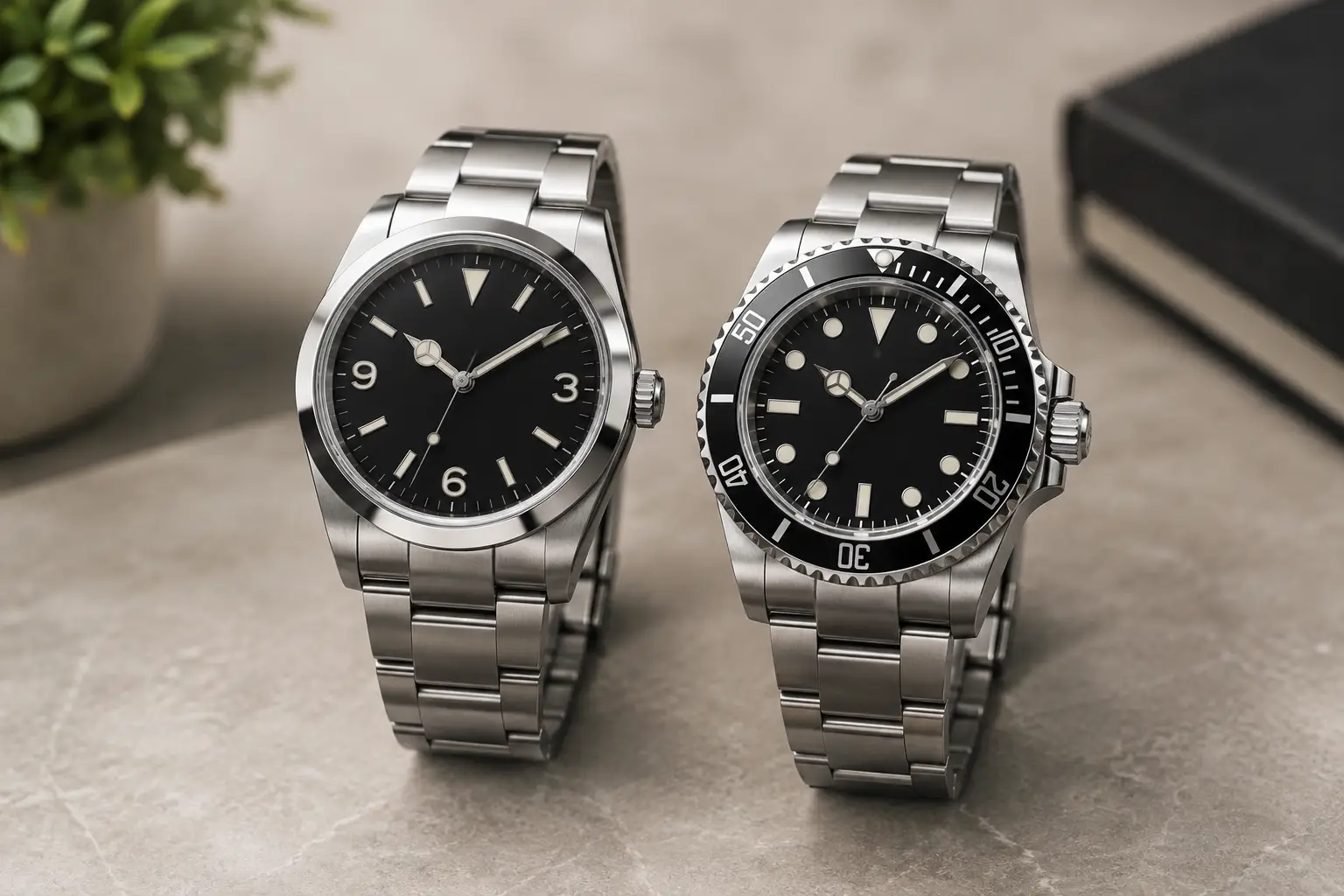
A Rolex Explorer Submariner comparison starts with a simple distinction: these are not interchangeable versions of the same watch. Both are steel Rolex tool-watch icons born in 1953, both use highly capable automatic movements, and both have strong recognition among collectors. Yet the Explorer is defined by restraint and daily versatility, while the Submariner is built around the visual and functional language of a professional dive watch.
For a buyer considering a significant pre-owned Rolex purchase, that difference matters more than a specification sheet. The right choice depends on how the watch will be worn, what design language feels lasting to you, and whether you value discretion or immediate visual presence.
Rolex Explorer vs. Submariner: The Core Difference
The Explorer is Rolex at its most distilled. Its defining features are a smooth bezel, black dial, Mercedes-style hands, and the distinctive 3-6-9 Arabic numerals. There is no date window, no rotating bezel, and little visual interruption. Its heritage is connected to mountaineering and the 1953 Everest expedition, but its modern appeal is less about expedition equipment than balanced, unfussy design.
The Submariner is more overtly purpose-built. Its unidirectional timing bezel, larger case profile, prominent crown guards, and highly legible dial establish it as a dive watch even when it never approaches water. The model's diving heritage is central to its identity, and the bezel gives the watch an interaction and visual depth the Explorer intentionally avoids.
Neither is objectively the better Rolex. The Explorer is generally the more understated choice. The Submariner has greater wrist presence and a more recognizable silhouette. A collector who wants one watch to disappear under a cuff may prefer the Explorer; someone who wants a Rolex with unmistakable sport-watch character may find the Submariner more satisfying.
Case Size and Everyday Wear
Modern Explorer references give buyers a meaningful size decision. The 36mm Explorer, including reference 124270, closely reflects the classic proportions that made the model a long-term favorite. It is compact, comfortable, and especially suitable for buyers who prefer traditional sizing or have a smaller wrist.
The 40mm Explorer, reference 224270, adds visual scale without moving into oversized territory. It can make sense for buyers accustomed to contemporary sports watches who still want the Explorer's clean dial and smooth bezel. The difference between 36mm and 40mm is substantial on the wrist, so dimensions should be considered alongside photographs and reference details.
The current steel Submariner is 41mm, though Rolex's case architecture and bracelet proportions keep it controlled rather than excessive. The water-resistant Oyster case, broad bezel, and larger dial opening give it a more substantial feel than either Explorer size. Earlier 40mm Submariner references remain important in the pre-owned market and may wear differently despite the seemingly modest one-millimeter distinction.
Bracelet fit contributes as much to comfort as case diameter. Both models use the Oyster bracelet, a durable three-link design that suits active daily use. The Submariner's Glidelock clasp provides tool-free extension adjustment, particularly useful during warm weather or when a precise fit is important. The Explorer uses Rolex's Easylink comfort extension, which offers less range but remains practical for daily changes in wrist size.
Dial, Bezel, and Date Preferences
The Explorer's black dial is an exercise in clarity. The 3-6-9 layout is distinctive without becoming decorative, and the absence of a date display keeps the composition symmetrical. Buyers who prefer a watch with no calendar correction and a clean, uninterrupted dial often return to the Explorer for that reason.
The Submariner offers more variation. The no-date Submariner, currently represented by reference 124060, is the closest in spirit to the Explorer's symmetry. It is the purist's dive-watch configuration: black dial, black bezel, and no date aperture. The Date Submariner, such as reference 126610LN, adds Rolex's Cyclops lens over the date window and can be more practical for buyers who rely on a calendar during the workday.
The green-bezel Submariner Date, reference 126610LV, creates a more expressive option without departing from the core Submariner design. It is a different proposition from the black-bezel models, and its color should be a genuine preference rather than a substitute for deciding between the Explorer and the Submariner itself.
A rotating bezel is not merely cosmetic. It can time a meeting, parking interval, or elapsed task without changing the watch's hands. For some owners, that small daily utility becomes part of the Submariner's appeal. Others prefer the Explorer precisely because there is nothing to adjust, scratch, or visually compete with the dial.
Shared Rolex Engineering, Different Personalities
Modern versions of both watches use Rolex's in-house automatic calibers, with approximately 70 hours of power reserve in current generations. Both are engineered for daily wear, with screw-down crowns, sapphire crystals, luminous displays, and solid Oyster bracelets. The Submariner carries a deeper water-resistance rating of 300 meters, while the Explorer is rated to 100 meters.
For most owners, the Explorer's water resistance is more than adequate for ordinary exposure to rain, swimming, and daily life when the watch is properly maintained. The Submariner's higher rating matters most to buyers who value dive-watch capability or simply want the confidence and presence of the more specialized case.
The practical trade-off is that the Submariner's ceramic bezel insert and more complex clasp create additional features to inspect when purchasing pre-owned. The Explorer has fewer external components, but condition still matters: bracelet stretch, clasp wear, case polishing, dial and hand originality, and service history can materially affect both ownership experience and collectibility.
Choosing the Right Pre-Owned Reference
A reference number tells only part of the story. Two watches with the same reference can differ considerably in condition, completeness, and service status. A sharply defined case with intact lug proportions may be more desirable than one that has been heavily polished. A complete set can be meaningful to some collectors, while others prioritize the watch's condition and verified mechanical performance.
For vintage and discontinued references, originality deserves careful attention. Original tritium dials and hands, period-correct bezels, bracelet codes, and documented service work can influence a collector's assessment. At the same time, a watch intended for regular wear may reasonably have service components. The appropriate balance depends on whether you are buying primarily for historical originality, daily use, or a combination of both.
The Explorer's relatively simple format can make it an appealing first serious Rolex, particularly in 36mm. The Submariner may be the more natural choice for a buyer who wants the classic steel sports-watch profile with a date function or timing bezel. For an established collection, the decision can be even more personal: the Explorer often complements more prominent watches, while the Submariner can serve as a highly capable centerpiece.
Authentication and Purchase Protection Matter
With pre-owned Rolex watches, the purchase process should be evaluated as carefully as the reference. Authentication, accurate condition reporting, component review, and secure insured delivery are not extras in this category. They are central to buying with confidence.
At Lume Wrist Watches, each timepiece is in-house certified before sale, with free insured shipping across the United States, a 30-day return window, and a two-year warranty. Those protections give a buyer time to confirm that the watch feels right on the wrist, not simply right in a listing photograph.
The Explorer is the Rolex for a buyer who values quiet precision and proportion. The Submariner is the Rolex for a buyer who wants function, heritage, and a stronger visual statement. Try to decide based on the one you will reach for most often after the initial excitement has passed.