How to Authenticate an AP Royal Oak
Published August 20, 2026 · Last updated October 21, 2026 · By Lume Wrist Watches
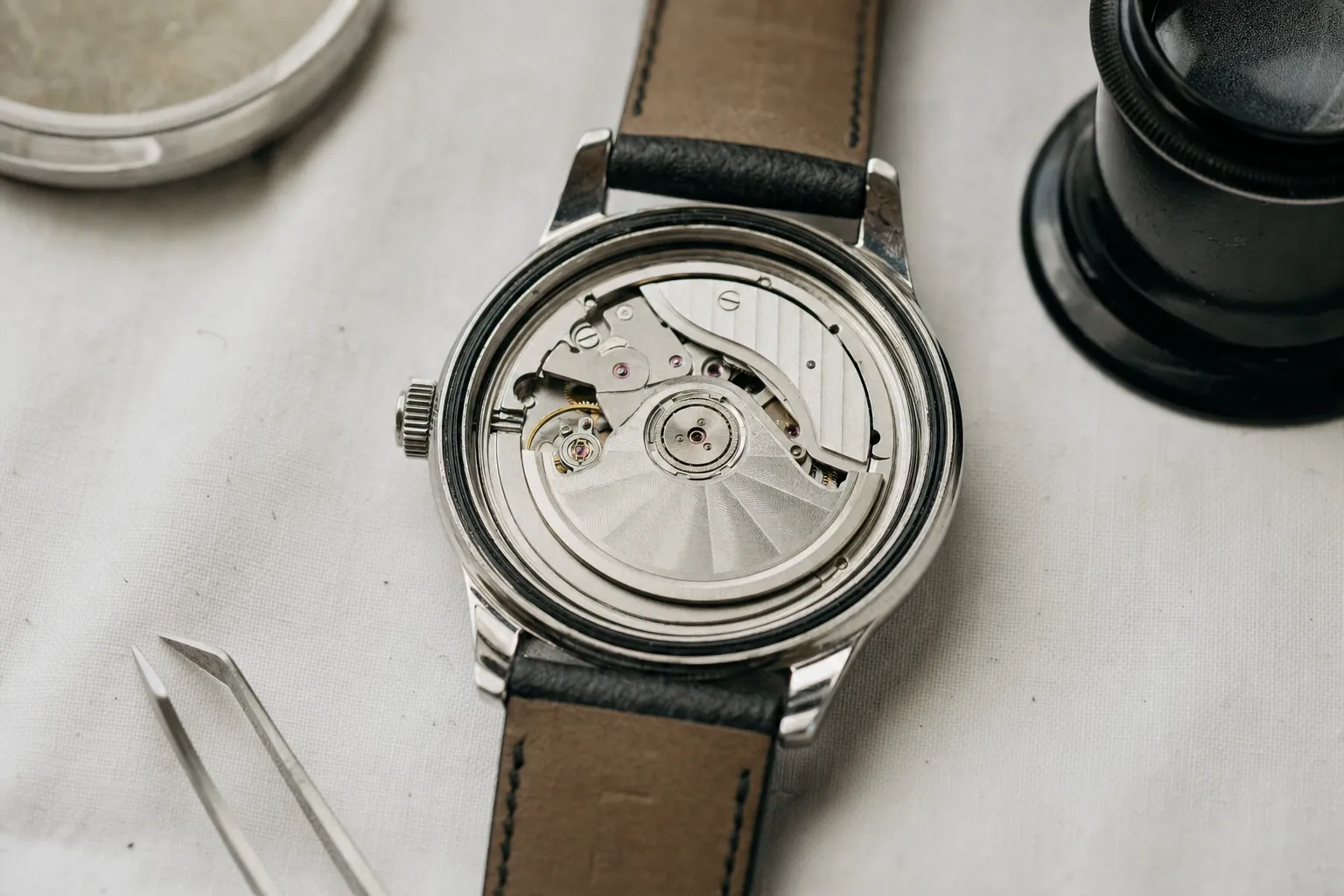
Evaluating a pre-owned Audemars Piguet Royal Oak requires a disciplined, detail-oriented approach to horological engineering. Knowing how to authenticate Audemars Piguet Royal Oak timepieces demands careful inspection of micro-finishing, correct mechanical architecture, and crisp factory casework. This technical guide outlines the critical authentication checkpoints every collector must assess before acquiring an iconic Royal Oak.
Examining the Bezel Hexagonal Screws and Alignment
The octagonal bezel defined by eight perimeter screws is the signature hallmark of the Royal Oak collection. On genuine pieces, these are not ordinary threaded screws driven from the top down. They are functional, slotted male through-bolts that pass completely through the bezel, gasket, and mid-case to thread into corresponding female hexagonal sleeve nuts seated in the caseback. Understanding this structural assembly is essential when exploring the Audemars Piguet Royal Oak secondary market.
``` [ 18k White Gold Hexagonal Bolt Head ] │ ┌──────────────────┴──────────────────┐ <-- Bezel (Polished & Brushed) │ [ Hexagonal Recess / Counter-sink ]│ └──────────────────┬──────────────────┘ │ ====================│==================== <-- Gasket Layer │ ┌──────────────────┴──────────────────┐ │ Mid-Case │ └──────────────────┬──────────────────┘ │ ┌──────────────────┴──────────────────┐ │ Caseback │ <-- Caseback └──────────────────┬──────────────────┘ │ [ Threaded Caseback Sleeve Nut (Secured from beneath) ] ```
White Gold Screws vs. Base Metals
Regardless of whether the watch case is manufactured from stainless steel, titanium, ceramics, or precious metal, the bezel screws on an authentic Royal Oak are almost exclusively fabricated from 18k white gold. This metallurgical choice imparts a subtle, warm luster that visibly contrasts with the colder, grayer tone of stainless steel.
Counterfeiters frequently cut production costs by utilizing standard 316L or 304 stainless steel, or nickel-plated brass, for these fasteners. Under a 10x loupe, genuine white gold screws exhibit mirror-polished flat tops with micro-chamfered internal slot edges. Fake screws often reveal rounded slot corners, machining burrs, or tool marks sustained during improper assembly.
Bezel Recesses, Slots, and Curvature
Because the screws are fixed bolts keyed into precisely milled hexagonal recesses in the bezel, they cannot rotate freely. On an authentic Royal Oak:
- Every screw head sits perfectly flush with the plane of the bezel, neither protruding above the surface nor sunken below the chamfered recess edge.
- The slots of all eight screws align in a seamless, unbroken concentric circle around the dial. The slot angles follow the radial tangent of the bezel curvature.
- The hexagonal sinks cut into the bezel exhibit sharp, vertical 90-degree corners with no wall distortion.
Counterfeiters struggle to replicate the tolerance of these recesses. On replicas, screw slots frequently appear misaligned, sitting at erratic angles or displaying varying depths across the eight positions. Any Royal Oak displaying a misaligned bezel screw slot is instantly identifiable as either a fake or a watch that has suffered catastrophic, non-factory aftermarket modification.
Dial Typography and Date Wheel Font Scrutiny
The Royal Oak dial is a masterclass in traditional horological finishing. Audemars Piguet constructs its dials using intricate geometric patterns—predominantly the Petite Tapisserie or Grande Tapisserie—that are remarkably difficult to forge accurately.
Tapisserie Execution: Guilloché vs. Stamped Dials
Genuine modern Royal Oak dials are manufactured using a specialized mechanical pantograph technique known as ramolayé. This machine transfers the pattern from a large-scale design matrix onto a brass dial blank, simultaneously cutting the raised square pyramids (pyramides) and carving micro-grooved concentric circular patterns (azurage) into the recessed channels between them.
``` GENUINE TAPISSERIE (Pantograph-Cut) ┌───────┐ ┌───────┐ │ Top │ │ Top │ <-- Flat, satin-brushed pyramid summits └───┬───┘ └───┬───┘ ///│\\\\\\\///│\\\\\\ <-- Microscopic concentric grooves (azurage) in channels
COUNTERFEIT TAPISSERIE (Hydraulically Stamped) ╭───────╮ ╭───────╮ │ Top │ │ Top │ <-- Rounded, soft pyramid edges ╰───┬───╯ ╰───┬───╯ └───-───-──┘ <-- Dull, smooth, featureless valleys without texture ```
Counterfeits typically use hydraulic stamping presses. Under magnification, stamped dials betray distinct flaws:
- Pyramid Definition: Authentic pyramids have flat, square tops with razor-sharp perimeter edges. Counterfeit pyramids have rounded, pillowed summits.
- Channel Grooves: Genuine dials reveal microscopic, light-refracting concentric tracks within the grooves between the squares. Fakes often leave these channels smooth, flat, or covered in thick, gloopy lacquer that obscures detail.
- Light Dispersion: An authentic dial produces a distinct shimmering, three-dimensional light play as the wrist turns. Stamped dials appear matte, flat, and visually dead under direct light.
Audemars Piguet Signature and Font Kerning
The dial text on a genuine Royal Oak is transferred via high-precision pad printing. The words "AUDEMARS PIGUET" and "AUTOMATIC" (or reference-specific complications) feature clean, raised ink with uniform density.
Examine the font structure under a loupe. The horizontal crossbar of the letter "A" sits at a specific, standardized height, and the serifs—if present on that reference's typography—are sharply delineated. Counterfeits frequently display uneven ink spread, fuzzy borders, or incorrect kerning where letters appear crowded together or spaced erratically.
On references featuring an applied "AP" monogram at 12 o'clock or 6 o'clock, the logo is crafted from solid gold. The cutouts between the letters "A" and "P" must be cleanly hollowed out without residual metal flash, and the top surface must exhibit a directional vertical brush flanked by high-polished diamond chamfers.
Date Window and Disc Typography
The date aperture provides immediate insight into the legitimacy of the piece. On an authentic modern reference, the date window features a distinct, stepped, or beveled internal frame that neatly truncates the adjacent Tapisserie squares without messy cuts or jagged edges.
The date disc itself uses Audemars Piguet's proprietary font. For instance, the numeral "1" features a sharp, downward-pointing top serif, while numerals such as "3" and "8" display specific geometric curvatures unique to the underlying caliber generation. Furthermore, the date wheel sits close beneath the dial plane, minimizing parallax error. Cloned movements often set the date disc deeper into the movement, creating a noticeable shadowed recess beneath the date cutout.
Caseback Engravings and Serial Number Formats
Audemars Piguet maintains rigorous conventions for caseback markings. Whether examining a solid steel vintage caseback or a modern sapphire exhibition window, the engravings serve as a primary data source when cross-referencing factory records.
Serial Letter Prefixes and Sequential Numbering
From the mid-1970s onward, Audemars Piguet introduced a sequential letter-prefix serial numbering system stamped into the caseback alongside a unique sequential production number. Understanding this chronological sequence helps confirm whether a watch's aesthetic traits align with its production era:
| :--- | :--- | :--- |
|---|---|---|
| A Series | 1972 – 1975 | Initial production of the original Model 5402 |
| B Series | 1975 – 1980 | Transition models; introduction of intermediate sizes |
| C Series | 1980 – 1987 | Expansion into complicated and dual-time references |
| D Series | 1987 – 1994 | Introduction of new case designs and monobloc updates |
| E Series | 1994 – 2000 | Standardization of intermediate automatic references |
| F Series | 2001 – 2007 | Launch of modern calibres such as Calibre 3120 |
| G Series | 2008 – 2010 | Transition toward larger 41mm case architectures |
| H Series | 2011 – 2016 | Contemporary reference lines; refined ceramic components |
| I Series | 2016 | Brief production window prior to J series rollout |
| J Series | 2016 – 2018 | Updated clasp signatures and dial configurations |
| K Series | 2018 – Present | Current generation production, including Calibre 4302 |
Serial engravings must match standard manufacturer font weights. Fake casebacks often feature generic serial numbers that are mass-reproduced across thousands of illicit units. A quick search of the specific letter and number sequence can often identify known counterfeit serial batches.
Laser Etching vs. Deep Mechanical Milling
Audemars Piguet uses mechanical engraving and diamond milling for primary serials, case numbers, and model designations. The letters "Royal Oak" across the back are deep, crisp, and executed with smooth internal floors.
Counterfeits frequently substitute this expensive machining process with shallow laser etching. Laser etching leaves microscopic discoloration, uneven depths, and rough, burned edges along the borders of the letters. An authentic engraving displays vertical sidewalls with a crisp, uniform depth that can be readily felt with a wooden pegwood stick or examined under angled lighting.
Integrated Bracelet Construction and Clasp Hallmarks
The integrated bracelet of the Royal Oak is notoriously difficult to replicate due to its complex geometric taper and exacting hand-finishing requirements.
Tapering and Articulation of the Links
From the wide shoulder links where the bracelet interfaces with the case lugs down to the clasp, every single link decreases proportionally in both width and thickness.
``` TAPER PROFILE: Lug Width: ───[ Wide Link Base ]─── │ │ │ Link │ ▼ ▼ ──[ Intermediate ]── │ │ │ Link │ ▼ ▼ Clasp Width: ───[ Narrow Terminal Link ]─── ```
When handling an authentic bracelet:
- Articulation is fluid yet firm. The bracelet drapes naturally around the wrist without catching, pinching, or binding.
- There is virtually zero lateral play or "slop" between the links. The links are joined via internally threaded pins that maintain microscopic clearances.
- The outer surfaces feature uninterrupted longitudinal satin brushing. When light glides across the assembled bracelet, the brushed grain flows continuously across link boundaries without visual breaks.
- The internal chamfers of each link are mirror-polished by hand. These beveled edges flash brilliant light reflections against the muted, satin-finished facets.
Counterfeits invariably exhibit loose tolerance between links, rough interior links that scrape against skin, and unevenly brushed link faces where the linear grain fails to align from link to link.
Clasp Blade Signatures and Spring Action
Depending on the era, the Royal Oak uses either a single-fold deployant blade system or a contemporary double-deployant butterfly clasp operated by twin push-buttons.
On genuine modern clasps, the inner folding blades feature crisp, bead-blasted recesses offset by mirror-polished edges. Hallmarks—such as the standard purity stamps on precious metal editions or the clean "Audemars Piguet" wordmark—are deeply stamped or milled, never laser-scratched. The push-button mechanics operate with a distinct, tactile click powered by robust internal leaf springs. If a clasp feels mushy, requires forced pressure to seat, or displays loose tolerances when closed, it warrants intense skepticism. Consult our comprehensive buying guide for further checks regarding hardware feel across pre-owned luxury models.
Movement Inspection: Calibre 3120 and 4302 Execution
The movement provides definitive proof of authenticity. While external elements like dials and cases can be approximated, replicating Audemars Piguet's in-house calibres requires haute horlogerie finishing and complex movement geometry that replica factories cannot match.
``` CALIBRE 3120 CALIBRE 4302 ┌───────────────────────────┐ ┌───────────────────────────┐ │ • Beat: 21,600 vph (3 Hz) │ │ • Beat: 28,800 vph (4 Hz) │ │ • Dual-Anchor Balance │ │ • Dual-Anchor Balance │ │ Bridge (Full Traversing)│ │ Bridge (Full Traversing)│ │ • Solid 22k Gold Rotor │ │ • Skeletonized Gold Rotor │ │ • Deep Family Crest Relief│ │ • Modern Architectural Cut│ └───────────────────────────┘ └───────────────────────────┘ ```
Winding Rotor Details and Family Crests
On the legendary Calibre 3120 (found in references like the 15300 and 15400), the monobloc oscillating weight is crafted from solid 22k gold. It is decorated with the deeply embossed family coats of arms of Audemars and Piguet:
- Left Crest: Three stars alongside a bird.
- Right Crest: A horse holding an arrow next to a tower.
On an authentic 3120 rotor, the stippled background within the crest shields is finely textured, creating high visual contrast against the polished, raised motifs. Cloned movements usually feature shallow, flat, cast-metal rotors with poorly resolved crest details and incorrect weight distribution.
On the contemporary Calibre 4302 (used in reference 15500), the rotor is an aggressively skeletonized, modern work of art crafted from 22k pink gold. The open-worked sections are framed by broad, flawless bevels that reflect light evenly.
Balance Bridge Architecture and Free-Sprung Regulation
The balance assembly is the most critical mechanical checkpoint when learning how to authenticate Audemars Piguet Royal Oak watches:
- Dual-Anchored Balance Bridge: Both Calibre 3120 and Calibre 4302 utilize a rigid balance bridge secured to the mainplate at both ends, spanning across the balance wheel. Many counterfeit watches use decorative "dress plates" placed over cheap base movements (like the Miyota 9015 or ETA 2824). These fakes often retain a cantilevered balance cock (anchored at only one end) hidden beneath a non-functional, decorative bridge plate.
- Variable Inertia Balance Wheel: Authentic calibres feature a free-sprung variable inertia balance with adjustable weights (gyromax-style micro-blocks) mounted directly on the balance rim. Most fakes use an inexpensive balance wheel regulated by a standard curb-pin regulator arm sliding along the balance spring stud. Any Royal Oak movement featuring a prominent index regulation lever arm protruding from the balance bridge is counterfeit.
Beveling, Côtes de Genève, and Perlage
The decorative finishing across the movement plates reveals true handcraft:
- Côtes de Genève: The Geneva stripes on bridges run straight, displaying subtle visual depth without scratching or machining scallops.
- Anglage (Chamfering): The borders of every bridge are hand-beveled and mirror-polished. The interior and exterior angles (angles rentrants and angles sortants) are razor-sharp. Counterfeits use stamped bridges with rounded, stamped-down edges or dull, tumbling-polished bevels.
- Sinks and Jewels: Synthetic ruby jewels are seated cleanly inside diamond-polished sinks. Screws feature heat-blued or mirror-polished finishes with chamfered slots and countersinks.
Explore more technical mechanics across the wider Audemars Piguet catalogue to familiarize yourself with their standard caliber layouts.
Weight, Dimensions, and Monobloc Proportions
A hallmark of Gérald Genta's original design was the marriage of high water resistance with an ultra-thin case profile. The structural design relies on tight case tolerances to ensure correct gasket compression.
Precision Case Profiles
Counterfeits that stack decorative plates onto off-the-shelf third-party movements are inevitably forced to thicken the case profile to accommodate the taller movement assembly.
To identify anomalous proportions, compare exact caliper measurements against official specifications:
- Reference 15202 (Extra-Thin "Jumbo"): Case thickness must measure precisely 8.1 mm. Counterfeits routinely exceed 9.5 mm.
- Reference 15400: Case thickness measures 9.8 mm with a 41 mm diameter. Counterfeit iterations often measure 10.5 mm to 11.5 mm thick.
- Reference 15500: Case thickness measures 10.4 mm with a 41 mm diameter.
Any deviation exceeding 0.5 mm in case thickness on a modern automatic Royal Oak strongly suggests an unauthorized movement-and-case configuration.
Gasket Visibility and Material Density
When examining the Royal Oak from the flank, a sliver of the black internal sealing gasket should be uniformly visible between the octagonal bezel and the brushed mid-case. The gasket must be precisely cut, presenting a straight, even line around the entirety of the case perimeter. Fakes often pinch the gasket unevenly or feature an overly thick rubber ring that creates an unsightly gap.
Finally, total weight serves as a rapid physical diagnostic. Stainless steel models must feel substantial due to the density of the multi-link integrated bracelet. For gold or platinum Royal Oaks, authentic examples weigh considerably more than base metal or gold-plated counterfeit pieces. Unless a counterfeit utilizes an expensive sintered tungsten core, it will fail a basic gram-scale measurement by a wide margin.
Frequently Asked Questions
### Are authentic Audemars Piguet Royal Oak bezel screws made of gold? Yes, on authentic Audemars Piguet Royal Oak timepieces, the eight hexagonal bezel screws are made of 18k white gold, even on stainless steel models. This provides a warm, bright contrast against the colder hue of the surrounding steel bezel. Certain specialized models, such as full rose gold or forged carbon pieces, may feature rose gold or blackened titanium hardware, but standard production steel references consistently use white gold.
### How should the date wheel font appear on a genuine Royal Oak? A genuine Royal Oak displays proprietary, cleanly printed Audemars Piguet typography on the date wheel with sharp serifs and flat-topped variations depending on the calibre generation. The numerals are printed with thick, raised ink that fills the aperture symmetrically without bleeding or misalignment. Furthermore, the date disc sits flush underneath the dial plate, avoiding the deep, shadowed recess common to counterfeit watches.
### Where is the serial number located on a modern Royal Oak case? On modern Royal Oak watches, the serial number is deeply engraved on the outer caseback perimeter or directly on the metal frame surrounding the sapphire display crystal. It typically consists of a letter prefix indicating the production era (such as H, I, J, or K) followed by a series of numbers, accompanied by the case's sequential production number. Authentic serials are crisp and mechanically milled, unlike the faint, shallow laser markings found on fakes.
### Can you identify a counterfeit Royal Oak by the balance wheel assembly? Yes, the balance assembly is one of the most reliable areas for exposing a counterfeit. Authentic modern calibres, such as the 3120 and 4302, feature a free-sprung variable-inertia balance wheel secured under a sturdy balance bridge anchored at both ends. Counterfeit movements typically utilize a single-anchored balance cock equipped with a visible index regulating arm to adjust timekeeping, which never appears on modern genuine calibres.