Boutique Versus Secondary Watches: Key Differences
Published October 24, 2026 · Last updated October 24, 2026 · By Lume Wrist Watches
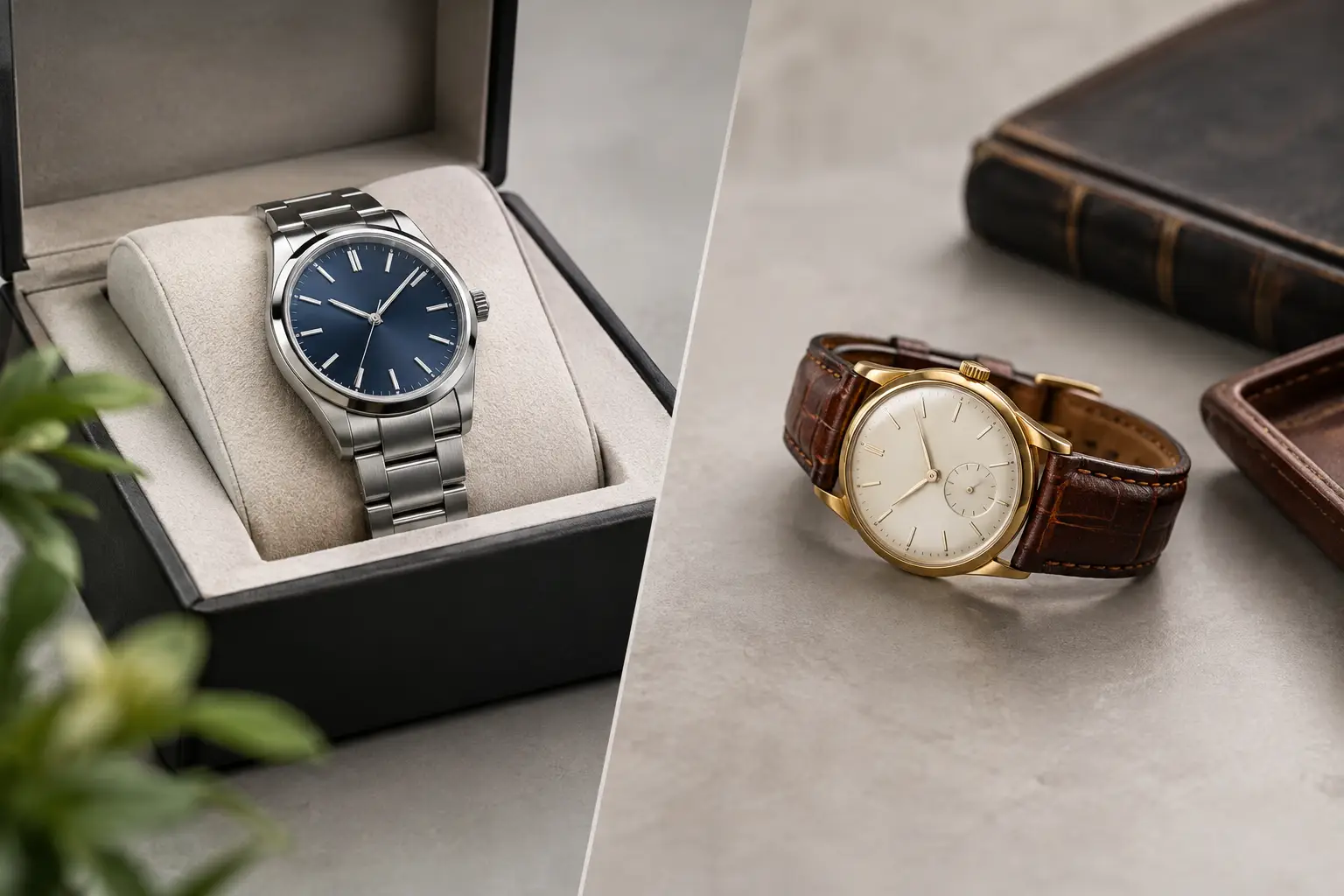
A stainless-steel Rolex, a discontinued Patek Philippe, or a sought-after Audemars Piguet can create a very different buying experience depending on where you purchase it. The boutique versus secondary watches decision is not simply about new versus pre-owned. It affects availability, condition expectations, documentation, service options, and the safeguards behind a high-value transaction.
For many buyers, a boutique is the natural starting point. For a specific discontinued reference, a model with immediate availability, or a watch with collectible history, the secondary market may be the more practical route. The right choice depends on the watch you want and the level of protection you expect after the purchase.
Boutique Versus Secondary Watches: The Core Difference
A brand boutique or authorized retailer typically sells current-production watches as new. The watch is supplied through the brand’s established retail channel, usually with its original box, papers, warranty documentation, and a manufacturer-backed purchase history. For buyers who want a current catalog model in untouched condition, this route offers a straightforward path.
The secondary market includes watches that have previously been sold, traded, collected, or otherwise entered circulation outside a brand’s current retail inventory. That can include recent models in near-new condition, vintage pieces, discontinued references, and watches that are difficult to obtain through a boutique.
Neither route is automatically better. A boutique purchase may be ideal when the desired model is available and a first-owner experience matters. A secondary purchase may be preferable when the priority is access to a particular reference, production era, dial configuration, or complete collector set that is no longer offered at retail.
Availability Often Decides the Purchase
Availability is where the difference becomes most apparent. Boutiques carry current collections, but demand for certain Rolex, Patek Philippe, and Audemars Piguet references can exceed supply. A buyer may have access to a model immediately, may need to register interest, or may need to consider another configuration.
The secondary market broadens the field. It gives buyers an opportunity to locate discontinued watches, prior-year examples, and references that are not readily available through current retail channels. For a collector searching for an older Omega Speedmaster configuration or a specific Rolex production period, a secondary dealer can offer options that a boutique simply cannot stock.
That wider selection requires more careful evaluation. Listings can vary significantly in completeness and condition. Two watches with the same reference number may differ in bracelet stretch, polish history, original components, service records, box and papers, or the presence of desirable period-correct details. The reference is only the beginning of the assessment.
Condition Is More Than a Cosmetic Question
A new boutique watch is generally expected to be unworn or in retail-new condition. That consistency is valuable, particularly for first-time luxury buyers who want no uncertainty around prior ownership, handling, or servicing.
Secondary watches require a more specific condition review. Light wear on a modern daily-wear watch may be entirely appropriate. On a collectible vintage piece, the state of the dial, hands, bezel, case lines, and bracelet can materially affect its character and desirability. An aggressively polished case, for example, may look bright in photographs while losing some of the original geometry collectors value.
Ask for a clear account of the watch’s condition rather than relying on broad labels such as “excellent.” A credible description should address visible wear, case refinishing, bracelet condition, crystal condition, functionality, and any known service history. High-resolution photography should support that description, not replace it.
A secondary watch does not need to be perfect to be a strong purchase. It needs to be accurately represented, appropriately evaluated, and aligned with your expectations for how you intend to wear or collect it.
Authentication and Provenance Need Different Attention
At a boutique, the retail channel itself provides a direct chain from the manufacturer to the buyer. In the secondary market, authentication and provenance become central parts of the transaction.
Authentication means confirming that the watch is genuine and that its movement, case, dial, bracelet, and other relevant components are consistent with the reference and represented configuration. Provenance addresses the watch’s history and supporting materials, which may include its original warranty card, box, service paperwork, and prior ownership documentation.
Not every legitimate secondary watch will include its original box and papers. Documents can be lost over decades, especially with vintage pieces. Their absence should not automatically disqualify a watch, but it should be reflected in the buyer’s evaluation. Conversely, paperwork alone should not substitute for a professional physical review of the watch itself.
This is why the seller matters. A structured secondary retailer should be able to explain its inspection process, disclose what is included, and stand behind the watch after delivery. Informal listings may provide access to a watch, but they can leave the buyer responsible for validating condition, authenticity, payment security, and shipping arrangements without meaningful recourse.
Warranty and Returns Change the Risk Profile
A new watch purchased through a boutique generally includes the manufacturer’s warranty, subject to its stated terms. That coverage can be a meaningful advantage for a buyer who wants direct brand support on a current-production piece.
A secondary watch may retain some remaining manufacturer warranty, depending on its age and documentation, but buyers should not assume this. The more relevant question is what protection the selling retailer provides. A dealer-backed warranty can offer practical confidence if a mechanical issue appears after purchase, particularly on a complicated or older watch.
Return terms deserve equal attention. A luxury watch can look different on the wrist than it does in a listing. Case proportions, dial color, weight, and bracelet fit are personal considerations. A defined return window gives the buyer time to inspect the watch in person and confirm that it meets expectations.
For US buyers, Lume Wrist Watches provides in-house certified timepieces with free insured US shipping, a 30-day return window, and a two-year warranty. Those terms are designed to give buyers a more accountable alternative to unverified transactions while maintaining access to sought-after secondary-market references.
Documentation Matters, but So Does Context
A complete set is often desirable, particularly for collectors. Original box, papers, booklets, hang tags, and service records can strengthen the ownership experience and help establish a watch’s history. For some references, the correct accessories from the relevant production period can be especially meaningful.
Still, completeness should be weighed alongside the watch itself. An authentic, well-preserved vintage watch without its original paperwork may be more compelling than a heavily refinished example with a full set. A modern watch with full documentation but undisclosed service issues is not automatically the stronger choice either.
The best approach is to assess the complete package: reference, condition, originality, mechanical performance, supporting documents, seller verification, and post-purchase coverage. This creates a more accurate picture than focusing on one feature alone.
When a Boutique Purchase Makes Sense
A boutique purchase is often the right fit when you want a current-production watch, the model is available, and receiving it directly through the authorized retail channel is a priority. It can also suit buyers who value a clean first-owner record and manufacturer warranty from the date of sale.
This path is particularly straightforward for watches intended to be worn regularly rather than collected around a rare configuration or discontinued production era. If the watch you want is available at a boutique, there is real value in the simplicity of the transaction.
When the Secondary Market Is the Better Fit
The secondary market is often the more appropriate choice when a reference is discontinued, difficult to source at retail, or available only through prior ownership. It can also be the practical route for collectors who care about a particular year, dial, bezel, bracelet, or historical variation.
The trade-off is diligence. Choose a seller that provides direct, detailed condition disclosure, professional authentication, insured shipping, a clear return policy, and warranty support. A watch is not only a mechanical object. It is a high-value purchase whose long-term satisfaction depends on the quality of the transaction around it.
Before committing, decide what matters most: newness, immediate availability, a specific reference, complete documentation, original condition, or post-purchase protection. That clarity will usually point you toward the right channel and help you buy the watch with confidence rather than compromise.