How Grand Seiko Watches Differ by Movement and Dial Finish
Published October 21, 2026 · Last updated October 21, 2026 · By Lume Wrist Watches

Grand Seiko watches differ most in their movements and dial finishes: the movement determines how the watch keeps time, while the dial controls how texture, color and light appear on your wrist. Choose between quartz, mechanical and Spring Drive first, then compare the exact reference, dimensions and condition.
Movement and Dial Finish: What Changes on the Wrist
Grand Seiko is Japanese, not Swiss. Its collections combine several distinct movement technologies with restrained, textured or reflective dials. These are separate buying decisions: a highly textured dial does not necessarily indicate a more advanced movement, and a simple black dial does not imply basic watchmaking.
Three Movement Families, Three Ownership Experiences
The useful starting point is the caliber, which identifies the movement inside the watch. Collection names such as Heritage, Sport and Evolution 9 describe broader design families, not one specific timekeeping system.
| Movement family | Power source | Time regulation | Seconds-hand behavior | Ownership consideration |
|---|---|---|---|---|
| --- | --- | --- | --- | --- |
| 9F quartz | Battery | Quartz oscillator | Typically one step per second | Battery replacement and periodic maintenance |
| 9S mechanical | Wound mainspring | Balance wheel and escapement | Multiple small steps per second | Winding, rate variation and mechanical servicing |
| 9R Spring Drive | Wound mainspring | Quartz reference with electromagnetic regulation | Continuous glide | Winding and specialist servicing, without a replaceable battery |
9F quartz: precision with minimal daily attention
A 9F model suits someone who rotates watches or wants dependable timekeeping without resetting a stopped mechanical movement. Standard 9F specifications commonly state accuracy within ±10 seconds per year, although selected versions carry different ratings.
Among Grand Seiko watches, quartz should be judged on its own engineering rather than dismissed as an entry-level substitute. The caliber still matters: date-only and GMT versions offer different functions.
For a closer examination of individual calibers, our guide to Grand Seiko quartz movements covers the details. For this comparison, the main distinction is practical: battery-powered operation separates 9F from both mechanical and Spring Drive ownership.
9S mechanical: traditional regulation, including Hi-Beat
A 9S movement uses a conventional mechanical escapement. Automatic models wind through wrist movement, while manually wound references require winding by hand.
Not every 9S caliber is Hi-Beat. Grand Seiko’s 36,000-vibrations-per-hour movements operate at 5Hz, producing ten small seconds-hand steps each second. They remain mechanically regulated watches, not Spring Drive.
There are meaningful differences within the Hi-Beat category. The 9S86 combines high-frequency mechanical timekeeping with a GMT function and approximately 55 hours of power reserve. The newer-generation 9SA5 offers approximately 80 hours and uses a different escapement architecture.
Published mechanical accuracy standards also require careful reading. A mean daily rate measured under controlled conditions is not a promise that every owner will observe that exact result on the wrist. Position, activity and winding state affect performance.
Spring Drive: mainspring power with electronic regulation
Spring Drive draws its energy from a mainspring. A quartz oscillator provides the timing reference, while an electromagnetic brake regulates the movement. It does not use a conventional escapement or require a replaceable battery.
When comparing Grand Seiko watches, the continuously gliding seconds hand is the clearest visible distinction between Spring Drive and mechanical Hi-Beat. Both may look smooth from a distance, but their regulation systems are fundamentally different.
The familiar 9R65 provides approximately 72 hours of power reserve. The 9RA2 extends that to approximately 120 hours and moves the power-reserve indicator to the back. Newer U.F.A. calibers, including 9RB2, introduce another specification level. Do not apply one Spring Drive caliber’s accuracy rating to the entire family.
Compare Grand Seiko watches by reference
The following examples show why movement and dial must be evaluated separately. Dimensions are manufacturer specifications, not measurements of an individual pre-owned watch.
| --- | --- | --- | --- | --- |
|---|---|---|---|---|
| SBGX261 | 9F62 quartz | 37mm (1.46 in) | Stainless steel | Restrained black dial |
| SBGJ259 | 9S86 mechanical Hi-Beat GMT | 40mm (1.57 in) | Stainless steel | Green bamboo-inspired texture |
| SBGA211 | 9R65 Spring Drive | 41mm (1.61 in) | Titanium | White snow-inspired texture |
| SLGH005 | 9SA5 mechanical Hi-Beat | 40mm (1.57 in) | Stainless steel | White birch-inspired texture |
| SLGA009 | 9RA2 Spring Drive | 40mm (1.57 in) | Stainless steel | White birch-inspired texture |
The SLGH005 and SLGA009 make a useful comparison. Both use a birch-inspired visual theme, but they differ in movement, power reserve and dial execution. The shared nickname does not make them interchangeable.
Likewise, the Grand Seiko Sport GMT SBGE255 Blue Dial combines Spring Drive caliber 9R66 with a GMT display. A GMT hand identifies an additional time-zone function, not whether the watch is mechanically or electronically regulated.
Dial Finish: Texture, Color and Reflection
A dial should be assessed in more than one lighting condition. Diffuse daylight reveals its overall color. Directional light makes ridges, recesses and reflective surfaces more apparent. Under subdued indoor lighting, a textured dial may look considerably quieter.
For Grand Seiko watches, the interaction between dial surface, faceted hands and applied markers often matters more than the color name. A green dial can appear bright in direct light and nearly black at another angle. A white textured dial may reveal shadows that disappear in a straight-on photograph.
Ask for an oblique photograph as well as a frontal image. Neither a heavily edited image nor a single bright studio photograph tells you how the watch will look throughout the day.
SBGJ259: a green dial with a mechanical GMT
The Grand Seiko Heritage Collection SBGJ259 Green Dial is a useful example of texture and movement serving different purposes. Its vertically patterned green dial provides visual depth, while its GMT caliber adds travel functionality.
There is an important specification correction to make: SBGJ259 uses the mechanical Hi-Beat GMT caliber 9S86, not Spring Drive. Grand Seiko’s official SBGJ259 specifications identify that movement. Confirm the listing’s movement field with the seller before ordering if it states otherwise.
The dial texture alone cannot identify the movement. Reference documentation and clear photographs should agree with the caliber specification.
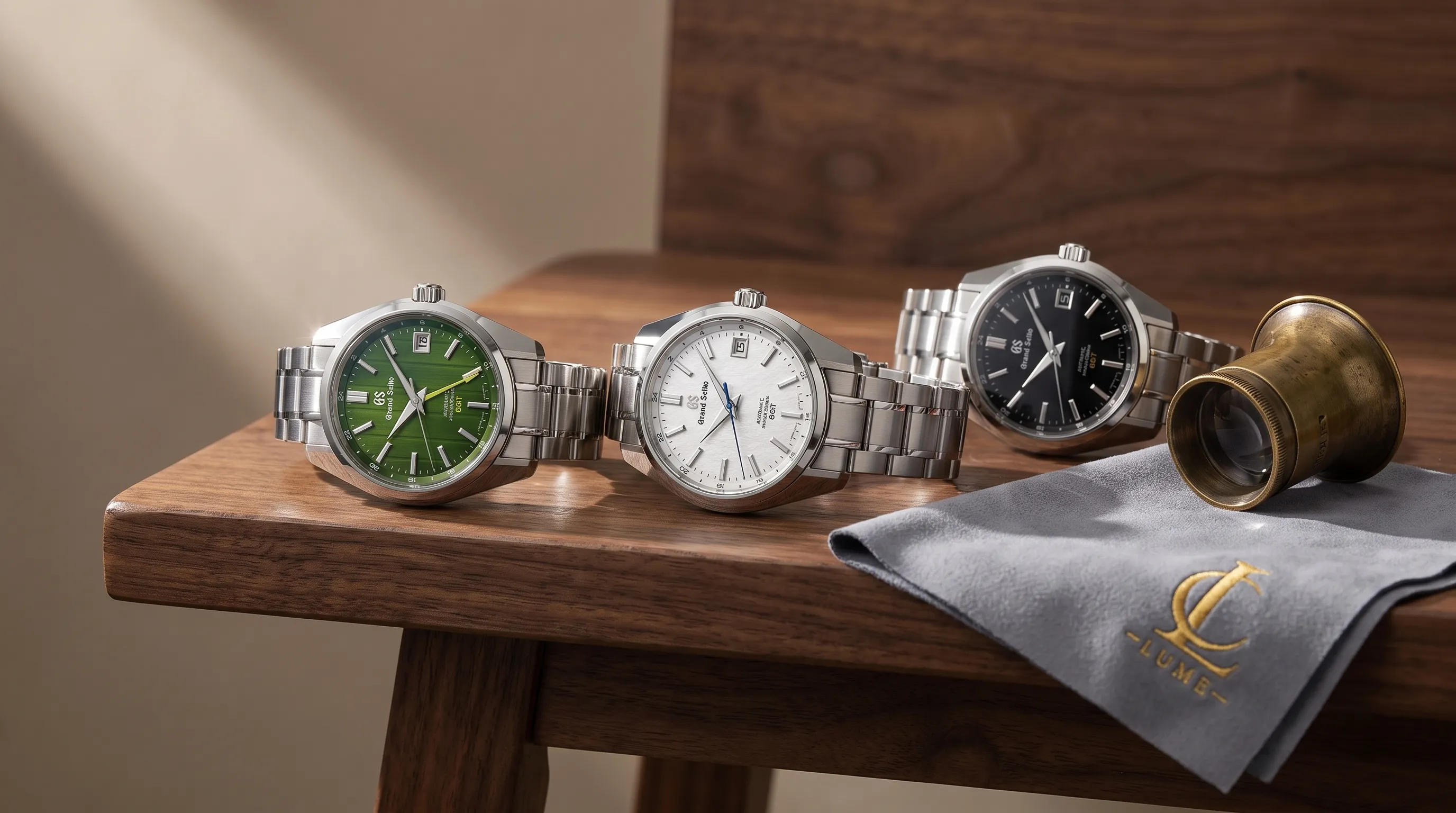
Snow, birch and polished surfaces are different treatments
The SBGA211’s snow-inspired surface and the birch-inspired dials of SLGH005 and SLGA009 create different patterns of shadow and reflection. They should not be treated as the same finish in different colors.
Keep dial terminology separate from case finishing, too. Zaratsu polishing usually describes the mirror-polished case surfaces associated with Grand Seiko. It is not a movement technology or a name for every textured dial.
Fit Can Change Your Preference
Grand Seiko watches with the same diameter can wear differently because of case thickness, lug shape, lug-to-lug length and bracelet construction. A 40mm case measurement describes width, not the entire wrist footprint.
For a first purchase, compare those dimensions with a watch you already wear comfortably. Ask whether the lugs stay within the top surface of your wrist and whether the clasp can be adjusted to your preferred fit. Confirm the number of included bracelet links, particularly when buying a gift.
Material matters as well. The titanium SBGA211 feels different from a similarly sized steel model. Neither weight is inherently better; one buyer may prefer a lighter watch while another wants more noticeable heft.
Readability deserves a separate check. Examine the hands against the dial in ordinary indoor light rather than choosing solely from close-up texture photographs.
What to Verify Before Buying Pre-Owned
For pre-owned Grand Seiko watches, establish reference accuracy before comparing asking prices. Confirm the complete reference, caliber, dial configuration and included accessories. Box and papers are useful documentation, but they do not replace physical authentication.
Condition requires more detail than a single grade. Ask for photographs of the bezel, case sides, lug edges, bracelet and clasp. Polishing can soften the transitions between brushed and mirror-finished surfaces. Dial discoloration, damaged markers and incorrect replacement parts deserve separate attention.
Service evidence should match the movement. A mechanical timing report does not describe Spring Drive regulation in the same way, and a quartz watch needs an appropriate battery and function check. Ask what work was completed, when it was performed and what the warranty covers. Water resistance should be tested before water use, rather than inferred from the original specification.
Lume Wrist Watches is an independent retailer, not an authorized Grand Seiko dealer. Purchases include a two-year warranty, 30-day returns (customer-paid return shipping, 15% restocking fee unless due to our error) and free insured US shipping. International shipping is available on request and quote. Review the applicable terms before purchase.
Frequently Asked Questions
Is Grand Seiko a Japanese brand? Yes. Grand Seiko originated in Japan. Its movement families and finishing traditions should be evaluated on their own terms rather than treated as Swiss-watch equivalents.
Does Spring Drive need a battery replacement? No. Its mainspring supplies the energy needed for operation, including its electronic regulation. It still requires appropriate maintenance and servicing.
Does a more textured dial mean a better movement? No. Dial treatment and movement specification are separate. Compare the caliber, functions and dimensions before deciding how much importance to place on a particular finish.
Neither a dial nickname nor a movement type guarantees a resale outcome. Evaluate the exact reference, condition and purchase terms, and allow for servicing and selling costs rather than assuming appreciation.
Compare the Exact Watch, Not Just the Dial Name
Choose the movement that fits your routine, then judge the dial under realistic light and the case against your wrist. Finally, verify the reference and condition of the individual example.
Browse Lume’s authenticated pre-owned watch inventory to compare available Grand Seiko watches by reference and asking price. For a specific piece, request additional photographs, bracelet sizing details and confirmation of the movement before making your decision.