How to Check Rolex Bracelet Wear Before You Buy
Published November 1, 2026 · Last updated November 1, 2026 · By Lume Wrist Watches
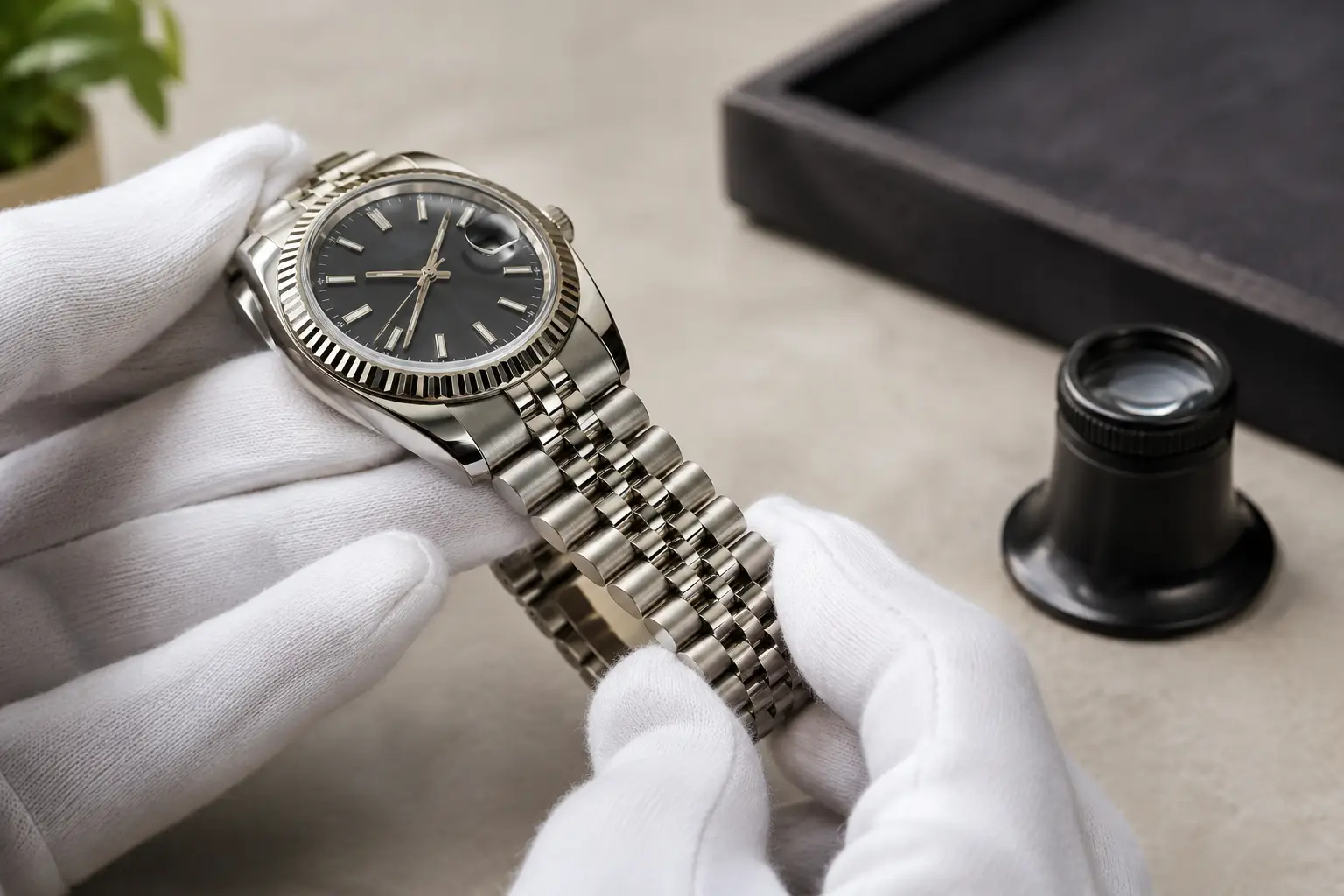
A Rolex bracelet can reveal more about a pre-owned watch’s life than a polished case or a bright dial. When you check Rolex bracelet wear, you are assessing daily use, prior maintenance, originality, and the potential cost of bringing the watch back to the condition you expect. For collectors and first-time buyers alike, this inspection deserves the same attention as the movement, bezel, and case.
Bracelet wear is not automatically a reason to reject a watch. A vintage Rolex with honest use may carry some looseness that is entirely consistent with its age. The key is to distinguish normal, disclosed wear from excessive play, damaged components, poor repairs, or condition issues that were not reflected in the watch’s description.
Why Rolex Bracelet Condition Matters
A bracelet is a working mechanical assembly. Every link, pin, screw, and clasp component moves against another surface over years of wear. Perspiration, dust, moisture, and improper cleaning can accelerate that friction. As metal gradually wears away around connecting points, the bracelet develops looseness often called “stretch.”
Despite the name, the steel has not literally stretched. The increased length and flexibility come from wear at the pins, tubes, and link openings. On older folded-link or rivet-style bracelets, this can be especially visible. Modern solid-link Oyster, Jubilee, and President bracelets are generally more resistant to wear, but they are not immune.
Condition affects more than appearance. Significant bracelet wear can alter how the watch sits on the wrist, make the clasp feel less secure, and require specialist attention. It also matters to collectors because an original, properly matched bracelet in strong condition supports the overall integrity of a Rolex reference.
How to Check Rolex Bracelet Wear in Photos
Clear photographs are a useful starting point, but they should never be the only basis for judging bracelet condition. Request views of the bracelet laid flat, draped naturally, fully extended, and closed around the watch head. Sharp, well-lit images should show both the outer and inner sides of the links.
Look for uneven gaps between links
Small, consistent gaps can be normal depending on the bracelet’s design and age. What deserves attention is irregular spacing: one section that sags more than the rest, visibly elongated openings around pins, or links that sit at unusual angles. These can indicate concentrated wear or a past repair.
Pay particular attention to the links nearest the clasp and the end links near the case. These areas often see the most movement and can provide an early indication of overall bracelet condition.
Examine the bracelet’s profile
A bracelet photographed from the side can disclose more than a straight-on image. On a newer or lightly worn solid-link bracelet, the links should articulate freely while retaining a relatively controlled profile. A heavily worn bracelet may hang with pronounced droop, particularly when supported from one end.
This visual test has limits. Bracelet length, weight, link style, and the angle of the photo all affect how much sag you see. A Jubilee will naturally appear more flexible than an Oyster, and an older bracelet should not be held to the same standard as a current-production example. Use the image to identify questions, not to make a final judgment in isolation.
Check for polishing and finish inconsistency
Rolex bracelets use purposeful finishing, often combining brushed surfaces with polished center links depending on the model. Over-polishing can soften the edges of links, blur the transition between finishes, and remove material over time. It may improve a bracelet’s immediate cosmetic appearance while reducing the crispness collectors expect.
Look for mismatched grain direction on brushed surfaces, rounded link edges, and deep polishing marks near the clasp. Light surface marks are normal signs of use. What matters is whether the bracelet still retains its intended shape and finish.
Inspect the Clasp and Adjustment System
The clasp is a separate wear point and should be checked carefully. Open and close it several times if you are inspecting in person. It should close positively without requiring excessive force, popping open unexpectedly, or feeling vague at the locking point.
On an Oyster clasp, inspect the folding blade, safety mechanism where applicable, and internal adjustment components. On a Jubilee or President-style concealed clasp, check that the closure engages securely and that the bracelet aligns evenly when closed. A worn clasp may show looseness, bent metal, weak retention, or a closure that no longer sits flush.
Modern Rolex systems such as Easylink and Glidelock should move through their intended range cleanly. Do not force an adjustment mechanism. Resistance can come from debris or user error, but forcing parts risks avoidable damage.
Clasp scratches alone are not a major concern. They are common because the clasp rests against desks, steering wheels, and other hard surfaces. Structural distortion, damaged hinge points, or unreliable closure are more consequential than ordinary cosmetic marks.
Confirm Bracelet Fit and Originality
A Rolex bracelet should be appropriate for the watch’s reference, era, and configuration. This is where buyers should avoid assumptions. Rolex has used multiple bracelet generations across long-running models, and a period-correct bracelet may differ from a current example in construction, clasp design, and end-link style.
Reference and bracelet markings can be useful supporting evidence, but markings alone do not establish authenticity or originality. They can be difficult to read, vary by production period, and should be evaluated alongside the case, dial, movement, end links, and documented service history when available.
Ask whether the bracelet includes all removed links. Missing links do not necessarily indicate a problem, especially if the watch was sized for a prior owner, but replacement links can be costly and may be difficult to source in a matching condition. More importantly, a bracelet that is too short can prevent a proper fit regardless of its cosmetic state.
If the watch has been serviced, ask whether the bracelet received work as well. A professional bracelet refresh may be appropriate, particularly when a clasp component needed replacement. However, the seller should be able to describe the work clearly. Vague statements such as “refinished” or “restored” deserve follow-up questions about what was repaired, replaced, or polished.
An In-Person Rolex Bracelet Wear Checklist
When viewing a watch in person, take a measured approach. You do not need to pull aggressively on the bracelet or dismantle any parts. A careful handling inspection is sufficient.
- Hold the watch by the case and let the bracelet hang naturally. Compare the fall of the links from one side to the other.
- Move through the bracelet slowly, checking for links that bind, twist, pinch, or feel substantially looser than adjacent links.
- Open, close, and secure the clasp several times to confirm positive engagement.
- Inspect the underside for grime packed into link joints, corrosion, unusually deep scratches, or evidence of rough repair.
- Try the watch on with the available links installed. Confirm that the bracelet sits comfortably and that the clasp position is workable for your wrist.
A bracelet should feel substantial but not rigid. Flexibility is part of its design. The concern is uncontrolled movement, inconsistent articulation, or a clasp that does not inspire confidence.
Know What Wear Means for Different Rolex Bracelets
Not every bracelet should be judged by the same criteria. Oyster bracelets tend to present wear through link play, clasp wear, and softening along the edges. Jubilee bracelets are designed with many smaller links and naturally feel more fluid, so focus on uniformity and security rather than expecting an Oyster-like firmness.
President bracelets require close inspection because their semi-circular links and concealed clasp create a distinct feel. Excessive droop, separation around individual links, or poor clasp alignment can be more noticeable on this style. Vintage bracelets, including folded-link examples, should be evaluated with an understanding of period construction. Honest looseness may be appropriate, while compromised structure is not.
The right question is not simply, “Does it have stretch?” Ask whether the bracelet’s condition is consistent with the watch’s age, reference, stated history, and asking condition. A 30-year-old watch with original components and moderate, even wear may be a more coherent purchase than one with heavily polished surfaces and unexplained replacement parts.
Buy With a Clear Condition Record
Before completing a purchase, make sure bracelet condition is addressed directly in the listing or sales conversation. Ask for additional images or a video if the available material does not clearly show the links and clasp. Confirm what is included, whether all links are present, and whether any bracelet repairs or replacements are known.
For a high-value pre-owned Rolex, professional authentication and a defined condition review reduce uncertainty where photos cannot. Lume Wrist Watches provides in-house certified timepieces, free insured US shipping, a 30-day return window, and a two-year warranty, giving buyers a structured way to evaluate an important purchase after it arrives.
A well-worn Rolex bracelet can still be a compelling part of a watch’s history. What matters is that its condition is understood before the watch becomes yours, not discovered after the transaction is complete.