Counterfeit Watch Purchase Case Study Explained
Published September 10, 2026 · Last updated October 17, 2026 · By Lume Wrist Watches Editorial Team
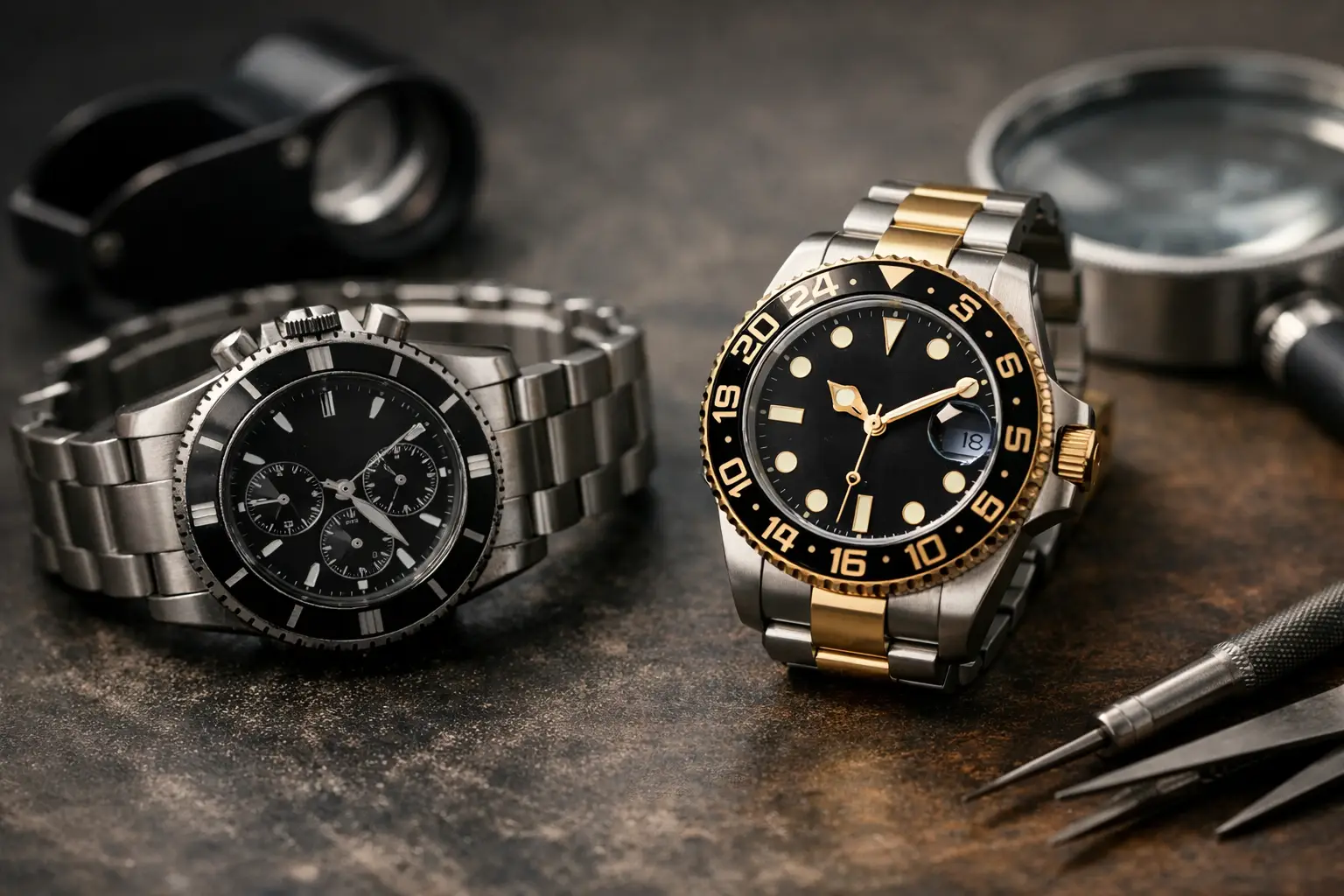
A luxury watch can look correct in a listing, arrive in a convincing box, and still fail the checks that determine whether it deserves a place in a serious collection. This counterfeit watch purchase case study examines how a buyer can be drawn in by a seemingly credible listing, where the transaction breaks down, and what a protected purchase process should provide instead.
The scenario is illustrative, but the risks are familiar across the pre-owned luxury market. The buyer was seeking a current-production Rolex sports model: a highly recognizable reference with strong demand, limited availability, and enough visual familiarity to create false confidence.
The Listing Looked Complete
The watch was offered by a private online seller who supplied bright, professionally framed photographs. The dial printing appeared sharp. The bracelet showed the expected finishing at a glance. A serial number was shown in the images, along with a box, cardholder, and paperwork that appeared consistent with the stated model.
The buyer also received a short video of the watch running and a promise that it had been "checked by a watchmaker." The seller accepted a payment method that offered little practical recourse once funds were transferred. Because the listing price appeared plausible rather than unusually low, the buyer interpreted that restraint as a sign of legitimacy.
That is a common point of failure. Counterfeit listings do not always rely on an obvious bargain. A price that sits near the expected market range can make a buyer less suspicious, particularly when the photos, accessories, and seller communication all reinforce the same story.
What Changed After Delivery
At first inspection, the watch felt substantial and wore comfortably. The buyer noticed no immediate issue with the crystal, bezel, clasp, or dial. But a closer examination raised questions that photographs had concealed: the alignment of certain dial details appeared slightly inconsistent under magnification, the bracelet finishing lacked the precision expected of the reference, and the timing performance was outside a reasonable range.
The decisive issue emerged when a qualified inspection was arranged. Opening the case revealed a movement that did not match the manufacturer-correct caliber for the stated reference. Some exterior components had been made to resemble the genuine model closely, while internal details and construction did not support the seller's claim.
The paperwork did not solve the problem. Documents and packaging can add context to a watch, but they do not authenticate it by themselves. They can be incomplete, unrelated to the watch, altered, or paired with a different timepiece. A serial number, even when it appears properly placed, is one data point in a broader review.
Why the Buyer Missed the Warning Signs
The buyer did not make one careless decision. Several reasonable assumptions combined into a costly one. The seller had supplied images, answered questions promptly, and presented a coherent ownership story. The watch was not being offered at a price so low that it obviously demanded skepticism.
The problem was that the buyer evaluated evidence without independent verification. The photos were selected by the seller. The video showed only what the seller chose to show. The watchmaker claim could not be confirmed, and there was no documented authentication process, written condition standard, return framework, or warranty backing the transaction.
For a collector, the lesson is not that every private seller is acting in bad faith. It is that a high-value purchase should not depend entirely on a seller's description. Good intentions do not correct an inaccurate listing, and a convincing presentation is not the same as documented accountability.
Counterfeit Watch Purchase Case Study: The Real Cost
The financial loss was only part of the outcome. Once the buyer raised concerns, communication slowed. The seller disputed the inspection, argued that the watch had been sold as represented, and pointed to the buyer's prior review of photographs. Recovering funds became a separate problem from proving the watch was not genuine.
The buyer also lost time arranging an assessment, documenting the issue, and trying to establish a path to resolution. For someone purchasing a luxury watch for a milestone, collection goal, or professional wardrobe, that disruption matters. The ownership experience begins before the watch is worn. It begins with knowing the piece is authentic, accurately described, and supported after delivery.
There is also a condition risk that applies even when a watch is genuine. A listing may omit polishing, replacement parts, water-resistance concerns, bracelet stretch, or mechanical service needs. Authentication and condition evaluation are related, but they are not interchangeable. A genuine watch can still be a poor purchase if its condition is not represented clearly.
What a Safer Purchase Process Looks Like
A structured retailer should be able to explain how it evaluates authenticity and what happens if the watch does not meet expectations. For high-consideration purchases, buyers should look beyond a general statement that a watch is "authentic" and assess the safeguards surrounding that statement.
A sound process starts with in-house certification and a review of the watch as a complete object, not merely a visual comparison against online images. Reference-correct details, movement, dial, case, bracelet, markings, and overall construction should be considered together. The appropriate depth of inspection depends on the model, its age, and the details that are relevant to that particular reference.
The transaction should also provide a clear path after delivery. Insured shipping protects the watch while it is in transit. A defined return window gives the buyer time to inspect the piece in person. A warranty provides meaningful support for covered mechanical concerns that may arise after the purchase. These terms do not replace due diligence, but they materially improve the buyer's position when compared with a final private sale.
Before committing, ask direct questions about authentication, condition, included accessories, return eligibility, and warranty coverage. The answer should be specific enough to help you make a decision. Vague reassurances, pressure to pay quickly, and reluctance to provide clear transaction terms deserve careful attention.
Documentation Is Useful, but It Is Not Proof
Collectors often place understandable value on a complete set. Original box, papers, booklets, tags, and service records may add historical context and can matter to future ownership. Yet a complete set should support an authenticated watch, not substitute for authentication.
The same principle applies to a seller's reputation. Positive feedback, polished communication, and a detailed story can be helpful signals, but they are not a technical examination. With a watch from Rolex, Patek Philippe, Audemars Piguet, Omega, or another leading manufacturer, the stakes justify a process that does not ask the buyer to take that final leap alone.
The Better Standard for a Luxury Watch Purchase
The strongest purchase decision is not based on whether a listing feels convincing. It is based on whether the seller can stand behind the watch with defined protections and professional verification. That standard is especially relevant for first-time buyers, but experienced collectors benefit from it as well when condition, provenance, and reference-specific details require close review.
Lume Wrist Watches approaches these purchases with in-house certified timepieces, free insured US shipping, a 30-day return window, and a two-year warranty. Those safeguards are designed to give buyers a clearer process before and after delivery, without treating a luxury watch purchase as a casual online transaction.
A fine watch should invite close inspection for the right reasons: its finishing, engineering, history, and presence on the wrist. When authenticity and purchase protections are established first, the buyer can focus on the watch itself rather than the uncertainty behind it.