Full Set Watch Only Buying Guide for Collectors
Published October 10, 2026 · Last updated October 17, 2026 · By Lume Wrist Watches Editorial Team
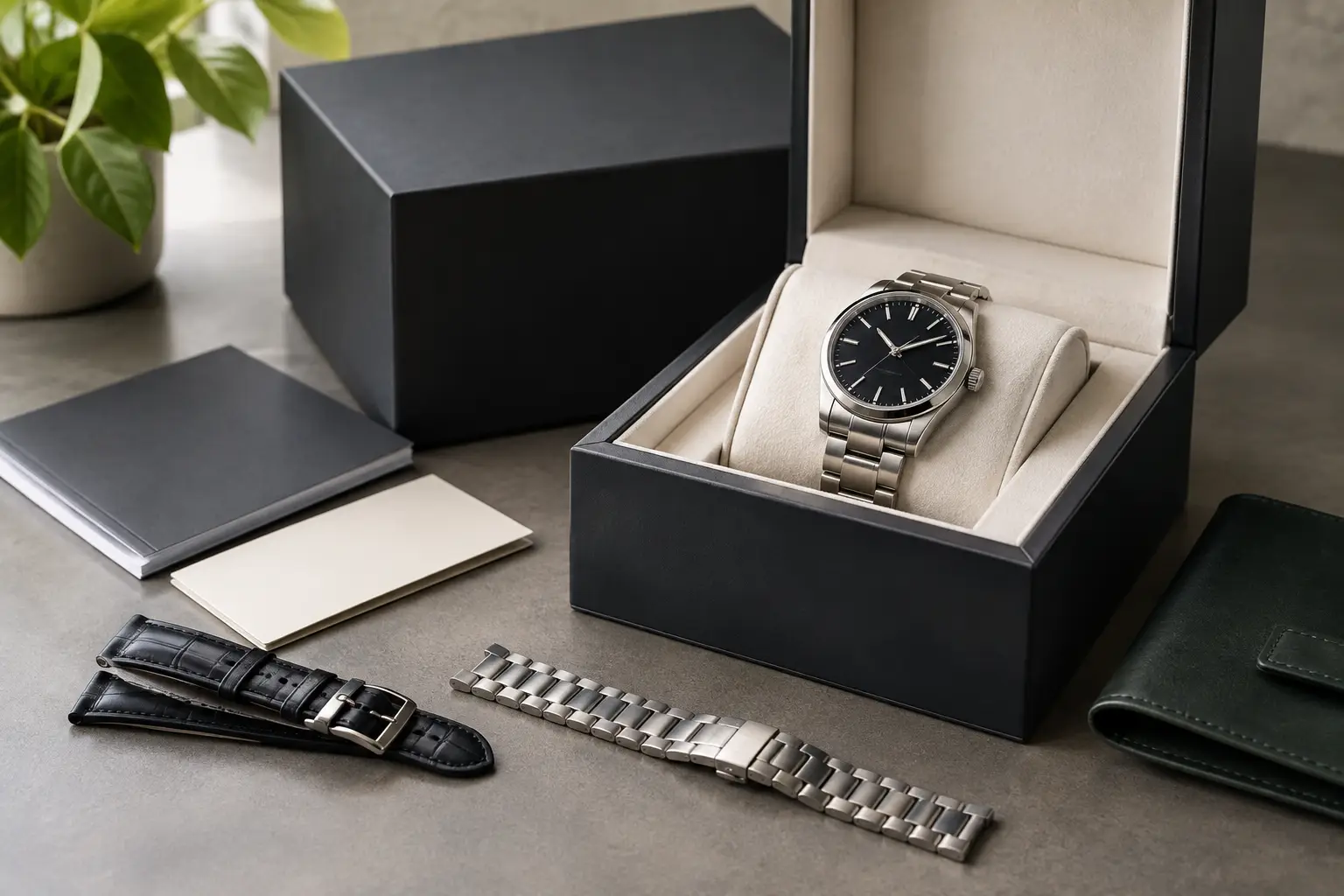
A full set watch only search is not simply a preference for a handsome box and extra paperwork. For many luxury-watch buyers, it is a disciplined way to narrow the market to watches with a more complete ownership record, stronger collector appeal, and fewer unanswered questions at the point of purchase.
A full set can add meaningful context to a Rolex, Patek Philippe, Audemars Piguet, Omega, or other high-end timepiece. It does not replace professional authentication or condition review. It does, however, help establish the watch's history and make the purchase easier to evaluate, enjoy, and eventually pass along.
What “Full Set” Usually Means
In the luxury secondary market, “full set” generally means the watch is offered with the original items supplied at retail. The exact contents vary by brand, model, production era, and market of original sale, so the term should never be treated as a fixed checklist.
For a modern watch, a complete set commonly includes the watch, presentation box, outer box, warranty card or certificate, manuals, booklets, and hang tags. Some references were also delivered with a serial-number tag, bezel protector, setting pin, pusher tool, spare links, or model-specific accessories. A complicated Patek Philippe, for example, may have additional literature or a certificate format unlike that of a contemporary Rolex sports model.
Vintage watches require more nuance. Original packaging and paperwork are less likely to have remained with the watch over several decades. A vintage piece with its period-correct box and papers can be highly desirable, but buyers should distinguish between accessories that are truly original to that watch and accessories that are merely correct for the era.
The phrase “full set” should describe what is physically included in the sale. A careful seller will identify those components clearly rather than relying on the label alone.
Why Collectors Look for a Full Set Watch Only
The appeal starts with provenance. A matching warranty card, certificate, or original purchase document can help connect a watch to its original retail delivery. That context is valuable when evaluating a specific reference, particularly one with a meaningful serial number, limited production, or a strong collector following.
Completeness also affects the ownership experience. A watch delivered with its original presentation materials feels more resolved. The documentation may preserve reference details, original configuration information, and instructions that are part of the product itself. For a buyer acquiring a milestone watch or building a focused collection, that matters beyond resale considerations.
A complete set can also broaden future buyer interest. Not every buyer requires papers and accessories, especially when pursuing a rare vintage reference. But among comparable examples, a watch with its original accompanying materials often attracts a wider audience. That does not mean a full set automatically makes a watch superior. Condition, originality, service history, and authenticity remain central to its value and desirability.
Full Set Does Not Mean Risk-Free
Boxes, cards, and booklets are supporting evidence, not conclusive proof. They can be separated from watches, replaced over time, or inaccurately paired with a different example. A warranty card should be reviewed for consistency with the watch's reference and serial information where applicable. The style of the card, box, manuals, and tags should also make sense for the watch's production period.
The watch itself still deserves the closest inspection. The case, dial, hands, movement, bracelet, clasp, engravings, and serial or reference markings must be evaluated as a coherent whole. A complete-looking package does not resolve questions about polishing, replaced components, incorrect parts, water damage, or mechanical performance.
This is why professional verification is particularly valuable. At Lume Wrist Watches, timepieces are in-house certified and sold with a two-year warranty, 30-day returns, and free insured US shipping. Those safeguards address the watch itself and the transaction, rather than asking a buyer to place undue confidence in packaging alone.
What to Verify Before You Buy
Begin by requesting a precise inventory of everything included. “Box and papers” is not always the same as “full set.” A watch may have a box and a warranty card but no outer box, manuals, tags, or original accessories. That may be entirely acceptable, provided the description is accurate and your expectations match what is being offered.
Next, examine whether the documents belong with the watch. For modern pieces, the reference shown on the card or certificate should align with the model being sold. If a serial number is printed, it should be reviewed against the watch where the brand and production era make that comparison possible. Buyers should also consider whether the country code, retailer information, and document format are plausible for the stated watch.
Then look closely at condition. A full set does not make a heavily polished case sharp again, restore stretched bracelet links, or reverse moisture damage. Ask for clear images of the dial, case edges, caseback, bracelet, clasp, and included documents. For watches with bracelet sizing, confirm whether all removed links are included. Replacing missing links can be costly and may affect how the watch fits.
Finally, consider the quality of the purchase process. High-value watches should be shipped securely and insured, with clear return terms and a meaningful warranty. Documentation is helpful, but the retailer's accountability is what gives buyers practical recourse if a concern arises after delivery.
When a Full Set Matters Most
For current-production and recently discontinued luxury watches, a complete set is often a sensible baseline. The original materials are still relatively obtainable, and buyers commonly expect them. This is especially true for widely collected Rolex references, modern Patek Philippe sports watches, Audemars Piguet Royal Oak models, and desirable Omega editions.
For rare vintage watches, the calculation changes. The watch may be exceptional even without its original box or papers if its dial, case, movement, and known history are compelling. Insisting on a full set only can sharply reduce the available choices and may cause a buyer to overlook a more original or better-preserved example.
There is also a practical distinction between collector completeness and personal priorities. If you intend to wear the watch regularly and have found an authentic, properly evaluated example in excellent condition, missing packaging may not be a deal-breaker. If the watch is intended as a long-term collection piece, a gift, or a reference you may later sell, completeness may deserve greater weight.
Questions Worth Asking About a Full Set
Before committing, ask whether the box is original to the watch or period-correct but not original. Ask which accessories are included and whether any have been replaced. Confirm whether warranty paperwork is dated and whether its reference and serial details correspond to the watch.
It is also reasonable to ask about service documentation. Service papers are not necessarily part of an original full set, but they can be useful evidence of maintenance. They should be viewed in context, since a service history can also indicate changed components or refinishing. The goal is clarity, not a perfect paper trail at any cost.
A seller should be able to provide direct answers, detailed photographs, and a condition description that addresses both the timepiece and its accessories. Ambiguity has little place in a purchase of this size.
A Better Standard Than the Label
“Full set” is valuable because it signals completeness, provenance, and care. Yet the phrase should be the beginning of your review, not the end of it. The best purchase is one where the watch, its documentation, its condition, and the seller's protections all support the same conclusion.
If a particular watch matters to you, inspect the full picture with the same care you would bring to the timepiece itself. A complete set is most rewarding when every included detail stands up to scrutiny.