How to Start a Rolex Automatic Watch Safely
Published August 19, 2026 · Last updated October 17, 2026 · By Lume Wrist Watches Editorial Team
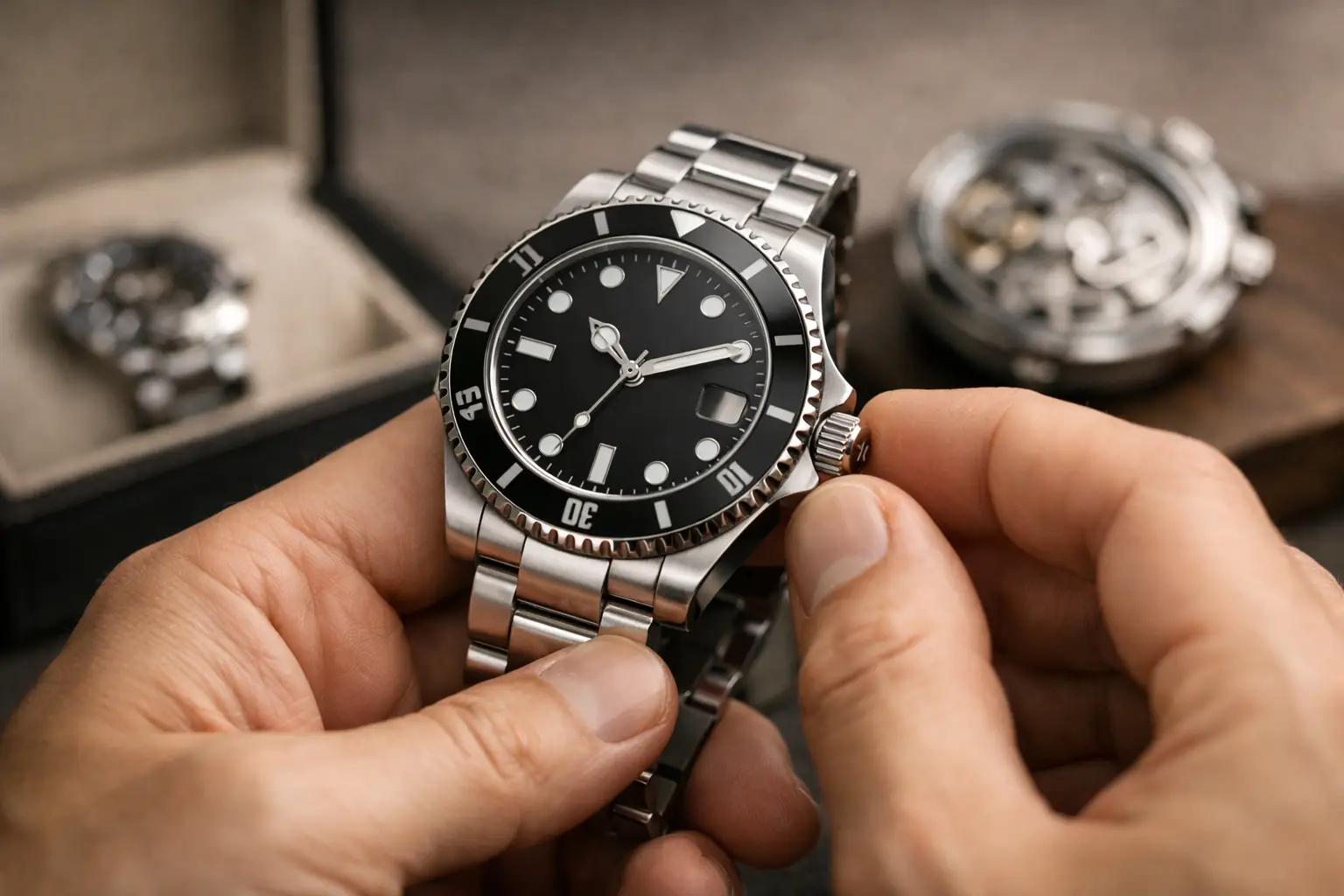
A Rolex that has been sitting still usually does not need a dramatic fix. It needs a proper manual wind, careful setting, and enough wrist time to rebuild its power reserve. Knowing how to start a Rolex automatic watch protects the movement, helps preserve water resistance, and prevents a small handling mistake from becoming an unnecessary service issue.
Most current Rolex automatic models are built for regular use, but the crown is a precision component. Treat it accordingly. Never force it, never adjust it while the watch is wet, and stop if its operation feels unusually rough, loose, or resistant.
How to Start a Rolex Automatic Watch
Begin with a clean, dry watch and a stable surface. If the bracelet is fitted, it is usually easiest to remove the watch from your wrist before working with the crown. This gives you better control and reduces the chance of pulling the crown sideways.
On most Rolex Oyster models, the crown is secured with a threaded system that helps maintain the case's water resistance. Hold the crown gently between your thumb and forefinger, then turn it counterclockwise, or toward you when viewing the watch from the crown side. After several turns, the crown should release from its locked position and spring slightly outward.
Do not pull the crown immediately. In its first unlocked position, it is ready for manual winding.
Turn the crown clockwise, away from you, approximately 25 full turns. This winds the mainspring and gives the automatic movement enough stored energy to begin running reliably. You may see the seconds hand start moving before you finish, but continue winding through the full initial range rather than relying on a few turns alone.
A modern Rolex automatic movement has a slipping mainspring bridle designed to prevent conventional overwinding during normal manual winding. Still, there is no benefit to applying excessive force or continuing indefinitely. If the crown feels wrong, stop rather than trying to power through resistance.
Once the watch is running, you can set the time and, where applicable, the date. Finish by pressing the crown gently toward the case and turning it clockwise until it is fully screwed down. The crown should sit flush against the case. This final step matters: an unscrewed crown can compromise the watch's water resistance.
Set the Time Before You Set the Date
The correct crown positions depend on the Rolex reference. A no-date Submariner or Oyster Perpetual generally has fewer setting steps than a Datejust, GMT-Master II, Sky-Dweller, or Daytona. If you are uncertain about your specific model, use its instruction booklet or have a qualified watch professional demonstrate the process.
For a typical date-equipped Rolex, pull the crown out one position after winding to access the quick-set date. Pulling it to the outer position allows the hands to be set. The order is worth following because it helps you establish whether the watch is showing morning or afternoon time.
Set the hands first and move them forward until the date changes. That date change marks midnight. From there, advance the hands to the correct current time, taking AM and PM into account. Only then use the quick-set function, if your model has one, to select the proper date.
Avoid using the quick-set date function when the hands are near midnight. A cautious working range is to move the hands outside roughly 9:00 PM to 3:00 AM before changing the date. During this period, the movement may already be engaging its date-change mechanism. Forcing a quick adjustment can place needless stress on the calendar components.
Some Rolex references require model-specific care. The GMT-Master II, for example, uses an independently adjustable local hour hand. The Sky-Dweller has its Ring Command bezel system, which changes the setting mode when rotated. Older Rolex watches may not have a quick-set date at all. With a vintage or complicated reference, careful reference-specific handling is more valuable than generic advice.
Why Shaking the Watch Is Not the Right First Step
It is common to see someone shake an automatic watch to get it moving. A few natural wrist movements may start a low-power movement, but shaking is not the preferred method for a stopped Rolex. It provides inconsistent energy, offers less control than winding, and can create unnecessary impacts.
Manual winding is the correct starting point because it gives the mainspring a meaningful charge. After that, wearing the watch normally allows the rotor to maintain power through the motion of your wrist.
If you intend to wear the Rolex only occasionally, expect it to stop after its power reserve is exhausted. Many current Rolex automatic movements offer approximately 70 hours of power reserve, while older references may offer less. The exact duration depends on the caliber, its condition, and how fully it was wound. A watch winder can be useful for certain collections, but it is not required for regular ownership and should be set appropriately for the specific movement.
Protect the Crown and Water Resistance
The crown is one of the most frequently handled parts of any Rolex, and it deserves particular attention. Always make adjustments in a dry environment. Do not unscrew or set the crown after swimming, during rain, or when moisture may be present around the case.
When you are finished, press the crown inward while turning it clockwise. Start the threads gently. If they do not catch smoothly, back off and try again rather than forcing them. Cross-threading can damage the crown tube and may affect the watch's ability to resist water.
A properly screwed-down crown is not a substitute for periodic pressure testing. Gaskets age, seals can be affected by impact, and a watch that has been opened for service should be checked before exposure to water. This is especially relevant for pre-owned and vintage Rolex watches, where service history and case condition vary.
Do not use tools to turn the crown. Your fingertips should be sufficient. If the crown cannot be operated comfortably by hand, that is a reason for inspection, not more leverage.
When a Stopped Rolex Needs Service
A stopped automatic Rolex often simply needs winding. However, a watch that stops again shortly after a proper manual wind may need professional attention. The same applies if the seconds hand starts and then quickly dies, the crown will not screw down, the date does not change correctly, or the movement makes an unusual grinding or scraping sound.
Power reserve can also reveal a problem. After approximately 25 crown turns, a healthy watch should not stop after only a few hours of normal wear. That does not automatically identify the cause, but it does justify a qualified evaluation. Lubricants can age, components can wear, and a prior impact may affect performance even when the watch looks clean externally.
For a newly acquired pre-owned Rolex, confirm that the watch's function matches its documentation and condition description before putting it into regular rotation. Authentication and in-house certification matter, but so does clear post-purchase support. Lume Wrist Watches pairs authenticated, in-house certified timepieces with free insured US shipping, a 30-day return window, and a two-year warranty, giving buyers a structured path if a mechanical concern appears after delivery.
A Simple Routine for Regular Wear
If you wear your Rolex several days each week, normal motion should keep it running. If it stops, manually wind it before setting the time. There is no need to wind it every morning when it is already running and being worn consistently.
For watches worn in rotation, wind and set each piece when you plan to wear it rather than repeatedly handling crowns out of habit. This is particularly sensible for a collection that includes vintage pieces or complications. Less unnecessary adjustment means less wear on components that were designed for precision, not constant manipulation.
A Rolex automatic watch is engineered to be used, but proper handling remains part of ownership. A calm 25-turn wind, deliberate time setting, and a securely screwed-down crown will do more for the watch than a forceful shake or a rushed adjustment ever will.