IWC Spitfire Watches Explained for Pilots and Collectors
Published September 2, 2026 · Last updated October 17, 2026 · By Lume Wrist Watches Editorial Team
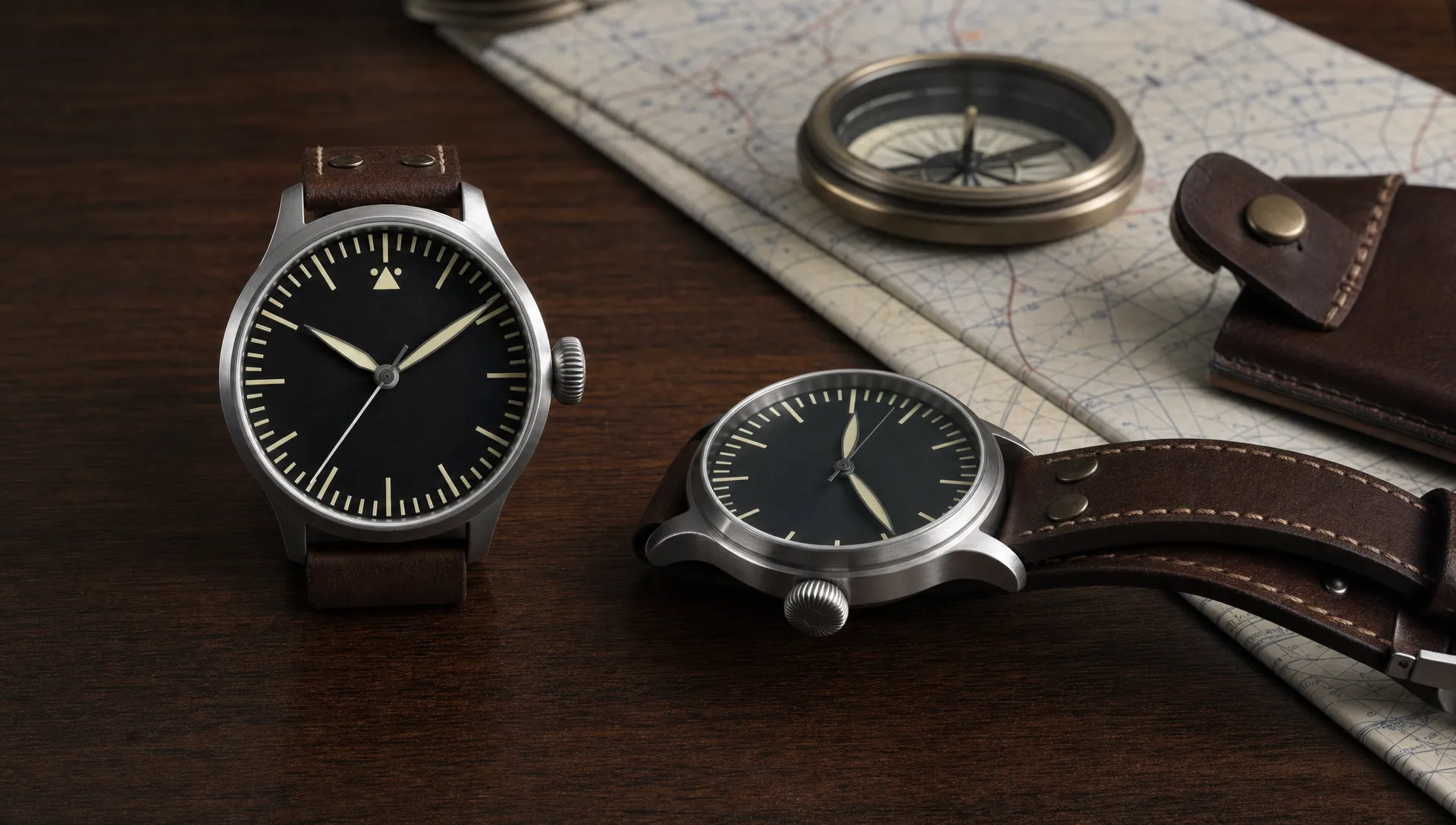
IWC Spitfire watches are pilot's watches with aviation heritage, strong legibility and a warmer personality than the standard black-dial IWC Pilot's line. For collectors, the appeal sits in the reference details: older ETA and Valjoux-based models, later in-house calibers, bronze cases, limited editions and a design language tied to the Supermarine Spitfire.
For a pilot, the Spitfire is not a primary flight instrument in 2026. It is a robust mechanical watch with practical timing, travel and visibility traits. For a collector, it is one of the more nuanced branches of IWC's modern pilot catalog, because it includes simple three-hand watches, chronographs, UTC models, Timezoners and high complications.
What the Spitfire name means in IWC watches
The name refers to the Supermarine Spitfire, the British fighter aircraft best known for its role in World War II. The Imperial War Museums overview of the Supermarine Spitfire is useful background if you want the aircraft context behind the name.
IWC has used aviation themes for decades, especially through its Mark-series pilot watches and Big Pilot models. The Spitfire sub-family sits inside that aviation world, but it does not always look identical from one generation to the next.
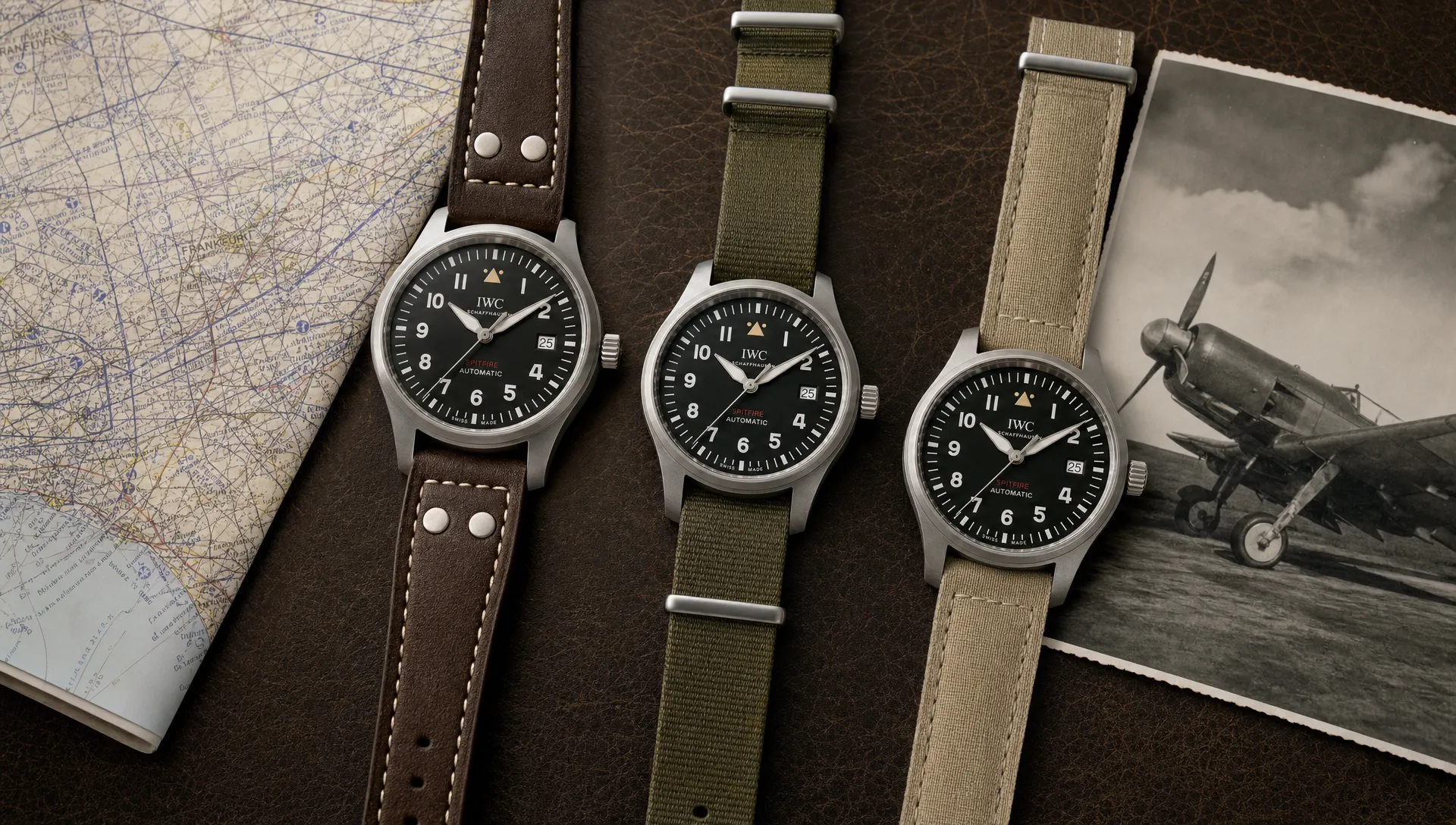
Earlier Spitfire references often used silver dials, applied numerals and a more polished, almost dress-pilot look. The 2019 generation shifted the line toward a stronger military character, with black or green dials, steel or bronze cases, textile straps and a more compact 39mm automatic model.
That split matters. A buyer who wants pure cockpit-instrument minimalism may prefer the standard Mark XVIII or Mark XX. A buyer who wants aviation design with more warmth, patina potential or historical character may find the Spitfire more compelling.
Main IWC Spitfire reference families
The table below focuses on references buyers commonly discuss in the pre-owned market. IWC has produced additional variants, and suffixes can differ by strap, bracelet, dial execution and limited-edition configuration.
| --- | ---: | ---: | --- | --- |
|---|---|---|---|---|
| Pilot's Watch Automatic Spitfire | IW326801, IW326802 | 39mm | IWC Caliber 32110, automatic, 72-hour power reserve | Clean daily-wear format, strong modern entry point into Spitfire |
| Pilot's Watch Chronograph Spitfire | IW387901, IW387902 | 41mm | IWC Caliber 69380, automatic chronograph | More functional on the wrist, with day-date and elapsed-time timing |
| Pilot's Watch UTC Spitfire Edition MJ271 | IW327101 | 41mm | IWC Caliber 82710, automatic UTC | Bronze case, travel function and limited-edition appeal |
| Pilot's Watch Timezoner Spitfire Edition _The Longest Flight_ | IW395501 | 46mm | IWC Caliber 82760, automatic world-time function | Large case, useful travel complication, more niche fit |
| Big Pilot's Watch Perpetual Calendar Spitfire | IW503601 | 46.2mm | IWC Caliber 52615, automatic perpetual calendar | High-complication Spitfire, more collector-focused than daily practical |
| Earlier Spitfire Mark and Chronograph models | IW3255, IW3265, IW3717 and IW3878 variants | About 39mm to 43mm | Caliber 30110, 79320 or 89365 depending on reference | Silver-dial and transitional-era models need close reference checking |
The most approachable modern Spitfire is the 39mm Automatic. The chronograph adds everyday utility, but also thickness and service complexity. The UTC and Timezoner models are more specialized. The perpetual calendar is a different collecting category altogether.
How Spitfire differs from the standard IWC Pilot's line
Design tone
Standard IWC Pilot's watches tend to be more direct: black dial, white numerals, simple hands and minimal ornament. Spitfire watches often add more texture. Depending on the generation, that can mean a silver sunburst dial, bronze case, green dial or vintage-colored luminous material.
The modern bronze Spitfires are especially distinct. Bronze changes with wear. It can darken, soften and build surface patina. Some collectors like that because the watch becomes more personal over time. Others prefer steel because it remains visually cleaner and easier to evaluate in photographs.
Movement strategy
Earlier Spitfire watches used robust outsourced base movements modified or finished to IWC specification. Examples include ETA 2892-A2-based automatic calibers and Valjoux 7750-based chronograph calibers. These are well understood by watchmakers and can be attractive to buyers who prioritize long-term service familiarity.
Later Spitfire references brought more IWC-manufactured calibers into the family. Caliber 32110 gave the three-hand Automatic Spitfire a long 72-hour power reserve. Caliber 69380 gave the Chronograph Spitfire an IWC automatic chronograph architecture. For a deeper look at chronograph architecture in general, Lume's guide to chronograph movements for collectors explains the differences between common chronograph systems without treating every movement as equal.
The practical takeaway is simple. Do not buy an IWC Spitfire by dial color alone. Buy it by reference, movement, case material, size and condition.
What pilots should actually look for
Mechanical pilot's watches today are mostly redundant instruments. Modern cockpits rely on certified avionics, digital timing and electronic navigation. Still, a good pilot watch should be readable, stable on the wrist and easy to operate under real conditions.
| Pilot-use factor | What to check | Why it matters |
|---|---|---|
| --- | --- | --- |
| Legibility | High contrast, clear hands, clean minute track | Fast reading matters more than decoration |
| Case size | 39mm, 41mm or 46mm depending on wrist and cockpit use | Oversized cases can catch on cuffs or gloves |
| Magnetic protection | Confirm whether the specific reference uses a soft-iron inner case | Not every reference has the same technical construction |
| Timing function | Chronograph or rotating time-zone system if needed | Useful for elapsed timing and travel, less so for basic local time |
| Strap choice | Textile, leather or bracelet depending on heat and activity | A secure strap matters more than period-correct styling |
| Water resistance and service | Check gasket condition, crown function and recent service history | Pilot watches are still exposed to sweat, weather and daily knocks |
For actual flying use, the 39mm Automatic Spitfire and 41mm Chronograph Spitfire are the most balanced. The Timezoner is useful for travel but large. The Big Pilot Perpetual Calendar Spitfire is impressive, but it is not the practical cockpit choice for most owners.
What collectors should focus on
The 2019 Spitfire generation
The 2019 generation is the cleanest place to start if you want the modern Spitfire identity. The 39mm IW326801 in steel and IW326802 in bronze gave the line a compact, wearable format with IWC's 32110 automatic caliber. The 41mm IW387901 and IW387902 chronographs added a stronger instrument presence without reaching Big Pilot proportions.
Collectors should compare steel and bronze carefully. Steel is easier to assess for polishing, scratches and edge definition. Bronze requires a more tolerant eye because patina is part of the ownership experience. A freshly polished bronze case can look attractive in a listing photo, but it may also obscure how the case has aged.
Earlier silver-dial Spitfires
Earlier Spitfire models are more divisive, which can be a positive for focused collectors. The silver dials, applied markers and polished elements make them less tool-like than a standard Mark-series pilot watch. Some buyers see that as elegance. Others see it as a departure from IWC's pilot-watch austerity.
Condition matters heavily here. Check dial cleanliness, hand matching, crown condition, bracelet stretch if applicable and whether the movement matches the reference. On chronographs, inspect the alignment of the counters and the feel of the pushers. A clean case with poor chronograph reset behavior is not a clean watch.
Limited editions and complicated Spitfires
The UTC Spitfire Edition MJ271, Timezoner Spitfire Edition _The Longest Flight_ and Big Pilot Perpetual Calendar Spitfire sit in a more specialized category. These are not substitutes for a basic pilot's watch. They are collector pieces with stronger stories, larger cases and more complicated movements.
Buy the complication because you want to own it, wear it and service it. Do not buy it because you expect a guaranteed resale outcome. Pre-owned watch values move with condition, completeness, demand, service status and broader buyer sentiment.
Sizing and wrist fit
IWC Spitfire watches wear differently across the range. Diameter is only one part of the story. Thickness, lug length, strap stiffness and dial openness all affect comfort.
| --- | --- | --- |
|---|---|---|
| Under 6.5 inches (165mm) | 39mm Automatic Spitfire | Best chance of balanced proportions |
| 6.5 to 7.25 inches (165mm to 184mm) | 39mm Automatic or 41mm Chronograph | Choose by desired thickness and dial activity |
| 7.25 to 7.75 inches (184mm to 197mm) | 41mm Chronograph or UTC | Strong presence without moving immediately to 46mm |
| Over 7.75 inches (197mm) | Timezoner or Big Pilot complication | Large case can work if lug span sits flat |
If buying as a gift, avoid assuming bigger means better. A 39mm IWC Spitfire can feel more refined and more wearable than a larger complication, especially for a first Swiss watch buyer. For collectors, the question is not only fit. It is whether the watch fills a clear role in the box.
Price and value context without speculation
It is tempting to rank Spitfire references by expected resale. That is not the right way to evaluate them. Condition, originality, box and papers, service history, case material and reference specificity all affect what a buyer should pay.
Use relative categories rather than fixed numbers unless you are looking at a live listing from a trusted seller.
| --- | --- | --- |
|---|---|---|
| Three-hand Automatic Spitfire | Most approachable modern Spitfire segment | Steel vs bronze, condition, strap set and completeness |
| Chronograph Spitfire | Higher than simple automatic in most cases | Movement complexity, pusher condition, service record and case thickness |
| Earlier Mark-style Spitfires | Varies widely by reference and condition | Dial preference, bracelet presence, originality and serviceability |
| UTC and Timezoner models | More specialized collector segment | Limited status, complication demand, size tolerance and completeness |
| Perpetual Calendar Spitfire | High-complication collector segment | Calendar function, movement condition, box and papers and service history |
A watch with a lower asking price can be more expensive in the long run if it needs service, has incorrect parts or lacks a credible authenticity trail. That is especially true for chronographs and perpetual calendars.
Authentication and condition checklist
Before buying an IWC Spitfire, verify the exact reference and configuration. Small differences can affect wearability, collector appeal and service expectations.
- Confirm the full reference number, not just the model nickname.
- Check that the dial, hands, crown, caseback and strap or bracelet match the reference.
- Ask whether the movement caliber is correct for that generation.
- Review case condition for over-polishing, softened lugs and inconsistent brushing.
- For bronze models, separate natural patina from aggressive refinishing.
- For chronographs, test start, stop and reset behavior.
- Confirm whether box and papers are present, but do not treat them as a substitute for authentication.
- Ask for service history and warranty terms in writing.
At Lume Wrist Watches, listed inventory is certified authentic by Watch CSA, inspected by in-house specialists and serviced before shipping. That matters because pre-owned condition is not only about cosmetics. It is also about whether the watch has been examined by someone who knows what should be inside the case.
IWC Spitfire versus other tool watches
A Spitfire is not the only way to buy a practical, aviation-linked or tool-oriented Swiss watch. It helps to define the role you want the watch to play.
If you want a busier aviation instrument with slide-rule heritage, Breitling's Navitimer is the obvious comparison. Lume's guide to the Breitling Navitimer's aviation heritage explains why that model feels more technical and less restrained than most IWC pilot watches.
If you want IWC design but something more formal than a pilot's watch, the Portugieser is the natural alternative. Lume's IWC Portugieser Chronograph buyer's guide is a better fit for buyers who want dressier proportions, Arabic numerals and a cleaner business-watch profile.
If you want a simpler black-dial tool watch rather than an aviation watch, a dive watch may make more sense. The Rolex No Date Submariner Ref 14060 Black is a very different proposition: dive bezel, Oyster case architecture and no-date symmetry instead of a pilot dial and IWC's aviation language. Lume lists that example as pre-owned, certified authentic by Watch CSA and fully serviced and inspected.
Collectors drawn to IWC history beyond the Spitfire line may also look at vintage dress and technical calibers, such as this IWC Caliber 853, which represents a different era of the brand's movement identity.
Which IWC Spitfire should you buy?
| --- | --- | --- |
|---|---|---|
| First IWC buyer | 39mm Automatic Spitfire in steel | Wearable, legible and easier to live with daily |
| Pilot or frequent traveler | Chronograph, UTC or Timezoner depending on wrist size | Adds timing or travel functionality without leaving the pilot category |
| Collector of modern IWC | 2019 bronze or steel Spitfire references | Cohesive design era with recognizable modern calibers |
| Collector of unusual IWC | Earlier silver-dial Spitfire or limited edition | More distinctive, but reference research matters more |
| Gift buyer | 39mm Automatic or 41mm Chronograph | Safer sizing than 46mm complications and easier to explain |
The safest choice for most wrists is the 39mm Automatic Spitfire. The most practical complication is the 41mm Chronograph Spitfire. The most collector-specific choices are the UTC, Timezoner and perpetual calendar models.
Frequently Asked Questions
Is the IWC Spitfire a real pilot's watch? Yes. It belongs to IWC's pilot-watch family and many references include practical traits such as strong legibility and, on certain models, soft-iron magnetic protection. It should not be treated as a primary aviation instrument.
Which IWC Spitfire size is best for daily wear? For most wrists, the 39mm Automatic Spitfire is the easiest daily wearer. The 41mm Chronograph works well if you want more presence and timing functionality. The 46mm models need a larger wrist and a collector's tolerance for size.
Are bronze IWC Spitfire watches harder to buy pre-owned? They require more careful condition review. Bronze develops patina naturally, so buyers need to distinguish honest aging from refinishing or poor care. Caseback condition, crown function and movement service still matter as much as the case color.
Do box and papers prove an IWC Spitfire is authentic? No. Box and papers help with completeness, but authentication still requires checking the watch itself, including the reference, case, dial, hands, movement and serial details.
Is an IWC Spitfire better than a Breitling Navitimer? Not better, just different. The Spitfire is usually cleaner and more restrained. The Navitimer is more technical and visually complex because of its aviation slide-rule heritage.
A measured next step
If you are considering an IWC Spitfire, start with the reference, size and movement before thinking about price. A clean 39mm automatic and a complicated 46mm limited edition are both Spitfires, but they serve very different owners.
Lume Wrist Watches is an independent New York City retailer of authenticated pre-owned luxury watches. You can browse current authenticated arrivals or contact our concierge team if you want help comparing an IWC pilot watch against Rolex, Breitling, Omega or another Swiss reference. Free insured shipping is available within the United States, with international shipping quoted on request.
## Part of the series This article belongs to our complete guide: Beyond the Big Four: Essential Luxury Watch Maisons to Know in 2026.\n