How to Authenticate Panerai Luminor References
Published July 30, 2026 · Last updated October 21, 2026 · By Lume Wrist Watches
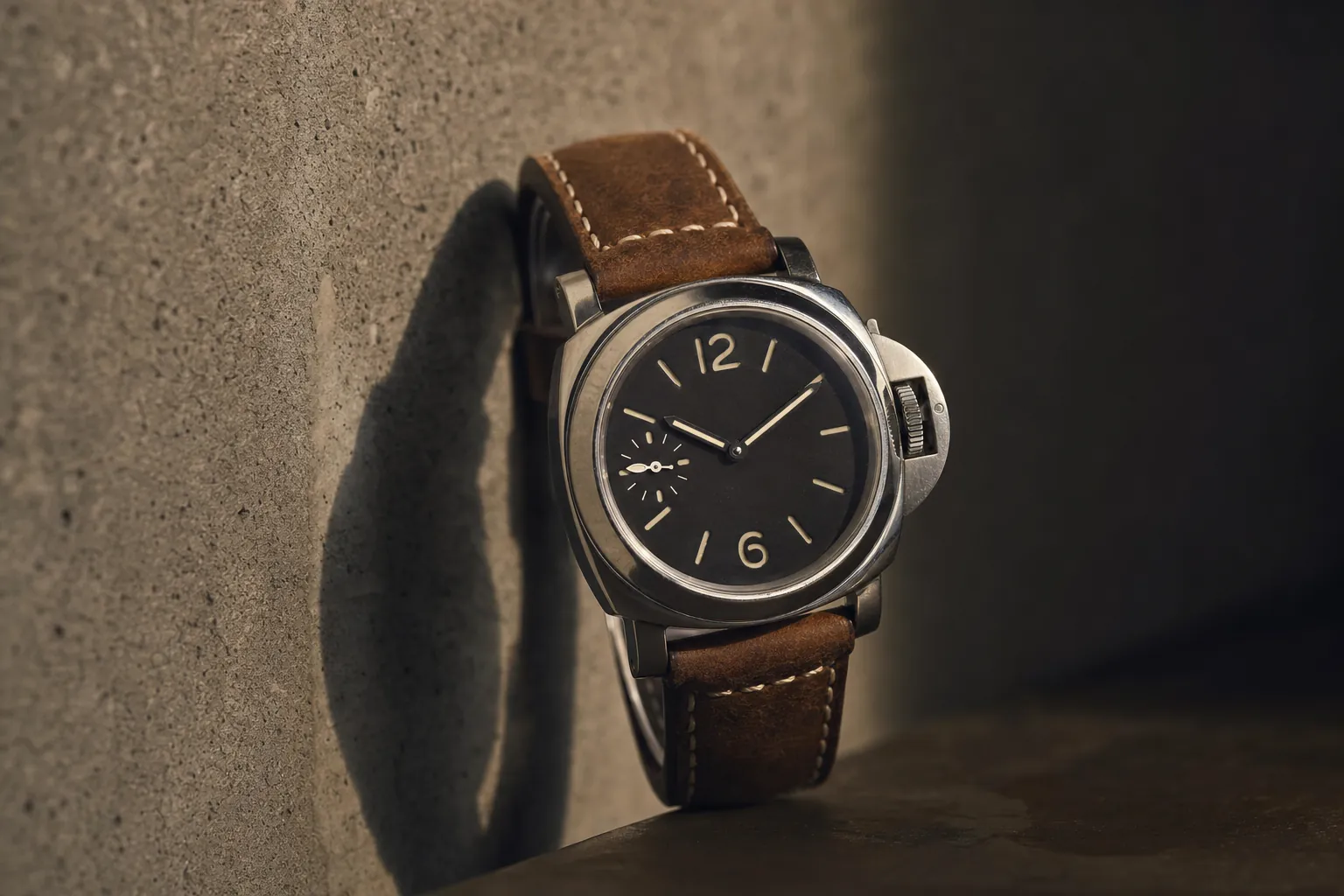
Few modern luxury timepieces possess a silhouette as instantly recognizable—or as frequently replicated—as the Panerai Luminor. As vintage reissues and contemporary references trade hands on the secondary market, knowing how to authenticate Panerai Luminor models requires a trained eye for micro-tolerances, metallurgical finishing, and era-specific manufacturing hallmarks. By examining key structural points from the crown-guard geometry to caliber architecture, collectors can systematically separate genuine Florentine-engineered tool watches from sophisticated counterfeits.
Decoding Caseback Serial Numbers and Millesimation Letters
The caseback of an authentic Panerai Luminor serves as its primary historical ledger. Since the acquisition of Panerai by the Vendôme Luxury Group (now Richemont) in 1997, production cases have adhered to a structured, alphanumeric stamping protocol that provides critical baseline data for verification.
When evaluating a Luminor caseback, you should encounter three distinct sets of numbers: the case reference (OP number), the individual production serial number (BB number), and the millesimation edition stamp.
The OP and BB Identification Sequences
The case reference begins with the letters "OP" followed by a four-digit numeral (such as OP 6518 or OP 6763). This reference designates the specific case design, metallurgy, and water-resistance rating rather than the model catalog number (PAM number). Counterfeiters frequently mix up OP stamps, placing an OP code intended for a 40mm Luminor Marina onto a 44mm Luminor Base case.
Beneath or adjacent to the OP number lies the individual serial number, traditionally beginning with "BB" (or occasionally "PB" for precious metals) followed by six or seven numeric digits. Genuine factory engravings are rendered via precise mechanical milling or clean, controlled laser engraving. The depth is consistent across all characters, with sharp internal corners free from the shallow acid-etching or rounded troughs common in counterfeit reproductions.
The Millesimation Dating System
In 1998, Panerai instituted the millesimation system, which assigns an alphabetical letter to represent the production year alongside a fraction showing the piece's unit number within that year's limited run (for example, `I 0412/1200`). The year sequence began with "A" in 1998, proceeding sequentially through the alphabet while skipping letters that could cause visual confusion, such as "I" in some reference contexts or "O".
| :--- | :--- |
|---|---|
| A | 1998 |
| B | 1999 |
| C | 2000 |
| D | 2001 |
| E | 2002 |
| F | 2003 |
| G | 2004 |
| H | 2005 |
| K | 2008 |
| M | 2010 |
| P | 2013 |
| S | 2016 |
| V | 2019 |
| Y | 2022 |
| Z | 2023 |
When you cross-reference a watch using a comprehensive luxury watch buying guide, confirm that the millesimation letter correlates directly to known production years for that specific reference. For example, a Luminor PAM 00111 should feature painted dials in early production (E through early G series) before transitioning to sandwich dials late in the G series (2004). If a watch displays an A-series stamp alongside a dial layout that Panerai did not manufacture until 2005, the watch is either a frankenwatch or an outright counterfeit.
Inspecting the Patented Crown-Protecting Device
The crescent-shaped crown-protecting device, patented by Panerai in the 1950s, is the most signature design element of the Luminor. Because of its mechanical complexity, it is also one of the most difficult components for counterfeiters to replicate with fidelity. Authenticating this mechanism involves checking metallurgical fit, edge finishing, and tactile operation.
Lever Action and Flush Tolerances
The tight tolerances of an authentic crown bridge allow zero lateral wobble. When closed, the lever arm should sit completely flush with the surrounding bridge contour, forming an unbroken, seamless curve. The rounded cam at the pivot of the lever must exert deliberate downward pressure onto the winding crown, compressing the internal gasket to ensure water resistance.
On a genuine piece, swinging the lever open requires distinct, smooth resistance before clicking definitively into the fully released position. Counterfeit crown guards often feel either excessively loose or gritty. When closed, fake levers often stick out past the edge of the case or sit recessed below the guard frame, revealing sloppy machining tolerances.
Pivot Pin Construction and Bridge Screws
Examine the pivot pin that anchors the lever into the crown bridge: On authentic Luminors, the pin is machined completely flush with both the top and bottom surfaces of the bridge. The ends of the pin are brushed to the exact same grain and direction as the surrounding metal bridge. * On counterfeit assemblies, this pin is frequently sunken, domed, or crudely polished, leaving an obvious visual mismatch.
Inspect the two rear screws securing the crown guard to the case flank as well. Genuine Panerai screws feature cleanly cut, perfectly centered slots with chamfered edges. They sit seated in counterbored holes without protruding beyond the case profile. Replicas frequently use generic hardware with rough burrs, off-center slots, or incorrect thread pitches.
Dial Details: Sandwich Construction and Font Accuracy
Panerai dials are celebrated for their minimalist legibility, but authenticating them requires extreme attention to dial depth, text typography, and luminous materials.
Two-Piece Sandwich Dials Versus Sausage Dials
Panerai primarily utilizes two dial constructions: the "sandwich" dial and the "sausage" (stencil painted) dial. The authentic sandwich dial consists of two distinct plates. The bottom plate is coated with luminous compound (such as Super-LumiNova), while the upper matte black dial plate features cutout apertures for the numerals and baton indexes.
On a genuine sandwich dial, the stencil cutouts reveal sharp 90-degree cut angles with razor-clean transitions. The depth between the two plates is uniform across the entire surface. Counterfeit sandwich dials regularly exhibit sloping, rounded edges inside the numeral cutouts, often caused by inferior stamping dies or poorly focused laser cutters. On certain fake dials, the top plate is noticeably too thin, or the underlying luminous paste is slathered on unevenly, leading to dark patches beneath the numbers under UV light.
Typography, Kerning, and Lume Application
Panerai's dial typography is distinct. Pay close attention to the open numerals "6" and "9": The tail of the "6" curves upward in a smooth, sweeping arc that terminates horizontally without closing. The upper loop of the "9" mimics this geometry in reverse. The letter "A" in "PANERAI" and "LUMINOR" features an exceptionally flat top rather than a sharp point. The crossbars on the "A", "R", and "E" sit at uniform horizontal heights across the dial line.
Counterfeits often use off-the-shelf fonts with overly rounded character curves or thicker line weights. Additionally, inspect the dial text for printing quality; genuine Panerai pad-printing produces crisp, opaque lettering with a subtle gloss lift above the matte dial plate. Fakes often display blurred borders, fuzzy letter edges, or inconsistent ink saturation.
Pre-Vendôme Versus Vendôme Era Production Hallmarks
When collectors examine vintage and neo-vintage Panerai timepieces, production era dictates which technical features should be present. The modern history of the brand splits neatly into the Pre-Vendôme era (1993–1997, under Officine Panerai SpA in Florence) and the Vendôme/Richemont era (1997 to present, manufactured in Neuchâtel, Switzerland).
Pre-Vendôme models (such as references 5218-201/A, 5218-202/A, and 5218-203/A) feature distinct manufacturing characteristics that differ entirely from modern Vendôme pieces: Case Profiles: Pre-Vendôme cases have subtly chunkier case profiles, thicker lugs, and a wide-body crown-protecting device with sharper internal bevels. Caseback Markings: They do not feature OP numbers, BB serials, or millesimation letters. Instead, they carry six-digit reference numbers and individual case numbers formatted without letter prefixes. Dial Lume: Dials from this era relied on tritium (`T SWISS T` or `SWISS T<25` markings at 6 o'clock), which naturally develops a warm, creamy-to-amber patina over time. Logo Finishes: The OP logo, when present on Pre-Vendôme dials, exhibits slightly shorter arrow stems compared to the modern Vendôme standard.
Vendôme-era manufacturing shifted to industrialized Swiss precision. The cases received refined satin-brushing and mirror-polishing techniques, consistent millimeter clearances across the entire design, and serialized casebacks featuring the OP/BB system. Applying Vendôme-era verification points to a Pre-Vendôme piece—or vice versa—is one of the most common mistakes made during authentication.
Movement Verification: ETA Bases to In-House Calibers
A definitive assessment requires uncasing the movement or inspecting it through the sapphire exhibition caseback. Panerai movements generally fall into two broad eras: heavily modified third-party calibers (primarily Unitas and Valjoux architectures) and in-house calibers developed in Neuchâtel.
Modified Unitas 6497 Bases (OP I, OP II, OP XI)
Manual-wind workhorses like the OP I, OP II, and OP XI rely on the robust Unitas/ETA 6497 architecture. However, Panerai modified these movements heavily before casing them: Bridge Decoration: Early Vendôme models featured bridges decorated with repeated "PANERAI" stamps across the plates. Later variants (such as the OP XI used in the PAM 0111) switched to classical Côtes de Genève striping. Regulator Assemblies: Authentic OP XI movements feature a functional swan-neck regulator mechanism. The micro-metric adjustment screw must be perfectly aligned with the swan-neck spring. * Balance Wheels: The balance wheel should be an authentic Glucydur balance with flat, clean spoke edges, beating steadily at 21,600 vibrations per hour (vph) on the OP XI, compared to standard 18,000 vph Unitas bases.
Counterfeits often use low-grade Asian clones of the 6497. On these fakes, the swan-neck regulator is frequently non-functional—the adjustment screw often does not even touch the regulator arm, and the decorative perlage or striping underneath the balance wheel is either missing or unevenly applied.
In-House Calibers: P.9000, P.9010, and P.3000
Modern Luminor models house proprietary in-house calibers such as the automatic P.9000/P.9010 or the manual-wind P.3000. Counterfeiters struggle to replicate these movements correctly and often resort to installing decorative plates over generic Asian 7750 or Miyota movements: Balance Wheel Position: On an authentic P.9000 or P.9010, the balance assembly is positioned at approximately 11 o'clock and held securely beneath a dual-supported balance bridge. Many counterfeit plates leave the balance wheel visible at the wrong angle (frequently 6 or 7 o'clock). Escapement Jewels: Genuine Panerai calibers feature deep, clean, functional synthetic rubies pressed directly into the bridges. Counterfeits with superficial overlay plates use fake, painted, or non-functional glued-on jewels that clearly do not interact with the gear train. * Hour-Hand Quick-Set: Calibers like the P.9000 and P.9010 feature an independent rapid-hour adjustment mechanism. Pulling the crown to the first click allows the hour hand to jump forward or backward in clean one-hour increments without stopping the seconds hand. Counterfeit movements typically lack this complication; turning the crown in position one merely changes the date rapidly or winds the mainspring.
Common Counterfeiting Tells on Modern Luminor Cases
Beyond internal mechanics and engravings, structural flaws on the exterior case can immediately signal a fake watch when you browse and evaluate watches in the pre-owned shop:
- Lug Screw Hole Proportions: Luminor cases utilize screw-in bars or Panerai's patented quick-release system to hold straps in place. On screw-bar cases, the drill holes on the lug flanks should feature clean, flush counterbores. Counterfeits frequently display rough internal threading, or use thin, low-grade spring bars instead of robust threaded pins.
- Bezel Fit and Transition: The smooth, polished bezel of a Luminor Base or Marina must join the brushed case body with an exacting seam line. There should be zero adhesive residue, micro-gaps, or uneven elevations around the perimeter.
- Crystal Clarity and Bevel: Panerai uses high-grade synthetic sapphire with an interior anti-reflective coating. When viewed obliquely, an authentic crystal preserves clear legibility across the dial markings. Counterfeits often use low-grade mineral glass or inferior sapphire lacking anti-reflective treatment, creating a milky halo or heavy optical distortion along the outer edge.
Frequently Asked Questions
### How do Panerai millesimation year letters work? Panerai introduced the millesimation system in 1998, designating that year's production run with the letter "A". Each subsequent year receives the next sequential letter of the alphabet, which appears stamped on the caseback alongside the individual watch's edition number for that year. This letter allows you to confirm that a watch's physical traits match the factory specifications for that specific production year.
### What should the crown-guard lever pin look like on an authentic Luminor? On an authentic Luminor, the crown-guard lever pin is machined completely flat and sits precisely flush with both the top and bottom surfaces of the bridge assembly. The outer faces of the pin are finished with the exact same directional brushing as the rest of the guard. If a pin is noticeably recessed, rounded, or polished differently than the surrounding metal, the crown guard is likely counterfeit.
### Can a sandwich dial confirm that a Panerai Luminor is authentic? No, the presence of a sandwich dial alone does not guarantee authenticity, as modern counterfeiters routinely manufacture two-piece stencil dials. True authentication requires assessing the microscopic precision of the cutout apertures, the 90-degree internal cut angles, and the font geometry of the numerals. Additionally, some authentic historical Luminor references were built with painted dials rather than sandwich dials.
### What markings distinguish genuine Panerai calibers from counterfeit movements? Genuine Panerai movements feature functional jewels seated directly into brushed bridge plates, finely executed Côtes de Genève striping, and sharp, chemically etched or milled text. Counterfeits often use decorative cover plates glued over generic third-party movements, which you can identify by static fake jewels, non-functional swan-neck screws, and incorrectly positioned balance assemblies.