Vacheron Constantin Overseas Generations Guide
Published August 17, 2026 · Last updated October 21, 2026 · By Lume Wrist Watches
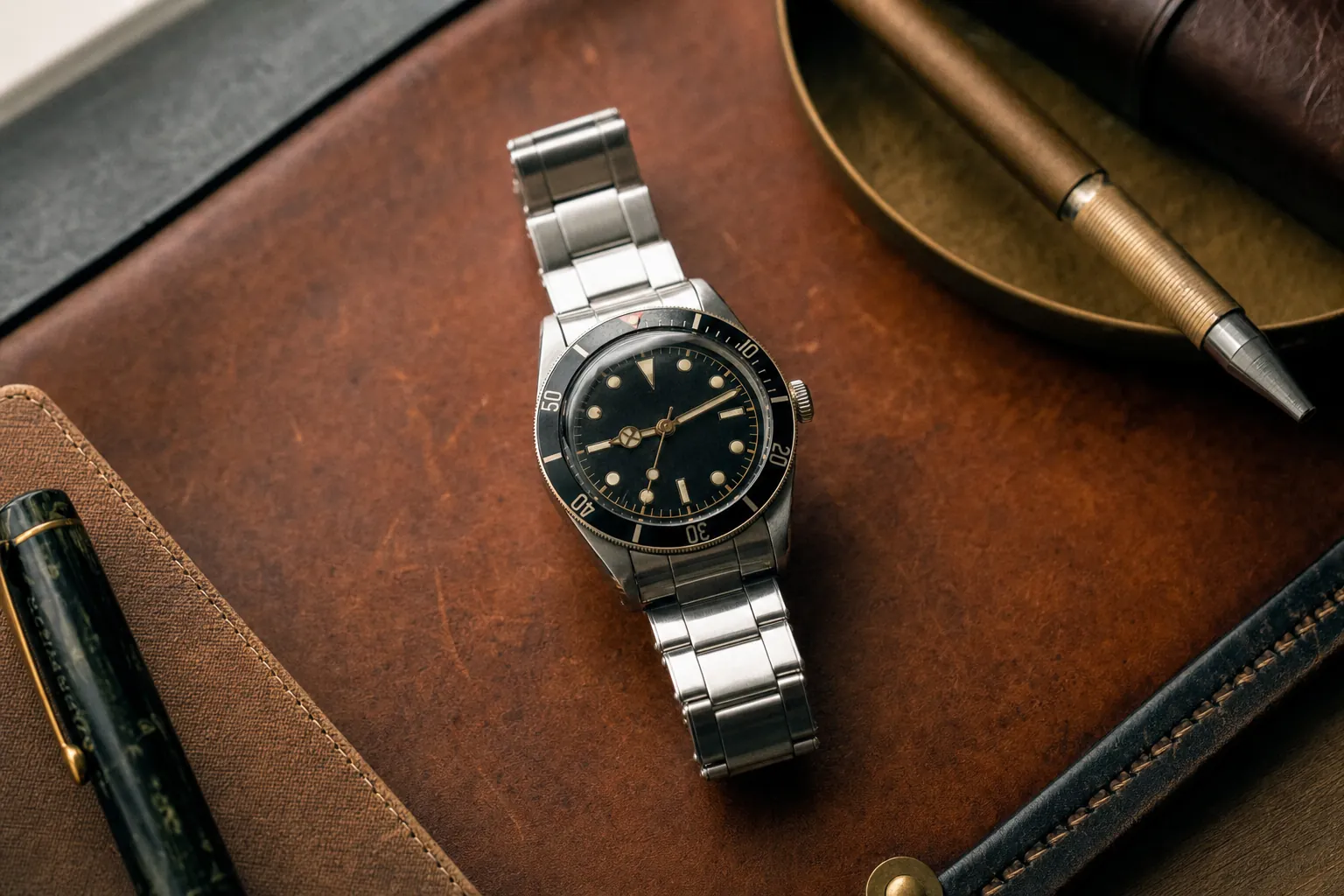
When Vacheron Constantin unveiled the Overseas in 1996, the manufacture established an architectural framework that redefined high-end, go-anywhere luxury sport watchmaking. Across three distinct generations, the collection has evolved through changing tastes in case proportion, horological engineering, and dial decoration. Navigating these production shifts provides essential context for collectors seeking an Overseas in our /shop or studying comparative references in an editorial /buying-guide.
The 1996 Debut: Generation 1 Ref. 42040 and 42042
The first-generation Overseas arrived in 1996 as a direct statement of modern sport-luxury horology. Developed by external designer Dino Modolo alongside Vacheron Constantin’s Vincent Kaufmann, the collection introduced a dynamic tonneau-shaped case topped with a serrated, gear-like bezel evocative of the brand's heritage Maltese cross.
Mounted on an integrated multi-link steel bracelet that fastened via a double-folding deployant clasp, the debut flagship reference was the Ref. 42040. It measured 37mm in diameter and roughly 8.5mm in thickness, maintaining the slim, wrist-hugging profile expected of haute horlogerie sport watches of the late 1990s. The solid screw-down caseback bore a detailed hand-engraved medallion depicting the Amerigo Vespucci, the Italian three-masted naval training vessel that symbolized the collection's nautical and globe-trotting spirit.
Mechanical Transition: Ref. 42040 to Ref. 42042
Underneath the Vespucci medallion, the earliest production Ref. 42040 housed the COSC-certified Calibre 1310. Based on the ultra-reliable, slim Girard-Perregaux Calibre 3100 architecture, this automatic movement operated at 28,800 vibrations per hour (4Hz) and featured a quickset date at 3 o'clock.
Around 1999, Vacheron Constantin introduced an engineering revision, re-indexing the reference to 42042. This reference incorporated the Calibre 1311, an upgraded evolution of the base movement that refined the winding mechanism and escapement components for enhanced long-term amplitude. Visually identical on the wrist to its predecessor, Ref. 42042 completed the standard-size Gen 1 three-hand lineage until the generation was officially phased out in 2004.
First-Generation Chronographs and Mid-Size References
Recognizing that collectors desired varied complications and alternate wrist footprints, Vacheron Constantin expanded the first-generation lineup beyond the standard 37mm time-and-date format.
``` Generation 1 Lineage: ├── Ref. 42040 / 42042 (37mm, Calibre 1310/1311) ├── Ref. 42050 / 42052 (35mm Mid-Size, Calibre 1310/1311) └── Ref. 49140 Chronograph (40mm, Calibre 1137 / FP 1185) ```
The Mid-Size Execution: Ref. 42050 and 42052
Alongside the 37mm execution, the manufacture produced the Ref. 42050 (and subsequent Ref. 42052) at a compact 35mm. While proportioned identically to its larger sibling, the mid-size variant met late-1990s European preferences for understated sport models. Both the 37mm and 35mm models shared the same 150-meter water-resistance rating, ensured by a deeply knurled, screw-down crown and threaded caseback.
The Big Date Chronograph: Ref. 49140
In 1999, Vacheron Constantin introduced its first Overseas complication: the Chronograph Ref. 49140. Sized at 40mm to accommodate its tri-compax registers and mechanical architecture, Ref. 49140 marked a major technical departure for the line.
Powering the watch was the automatic Calibre 1137, constructed on the Frédéric Piguet 1185 column-wheel base with an integrated dual-aperture "big date" display positioned boldly beneath 12 o'clock. The chronograph pushers featured fluted, screw-down locking collars that preserved water resistance while mirroring the visual language of the Maltese-cross bezel.
Generation 2 (2004): Bold 42mm Architecture and Guilloché Dials
By the early 2000s, prevailing design currents tilted heavily toward assertive wrist presence, angular geometry, and larger case dimensions. Vacheron Constantin addressed this shift in 2004 with the release of the second-generation Overseas, inaugurating an aesthetic era marked by industrial lines and layered finishes.
The centerpiece of this update was the Ref. 47040. The case grew substantially from 37mm to 42mm in diameter, with a thickness of 9.7mm. While retaining the tonneau silhouette, the case flanks were made broader, more muscular, and distinctly blockier. Prominent crown guards were integrated directly into the case architecture, framing a larger, easy-to-grip screw-down crown.
Integrated Maltese Cross Bracelet and Dial Detailing
The defining visual upgrade of Generation 2 was the re-engineered integrated bracelet. Unlike the triple-link arrangement of Generation 1, the new bracelet links were shaped specifically to represent the arms of Vacheron Constantin’s half-Maltese cross. Each link underwent complex hand-finishing, pairing satin-brushed vertical surfaces with high-polished bevels within the interior cuts.
The dials also transitioned to high-texture stamping. Second-generation dials featured an intricate, guilloché-like geometric grid pattern across the center, interrupted by applied luminescent dagger markers and oversized Arabic numerals at 12, 3, 6, and 9 (or at 12 on chronographs). The date aperture shifted from the traditional 3 o'clock location to an angled position between 4 and 5 o'clock on the time-only models, maintaining symmetry across the dial surface.
Anti-Magnetic Engineering: The Ref. 47040 Inner Soft-Iron Shield
A crucial mechanical upgrade introduced in the second generation was the incorporation of comprehensive anti-magnetic protection. As electronic devices, personal computers, and magnetic clasps became ubiquitous in daily environments, mechanical calibers faced an increased risk of magnetization.
The Faraday Cage Construction
To combat this, the interior of the Ref. 47040 was engineered around a soft-iron casing—often called a Faraday cage. This system enveloped the movement entirely:
- Soft-Iron Dial Plate: Positioned immediately beneath the decorative dial surface to deflect magnetic fields from the front of the watch.
- Soft-Iron Movement Ring: Wrapped around the perimeter of the movement holder.
- Threaded Soft-Iron Inner Back: Positioned directly between the movement and the exterior solid steel caseback.
This multi-component shield conferred anti-magnetic resistance up to 25,000 A/m (roughly 300 Gauss), far exceeding the standard ISO 764 requirements for antimagnetic watches.
The Calibre 1226
Inside this defensive shell operated the Vacheron Constantin Calibre 1226. Built on the ultra-slim Jaeger-LeCoultre 889/2 (and later JLC 899) ébauche, this 3.25mm-thick caliber operated at 4Hz with a 40-hour power reserve. Its slim profile allowed the watch to remain comfortably under 10mm thick, balancing the wide 42mm case with slender vertical proportions. The generation retained its 150-meter water resistance and kept the classic engraved Amerigo Vespucci solid caseback to seal the magnetic barrier.
Generation 3 (2016): Modular Strap Architecture and Display Backs
Marking the 20th anniversary of the collection in 2016, Vacheron Constantin launched the third-generation Overseas under the creative direction of Christian Selmoni. Generation 3 completely overhauled the case, movement catalog, and exterior ergonomics.
The front bezel dropped from eight distinct notches to six broader, more sculptural facets, directly mirroring the Maltese cross. The case profile acquired softer, fluid curves, replacing the sharp, aggressive angles of Generation 2 with a polished, flowing drop-down bevel along the case flanks.
In-House Calibers and Exhibition Casebacks
Generation 3 severed ties with outsourced base calibers. The flagship three-hand model, Ref. 4500V (measuring 41mm by 11.0mm), premiered the in-house Calibre 5100. Comprising 172 components, the Calibre 5100 features twin mainspring barrels delivering a 60-hour power reserve, beating at 4Hz.
Crucially, Generation 3 marked the retirement of the solid Amerigo Vespucci caseback on core models, replacing it with a sapphire exhibition window revealing the Geneva Seal (Poinçon de Genève) finishing. To maintain anti-magnetic resilience without concealing the movement behind a soft-iron cap, Vacheron Constantin installed an internal soft-iron casing ring around the movement perimeter, sustaining resistance up to 25,000 A/m while leaving the 22-karat gold wind rose rotor in full view.
The chronograph complication simultaneously upgraded to the Ref. 5500V (42.5mm), powered by the in-house Calibre 5200. This column-wheel chronograph uses a vertical clutch to prevent stuttering upon hand engagement, with its column wheel visibly capped with a Maltese cross screw.
The Quick-Change Strap System
The technical triumph of Generation 3 was its patented interchangeable strap system. Without tools, the wearer can compress release tabs beneath the end-links to disengage the bracelet.
Each standard-production Overseas was packaged with three distinct attachments: 1. A solid stainless steel bracelet with an internal micro-extension clasp. 2. An integrated, patterned rubber strap. 3. A hand-stitched Mississippiensis alligator leather strap.
A dedicated modular folding buckle could be swapped between the rubber and leather options in seconds, making the 4500V reference an exceptionally versatile platform.
Key Dial Colors and Rare Variants Across Production Eras
Each Overseas generation produced distinct dial finishes that reflect changing production techniques across thirty years of manufacturing.
### Generation 1 Palettes and Textures First-generation dials featured fine vertical brushing or matte granular textures. Core colors included deep navy blue, silver-white, and charcoal black. Collectors also prize rare variations with full Arabic numerals in a military style, as well as scarce chronometer dials produced in warm salmon-copper tones.
### Generation 2 Highlights and Deep Stream Generation 2 relied predominantly on silver-white and deep black guilloché surfaces, alongside rich electric blues. In 2009, Vacheron Constantin launched the "Deep Stream" variant across the time-only (Ref. 47040) and chronograph lines. The Deep Stream substituted the traditional polished steel bezel with an understated, brushed titanium bezel, paired with an anthracite grey dial and delivered on a textured rubber or leather strap.
### Generation 3 Lacquers and Dual-Tone Models Generation 3 introduced multi-layered translucent lacquer dials, most prominently the celebrated deep royal blue, achieved by applying repeated coats of colored lacquer followed by clear varnish and hand-polishing. Opaline silver and intense black lacquer dials formed the ongoing core range, alongside limited runs of warm brown dials in the collection's early third-gen production. Subsequent additions introduced high-contrast reverse-panda chronograph dials and sunburst green lacquered options.
Comparing Wearability and Specs Across Generations 1, 2, and 3
The evolution from 1996 to the modern era demonstrates how the Overseas shifted from a slender classic sport watch to an assertive luxury piece, before stabilizing into an integrated, modular design.
| Specification | Generation 1 (Ref. 42040/42042) | Generation 2 (Ref. 47040) | Generation 3 (Ref. 4500V) |
|---|---|---|---|
| :--- | :--- | :--- | :--- |
| Production Years | 1996–2004 | 2004–2016 | 2016–Present |
| Case Diameter | 37.0 mm | 42.0 mm | 41.0 mm |
| Case Thickness | ~8.5 mm | 9.7 mm | 11.0 mm |
| Water Resistance | 150 meters | 150 meters | 150 meters |
| Bezel Flutes | 8 notches | 8 notches | 6 notches |
| Base Caliber | VC 1310 / 1311 (GP 3100 base) | VC 1226 (JLC 889/899 base) | In-House VC Calibre 5100 |
| Power Reserve | ~48 hours | ~40 hours | 60 hours |
| Anti-Magnetism | Basic housing | Soft-iron cage (25,000 A/m) | Internal ring (25,000 A/m) |
| Caseback | Solid Amerigo Vespucci | Solid Amerigo Vespucci | Sapphire Display Window |
| Strap Attachment | Integrated screw-pin | Integrated screw-pin | Tool-free Quick Change |
Generation 1 wears light, flat, and compact, sitting comfortably under dress cuffs. Generation 2 delivers the most pronounced wrist presence, with rigid first bracelet links that demand a broader wrist to avoid overhang. Generation 3 reconciles the two extremes: its articulating first links drop naturally around the wrist, and its modular strap interchangeability allows it to move effortlessly between formal and athletic settings.
Frequently Asked Questions
### Who originally designed the 1996 Vacheron Constantin Overseas? The original 1996 Overseas was designed by external designer Dino Modolo in collaboration with Vincent Kaufmann, an in-house designer at Vacheron Constantin. While heavily influenced by the aesthetic spirit of the historic 1977 Ref. 222 designed by Jörg Hysek, the first-generation Overseas was an entirely new creation featuring distinct crown guards and the signature Maltese-cross bezel.
### What movement powers the second-generation Overseas Ref. 47040? The three-hand second-generation Overseas Ref. 47040 is powered by the Vacheron Constantin Calibre 1226. This automatic movement is based on the ultra-thin Jaeger-LeCoultre Calibre 889 (and later updated to the 899 base), operating at 28,800 vibrations per hour with a 40-hour power reserve.
### Did first-generation Overseas models feature in-house calibers? No, first-generation Overseas watches did not utilize in-house manufactured calibers. The time-and-date models (Ref. 42040 and 42042) relied on the Calibre 1310 and 1311, which were based on high-grade Girard-Perregaux 3100 ébauches, while the chronographs (Ref. 49140) used the Calibre 1137 based on the Frédéric Piguet 1185.
### When did Vacheron Constantin introduce the quick-change strap system? Vacheron Constantin introduced its patented quick-change interchangeable strap mechanism in 2016 with the launch of the third-generation Overseas collection. The tool-free system allows wearers to alternate between the integrated steel bracelet, a rubber strap, and an alligator leather strap in seconds using release catches built into the back of each mount.
### How do case sizes compare between Overseas generations? Case sizes expanded noticeably over the line's history. Generation 1 launched with a classic 37mm profile alongside a 35mm mid-size option, Generation 2 upsized dramatically to an aggressive 42mm case across its core models, and Generation 3 settled on a versatile 41mm case for standard time-and-date references.