How to Compare Watch Condition Reports Well
Published October 14, 2026 · Last updated October 17, 2026 · By Lume Wrist Watches Editorial Team
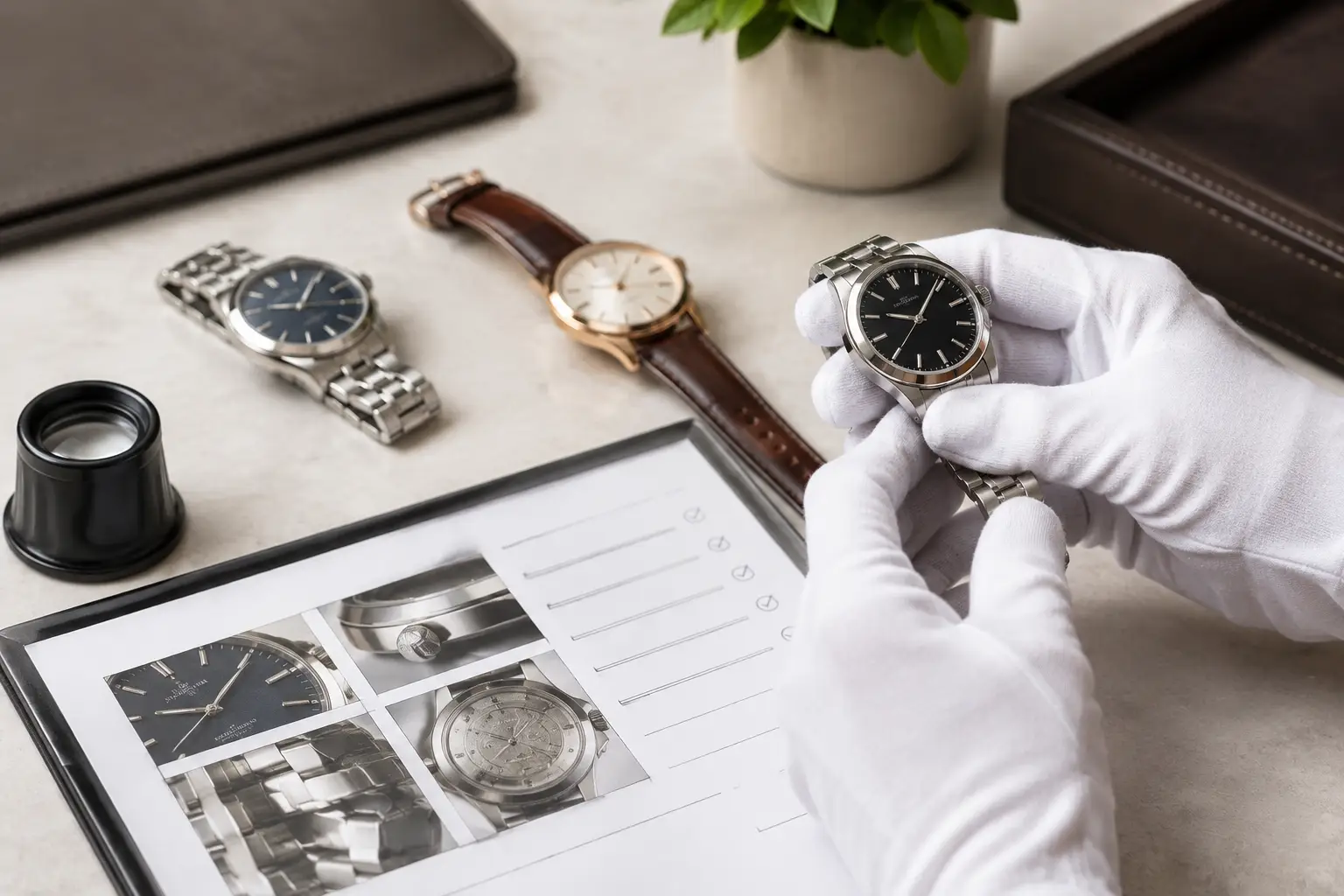
A pre-owned Rolex, Patek Philippe, Audemars Piguet, or Omega can look nearly identical across two listings while carrying meaningfully different condition histories. To compare watch condition reports well, look past broad labels such as “excellent” or “very good.” The details behind those words determine how the watch will wear, how original it remains, and whether the seller’s description gives you a reliable basis for purchase.
Condition is not a single score. It is a record of physical preservation, prior intervention, mechanical health, and completeness. A clear report lets a buyer separate normal use from material compromises before committing to a high-value timepiece.
Compare Watch Condition Reports Beyond the Grade
A condition grade is useful only when the seller explains how it was reached. “Excellent” may mean light signs of wear to one retailer and a refinished case with a replaced crystal to another. Neither description is automatically wrong, but they do not communicate the same thing.
Start by asking whether the report addresses the case, bracelet or strap, dial, hands, crystal, bezel, movement, and included accessories. If it relies on one favorable adjective without component-level observations, it leaves too much for the buyer to infer.
The most useful reports distinguish between cosmetic condition and mechanical condition. A watch can be cosmetically clean yet overdue for service. Conversely, a vintage piece can show honest age while functioning properly after professional maintenance. These are different considerations and should not be blended into one vague assessment.
Originality also deserves its own treatment. An original dial with even patina may be more desirable to a collector than a later replacement dial in perfect visual condition. For a buyer who wants a watch to wear every day, a replacement service component may be entirely acceptable if it is disclosed. The right answer depends on the reference, the era, and your priorities, but disclosure is non-negotiable.
Read the Case and Bracelet Closely
The case profile often reveals more than the headline condition grade. Look for specific commentary on polishing, sharpness of the lugs, bezel edges, caseback engraving, and the definition of any factory finishing. On watches with strong architectural lines, such as many Audemars Piguet Royal Oak references, excess polishing can soften the geometry that gives the design its character.
A polished watch is not necessarily a poor purchase. Many pre-owned watches have been professionally refinished during their lives, and a careful refinish can improve day-to-day presentation. The trade-off is preservation. A report that simply says “light wear” may not tell you whether the watch retains its original case proportions or has had material removed during prior work.
For bracelets, compare stretch, clasp function, link condition, and screw integrity where applicable. Bracelet stretch is particularly relevant on older models with long service histories. It can range from normal articulation to noticeable looseness that affects both appearance and comfort. Clear photos should support the written description, especially around the clasp, end links, and sides of the bracelet.
If the watch is fitted with a leather, rubber, or fabric strap, determine whether it is original, period-correct, or a replacement supplied for wear. A replacement strap can be practical and appropriate, but it should not be presented as original equipment.
Photos Should Confirm, Not Replace, the Report
Photos are evidence, but they have limits. Studio lighting can minimize hairline marks, and a highly reflective crystal can conceal dial details. Ask whether images show the actual watch being sold rather than stock photography, then compare the photos against the written observations.
Useful photographs show the dial straight on, both case sides, the lugs, caseback, clasp, bracelet links, and any visible serial or reference markings when appropriate. Macro images can be valuable, though they can also make minor surface marks appear more dramatic than they are in normal wear. Evaluate both close-up images and full-watch views.
When a report states that the watch is unpolished, photos should show crisp transitions and consistent finishing. When it states that a watch has been refinished, the report should be equally direct. Transparency is more useful than a cosmetic claim designed to sound favorable.
Separate Wear From Damage and Alteration
Not all imperfections carry the same weight. Fine surface marks on a polished case are expected on a worn luxury watch. A chip in a sapphire crystal, deep dent in a lug, moisture-related dial damage, or a bezel insert with significant loss requires more careful consideration.
Compare reports by the specificity of their language. “Minor wear consistent with age” can be credible if supported by photographs and a detailed inspection. It becomes less helpful when it is used to cover a broad range of issues. A disciplined report identifies the location and nature of notable wear rather than asking the buyer to make assumptions.
Be especially attentive to the dial and hands. Originality, lume condition, spotting, discoloration, corrosion, and hand matching can influence collector appeal and historical integrity. On vintage watches, natural aging is not automatically a defect. However, an altered, refinished, or replaced dial should be disclosed clearly because it changes the watch’s identity from a collecting perspective.
Evaluate Movement Condition and Service Information
A visual report alone cannot establish the health of a mechanical watch. The movement should be inspected for proper operation, and the seller should be prepared to explain what level of review or service was completed.
A full service and a functional inspection are not the same. A full service generally involves disassembly, cleaning, lubrication, replacement of worn components as needed, reassembly, and regulation. A functional inspection may confirm that the watch winds, sets, runs, and performs within an observed range without representing that it has received a complete overhaul.
Neither option is inherently better for every buyer. A recently serviced watch may provide added immediate confidence, while an unserviced but accurately described watch may appeal to a collector who prefers to decide how and where work is performed. What matters is that the report does not imply a service history that cannot be supported.
For chronographs, calendars, GMT functions, and other complications, compare whether those features were tested. The date may change properly while the chronograph reset mechanism has not been addressed. Likewise, a watch can keep reasonable time during a brief check yet still have an unknown long-term service interval. Ask for precision about what was inspected and what is warranted.
Compare Completeness and Provenance Separately
Box, papers, tags, manuals, and service documentation can affect the experience of ownership and, in some cases, collector interest. They are not condition in the narrow physical sense, but they belong in a complete purchasing assessment.
Do not let a complete set distract from the watch itself. A watch with papers can still have an overpolished case, replaced components, or mechanical needs. Equally, a watch sold without its original accessories may be an excellent example if its condition, reference details, and authenticity review are properly documented.
Service records can add useful context, particularly when they identify the work performed and the timing of the service. They should be considered supporting evidence, not a substitute for a present-condition inspection. A service performed years ago does not describe the watch’s current performance on its own.
Use Seller Protections as Part of the Comparison
The quality of a condition report matters most when it is paired with accountability. Before purchase, establish who inspected the watch, whether authenticity is addressed, what return period applies, and what warranty coverage is included. These terms are especially relevant when minor details cannot be fully resolved from photos or a written report.
For US buyers, Lume Wrist Watches pairs in-house certification with free insured US shipping, a 30-day return window, and a two-year warranty. Those safeguards do not replace careful review, but they give the buyer a defined process if the watch does not align with the listing or develops a covered mechanical issue.
A seller should also communicate plainly about any exclusions, such as normal cosmetic wear or water resistance expectations for a pre-owned piece. Water resistance can change with age, prior service, seals, and crown condition. Unless a report specifically confirms testing and states the result, avoid assuming that a vintage or previously worn watch is suitable for swimming.
A Better Standard for Comparing Two Listings
When two watches appear similar, compare them in the same order: original components, case integrity, dial and hand condition, bracelet or strap condition, movement review, service disclosure, included accessories, and purchase protections. This prevents one attractive detail, such as a full set or a glossy case, from outweighing a less favorable issue elsewhere.
The strongest condition report is not the one that claims perfection. It is the one that gives you enough precise, supportable information to understand the watch you are buying - including the marks, prior work, and unknowns that remain. That level of clarity is what turns a luxury-watch purchase from a visual impression into a considered decision.