How to Buy a Vintage Omega Seamaster With Confidence
Published October 6, 2026 · Last updated October 14, 2026 · By Lume Wrist Watches Editorial Team
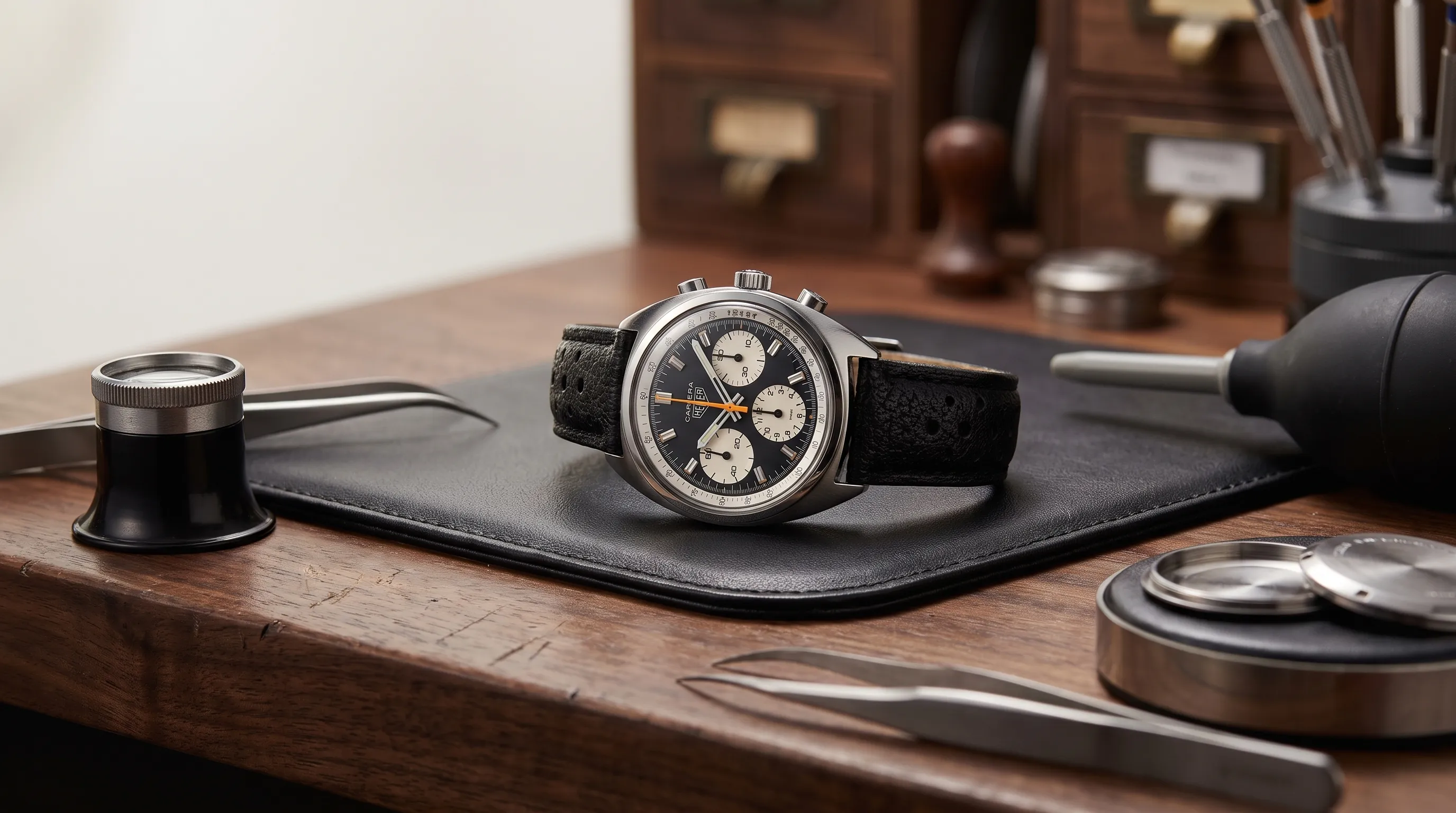
When an “omega seamaster vintage” search turns up a promising watch, verify its case reference, movement and dial before comparing the asking price. Buy only after the seller documents the watch’s condition, service work and return terms.
The Seamaster name covers compact dress watches, chronometer-rated models and purpose-built divers. Your first decision is which kind you want. Your second is whether the particular example has the originality, mechanical condition and fit to justify its price.
Choose the Seamaster family before the individual watch
Omega introduced the Seamaster in 1948. Many early examples look more like dress watches than the modern dive watches associated with the name. They have restrained dials, modest case dimensions and no rotating timing bezel.
That distinction matters. A buyer seeking a discreet watch for office wear should not evaluate a 1950s three-hand Seamaster against a large vintage Seamaster 300 simply because both carry the same name.
The following specifications are reference-level starting points, not confirmation of an individual watch’s configuration.
| Reference family | General period | Approximate case diameter, excluding crown | Movement commonly associated with the reference | Buying focus |
|---|---|---|---|---|
| ------------------ | ---------------- | --------------------------------------------- | ------------------------------------------------ | -------------- |
| 2846 | 1950s | 34mm (1.34 inches) | Automatic calibers 500 or 501, depending on execution | Dial originality, case shape and installed caliber |
| 168.022 | Late 1960s | 36.5mm (1.44 inches) | Automatic chronometer caliber 564 | Dial configuration, date function and case finish |
| 165.024 Seamaster 300 | 1960s | Approximately 41mm (1.61 inches) | Automatic caliber 552 | Bezel, dial, hands and replacement components |
For a compact starting point, examine the photographs and specifications of the Omega Seamaster 2846-1SC. The Omega Seamaster CD168.022 provides another reference to investigate if you prefer a somewhat larger case and a date display.
A vintage Omega Seamaster should be assessed against its own reference and execution. Similar-looking watches can differ materially in movement, case construction and collectibility.
How to read an “omega seamaster vintage” listing
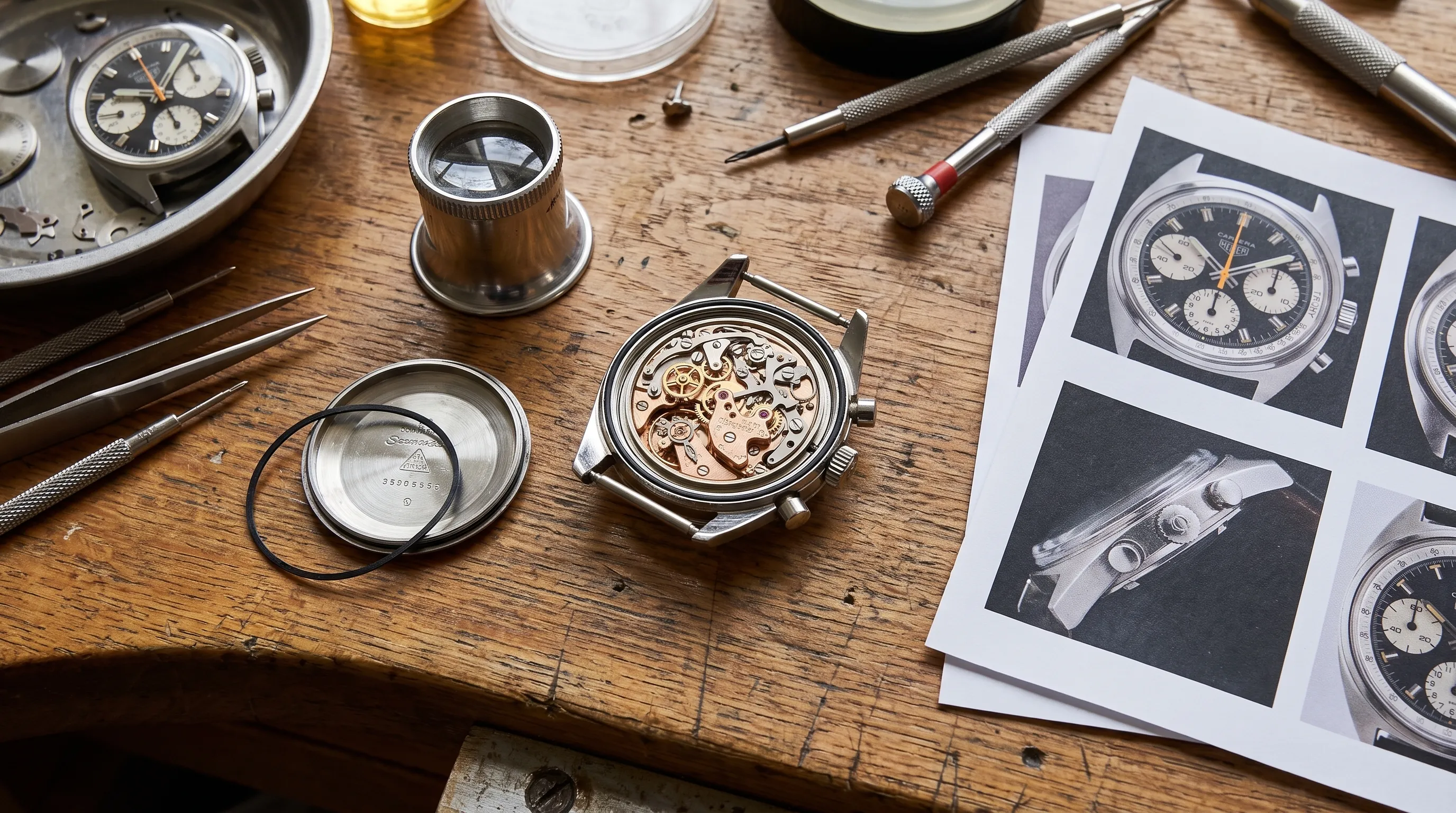
A useful listing identifies the exact watch rather than relying on a model name and an approximate decade. Request photographs of the dial, case sides, lugs, caseback and movement. The inside caseback usually carries the case reference; the movement carries its caliber designation and serial number.
These markings answer different questions. The reference identifies the case design. The caliber identifies the movement type. The movement serial helps estimate production timing, but it is not an exact retail purchase date.
Cross-check the configuration against Omega’s vintage watch database. Allow for legitimate variations, but ask the seller to explain inconsistencies rather than assuming that every difference is harmless.
Do not treat a serial-number chart as proof of originality. A movement can be genuine Omega yet still be inappropriate for the case in which it is installed. A correct caliber also does not establish that the dial and hands are original.
For any vintage Omega Seamaster, the useful question is whether the case, movement and visible components form a coherent, documented example. “Authentic Omega” and “entirely original configuration” are separate claims.
Separate authenticity, originality and condition
Dial and hands
An authentic watch can have a refinished dial. Redialing may improve visual neatness while changing the watch’s historical character. Inspect the lettering, minute track, printing alignment and relationship between the dial furniture and the hands.
Uneven aging is not automatically evidence of a problem. Uniform aging is not proof of originality either. Photographs can reveal reasons to investigate, but a single visual clue rarely settles the question.
Ask directly whether the dial has been refinished, whether luminous material has been replaced and whether the hands are period-correct or later service replacements. Do not scrape, open or disturb old luminous material yourself.
Case and replacement parts
Polishing can soften lug edges, reduce definition and alter the original finish. Look at both sides of the case and compare their shapes. A bright surface is less informative than clear geometry.
Replacement crowns and crystals may be sensible service choices. They should still be disclosed, especially when originality is part of the asking-price rationale. Replaced bezels and dials deserve particular attention on collectible diving references.
When evaluating a vintage Omega Seamaster, decide which compromises you accept before negotiating. A disclosed service crown may suit a daily wearer. A refinished dial may not suit a collection built around original examples.
An Excellent condition grade is not a claim that every component is untouched. Ask what the grade covers and which restoration or replacement work has been performed.
Require service evidence, not just “runs well”
A watch that starts when wound is not necessarily ready for regular use. Ask when it was serviced, who performed the work and what the service included. Useful documentation identifies movement cleaning, lubrication, adjustment and any replaced components.
Request recent timing information where available. Rate, amplitude and beat error can help a watchmaker assess performance, but the readings need context. Test position, state of wind and the correct instrument settings matter. One favorable photograph of a timing machine is not a complete condition report.
Check winding, hand-setting and date operation as applicable. Do not experiment with date-setting shortcuts until you have instructions for the installed caliber. Vintage mechanisms do not all operate the same way.
Treat water resistance as unproven unless there is a recent test and a clear statement of suitability. A Seamaster inscription or historical depth rating does not establish the current condition of its seals.
A serviced vintage Omega Seamaster can be a practical wearer, but it remains an older mechanical object. Plan to protect it from water, impacts and strong magnetic sources rather than treating it like a newly manufactured sports watch.
Check fit before choosing a reference
Case diameter is only part of fit. Lug-to-lug length, thickness, strap width and dial proportions all affect how a watch wears. Ask for measurements of the actual example and a wrist photograph with the wearer’s wrist circumference stated.
A 34mm (1.34-inch) Seamaster may look restrained by current standards. That can be precisely the attraction under a shirt cuff. Try a similarly sized watch before rejecting it or assuming it will suit the recipient of a gift.
If your wrist measures 6.5 inches (approximately 165mm), for example, that measurement helps contextualize a seller’s wrist photograph. It does not establish a universal maximum case size.
Also decide whether you actually want a simple three-hand watch or a chronograph. A Heuer Carrera (73653 N) offers a different vintage collecting direction, while the distinctive case of the TAG Heuer Monaco Chronograph (CBL2180.FC6497) provides a useful contrast in wearing style. Neither is a price comparable for a Seamaster.
Compare the whole purchase, not just the price
Compare examples with the same reference, case material and broadly similar originality. A polished watch with a refinished dial is not equivalent to an example retaining its original dial and stronger case definition.
Use live prices and documented transaction evidence where available. An asking price records what a seller wants, not what a buyer paid. Broad price ranges can conceal differences that matter more than the apparent saving.
| ----------------- | --------------------- | ------------------------------- |
|---|
When budgeting for a vintage Omega Seamaster, include any immediate strap replacement, unresolved maintenance and applicable taxes. Obtain an estimate for known work before buying rather than assigning a generic service allowance.
Original boxes and papers can add context. They do not override evidence from the watch itself, and their absence does not automatically make an older Seamaster unsuitable. Buy for wearing enjoyment and collecting interest, not an assumed financial return.
Get the seller’s commitments in writing
Before paying, confirm that the invoice identifies the reference and the exact watch. Keep copies of the listing photographs and written disclosures. Ask how the return period starts, what condition requirements apply and whether any charges are excluded from a refund.
A warranty needs similar scrutiny. Confirm what it covers, how service is arranged and whether water damage, accidental damage or particular vintage components are excluded. Authentication, servicing and warranty coverage answer different questions.
Lume Wrist Watches is an independent retailer, not an authorized Omega dealer. Its inventory is listed in Excellent condition, certified authentic by Watch CSA and serviced before shipping. Lume provides a 30-day return guarantee and two-year warranty coverage; request the applicable terms before completing a purchase.
Shipping is free and insured within the United States. International shipping is available on request and quote. Confirm delivery arrangements and any required signature, particularly for a gift.
For a vintage Omega Seamaster, confidence comes from specific evidence and clear responsibilities. Certification supports authenticity. Component disclosure addresses originality. Service records and written terms help establish what happens after delivery.
Frequently asked questions
Is every vintage Seamaster a dive watch? No. Many early Seamasters are compact, dress-oriented watches. The model name alone does not identify a diving reference or establish present-day water resistance.
Should I avoid a watch with a replacement crown or crystal? Not necessarily. These can be practical service replacements. Ask whether they are appropriate for the reference and decide how much originality matters to your purchase.
Are box and papers necessary? No. They can support provenance when they belong to the watch, but they do not replace inspection. Reference consistency, component disclosure and mechanical condition remain central.
Can I wear a vintage Seamaster every day? Potentially, if its condition and service history support regular use. Follow the seller’s operating instructions and avoid water unless recent testing and explicit guidance establish suitability.
Compare the exact watch before committing
Explore Lume’s authenticated pre-owned watch collection, then request the photographs, measurements and component disclosures for any Seamaster you are considering. A clear answer about the individual watch is more valuable than a broad assurance about the model.
## Part of the series This article belongs to our complete guide: Omega Watches: Complete 2026 Buying Guide.\n