Vintage Rolex GMT-Master Details for Collectors
Published August 10, 2026 · Last updated October 21, 2026 · By Lume Wrist Watches
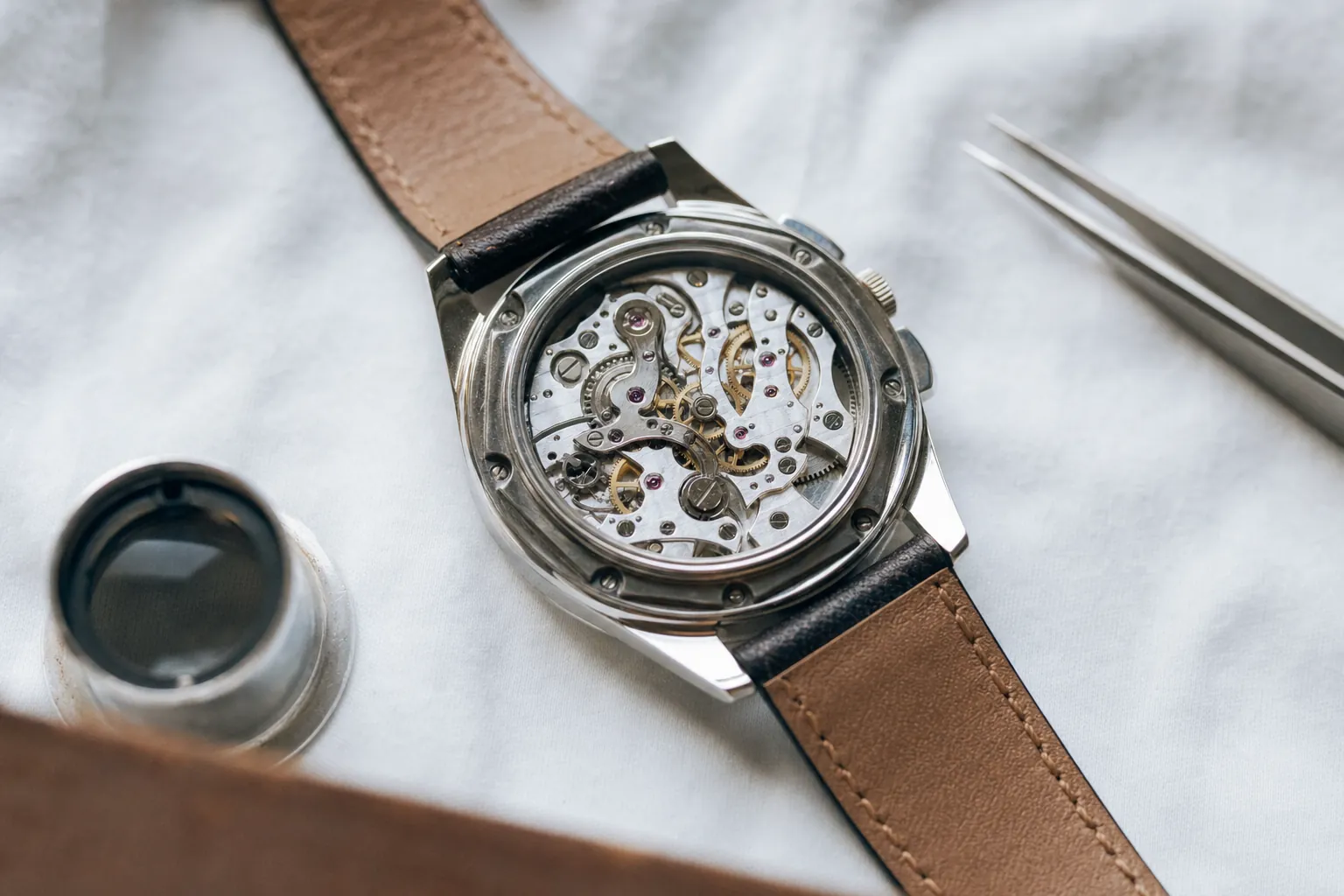
Understanding the micro-details of vintage Rolex sports watches requires a meticulous eye for evolving component architecture and production nuances. For collectors studying classic pilot tool watches, cataloging the interplay between dial textures, metal finishing, and movement variations forms the foundation of proper connoisseurship. Navigating the world of vintage Rolex GMT-Master dial variations and hardware specifications reveals how incremental manufacturing adjustments defined an entire era of functional watchmaking.
Deciphering Matte and Gilt Dial Iterations
The dial is the primary focal point when categorizing classic dual-time references. Rolex transitioned production techniques across the 1950s, 1960s, and 1970s, producing distinct eras characterized first by high-gloss galvanic surfaces and subsequently by utilitarian matte finishes.
Gilt-Gloss Generations: Chapter Ring and Open Track
Early production references—predominantly reference 6542 and early reference 1675 models produced up to approximately 1966—featured gilt dials. These dials were produced using a galvanic printing process. Instead of printing the text directly onto a painted black surface, the brass dial blank was polished, chemical resist was applied to designate the lettering and hour markers, and a black lacquer coating was applied to the negative space. The golden text and minute divisions are exposed brass visible through the lacquer.
Collectors separate gilt dials into two primary categories: chapter ring and non-chapter ring (open track). Chapter ring dials feature a closed outer circumference connecting all minute hash marks. This design was phased out around 1964. Post-1964 gilt dials display an open minute track where individual minute indices extend toward the dial edge without an interconnecting ring.
During these early runs, Rolex also integrated subtle visual markers to denote changes in luminous compound formulations: Exclamation Point Dials (circa 1962): A small luminous dot applied directly beneath the six o'clock baton marker signified falling radiation levels in the luminous compound. Underline Dials (circa 1963–1964): A small, pad-printed silver or white horizontal line beneath the upper or lower dial text signaled the formal industry shift from radium to lower-emission tritium luminous paint.
Matte Dial Classifications: Mark I Through Mark V
Around 1966, Rolex transitioned from gilt-gloss dials to matte black dials with pad-printed white text. Within the reference 1675 production run, collectors categorize these matte surfaces into recognized configurations, commonly spanning Mark I through Mark V. Exploring the nuances across these references is a cornerstone of any detailed buying guide for vintage tool watches.
The Mark I dial (circa 1967–1972) is easily recognized by its "Long E" typography. On these dials, the central horizontal bar of the "E" in "ROLEX" shares the same length as the top and bottom bars, rather than being shorter.
Subsequent matte dial variations reveal clear typographical shifts: Mark II: Characterized by serif details on the depth rating and model signature, with the coronet appearing broader and slightly flatter. Mark III ("Radial Dial"): Produced primarily in the late 1970s (mid-5-million serial range), featuring smaller circular luminous plots set further inward from the outer minute track, creating a noticeably elongated appearance to the minute hash marks. Mark IV: Features standard plot spacing, a distinct coronet with thin, spiky fingers, and crisply defined serifs on the "GMT-MASTER" text. Mark V: The final standard matte production run for reference 1675, marked by an open, rounded coronet and subtle changes to the font weighting within the "Superlative Chronometer Officially Certified" lines.
Bakelite, Aluminum, and Color-Faded Bezel Inserts
The bidirectionally rotating 24-hour bezel is the most unmistakable visual element of the GMT-Master. Its physical evolution mirrors developments in material durability and ultraviolet resistance throughout the mid-20th century.
``` +--------------------+-----------------------+------------------------------------------+ | Bezel Material | Approximate Era | Key Identifying Characteristics | +--------------------+-----------------------+------------------------------------------+ | Bakelite | 1954–1956 | Radium numerals embedded under acrylic | | "Fat Font" Red-Back| Early 1960s–Early '70s| Wide numeral strokes; raw red anodized back| | Fuchsia / Magenta | Late 1960s–Early '70s | Chemical shift of red half to purple/pink| | "Thin Font" Blue-Back| Mid-1970s–1980s | Narrow typography; bright blue back coat | +--------------------+-----------------------+------------------------------------------+ ```
From Bakelite to Anodized Aluminum
The earliest GMT-Master, reference 6542, carried an insert molded from luminous Bakelite (an early thermosetting synthetic resin, often reinforced with an acrylic base). The radium-infused numerals were painted on the underside of the clear resin ring, allowing them to glow through the insert in low-light flight conditions. However, the rigidity and brittle nature of the material made it prone to cracking under direct impact or temperature changes.
In response, Rolex replaced the Bakelite bezel around 1956 with a stamped aluminum insert. The numerals on these aluminum inserts were chemical-etched or printed, and the metal was anodized to seal the surface. The early aluminum variants produced throughout the 1960s are known as "Fat Font" inserts. These feature broad, heavy strokes on the typography, flat-top "4"s, and curved inner profiles on the "8"s and "0"s.
Chemical Aging and Natural Color Alterations
The physical properties of 1960s anodized dyes resulted in diverse aging patterns when exposed to daylight, saltwater, and environmental elements. The original red and blue "Pepsi" insert was designed to delineate daylight and nighttime flight hours. Over decades, specific batches aged in unique ways.
The most famous of these variations is the "Fuchsia" or "Pink" bezel insert. Found primarily on watches produced between roughly 1967 and 1970 (overlapping the 1.6-million to 2.1-million serial range), these inserts were coated with an unstable red dye mixture that contained lower levels of yellow pigment. Over time, sunlight exposure turned the top red half into a vibrant magenta, fuchsia, or violet hue, while the blue half typically remained a rich dark navy.
Later production runs shifted to "thin font" inserts. These feature narrower text strokes and often display blue paint along the inner perimeter of the reverse side (commonly referred to as "Blue-Backs"), contrasting with early inserts that retained a bare or red-anodized reverse face.
Crown Guard Evolutions: From Elcorn to Pointed Guards
The introduction of crown guards remains one of the clearest visual milestones in the history of vintage Rolex case production. While the original reference 6542 lacked crown guards entirely, Rolex updated the case profile with the launch of reference 1675 in 1959.
``` 6542 (No Guards) ──► Square Guards (1959) ──► Elcorn/Eagle Beak ──► PCG (Cornino) ──► Rounded Guards ```
Square and Elcorn Guards
The earliest 1675 cases, manufactured in late 1959, featured thick, square crown guards. These squared walls extended fully to protect the winding crown, but their angular profile made gripping and turning the crown difficult for pilots wearing flight gloves. Very few square crown guard examples were produced before Rolex redesigned the tooling.
Immediately following the square iteration, Rolex experimented with the "Elcorn" (or "Eagle Beak") profile. On these cases, the tips of the guards were shaved down at a steep angle, tapering sharply toward the crown in a silhouette reminiscent of an eagle's beak.
Pointed Crown Guards (Cornino)
By 1960, the case profile matured into what collectors globally designate as Pointed Crown Guards (PCG), or Cornino ("little horn" in Italian). On a PCG case, the guards slope gradually toward a defined, pointed tip flanking the winding crown.
Rolex utilized PCG cases until approximately 1963 or 1964 (up to roughly the 1.0-million serial threshold). By 1964, tooling was revised once more to create symmetrical, rounded crown guards. This rounded architecture remained the visual standard for stainless-steel GMT-Master cases for the rest of the reference 1675 production run, extending through the late 1970s.
Assessing Factory Lug Chamfers and Case Polishing
The geometry of a vintage GMT-Master case is a key detail when examining any vintage timepiece in the watch shop. From the factory, Rolex applied distinct finishing techniques that created sharp transitions between the polished and brushed planes of the case.
Factory Bevels Versus Reworked Metal
Original factory cases featured wide, crisp chamfers (often referred to as bevels) running the entire length of the top outer edge of each lug. This edge acted as a dynamic transition between the brushed satin top of the lug and the high-polish mirror finish of the case flank.
When evaluating these edges, collectors examine several specific traits: Bevel Width: Original factory chamfers on references like the 1675 were broad and uniform, widening slightly as they met the lug tips. Crispness of the Transition: An unpolished or minimally polished case displays a distinct, razor-sharp ridge line separating the brushed grain from the beveled plane. * Top-Surface Grain: The factory applied an angled, linear satin brushing that moves slightly diagonal to the case body.
Over decades of wear, routine servicing often involved polishing wheels that softened these sharp intersections. Repeated metal removal rounds the crisp transitional ridge, thins the outer profile of the lugs, and creates a soft, rounded slope rather than an intentional, flat chamfer.
Lug Hole Integrity and Spring Bar Seating
Another critical area of inspection is the drilled lug holes. Factory holes were drilled cleanly with crisp, sharp edges at the outer surface of the case flank.
On over-polished cases, the exterior metal of the lug is worn down, causing the lug holes to sit dangerously close to the outer edge of the lug chamfer. In extreme instances, excessive polishing creates "cratered" holes, where the surrounding steel sinks inward, or allows the tips of the spring bars to protrude past the plane of the case flank.
Period-Correct Movements: Calibers 1036, 1065, 1565, and 1575
The mechanical development of the GMT-Master evolved in tandem with Rolex’s automated movements. Understanding the calibers housed within early references clarifies how Rolex approached dual-time functionality.
The 1000-Series Calibers
The earliest reference 6542 models relied on movements derived from the base caliber 1030 architecture: Caliber 1036: Installed in the initial batches of reference 6542, beating at 18,000 vibrations per hour (vph) and powered by a bidirectional "butterfly" rotor. Calibers 1065 and 1066: Minor technical iterations that introduced improved balance wheel assemblies and reverser wheels, also operating at 18,000 vph.
In all 1000-series GMT calibers, the 24-hour hand was mechanically geared directly to the 12-hour movement wheel in a 1:2 ratio. The 24-hour hand could not be adjusted independently; tracking an alternate time zone required rotating the external bezel to align with the fixed 24-hour hand.
The 1500-Series Workhorses
With the introduction of reference 1675, Rolex upgraded the movement to the modern 1500 family: Caliber 1565 (often marked "1560" on the bridge): Standard in the 1675 from 1959 through roughly 1965. It operated at 18,000 vph, featured a free-sprung Microstella balance, and utilized a date mechanism that snapped instantaneously at midnight. Caliber 1575 (often marked "1570" on the bridge): Introduced around 1965, this movement increased the operating frequency to 19,800 vph, offering greater rate stability.
Around 1971 to 1972 (approximately the 3.0-million serial range), Rolex introduced a stop-seconds ("hacking") mechanism to Caliber 1575. This modification enabled the balance wheel to halt when the winding crown was pulled out to the time-setting position, allowing pilots and navigators to synchronize their seconds hand precisely to a reference signal.
Oyster versus Jubilee: Matching Period Bracelets
The GMT-Master was delivered on either Oyster or Jubilee bracelets, depending on customer preference and intended use. Ensuring that the bracelet construction matches the watch's production year is essential for evaluating historical consistency.
Oyster Evolution: Riveted, Folded, and Solid Links
Early GMT-Masters utilized riveted Oyster bracelets. European-market watches typically featured Swiss-made reference 7206 bracelets (or the expanding reference 6636), which utilized hollow links enclosed by visible lateral rivets, paired with 80 end links (and later 58 end links for PCG and early standard cases). Watches sold in the American market were often fitted with domestically produced C&I rivet bracelets, which bore separate date codes stamped inside the clasp blades.
By the late 1960s, Rolex shifted to folded-link Oyster bracelets: Reference 7836: Constructed from folded sheets of stainless steel rather than hollow pinned blocks, paired with 280 or 380 end links. Reference 78360: Introduced in the late 1970s, this bracelet introduced heavy, solid outer and center links, using 580 end links to sit flush against the 20mm case lugs.
Jubilee Options and Fitted End Links
Rolex also offered the GMT-Master on the dressier five-link Jubilee bracelet, an option that became popular among commercial airline crews.
Early Jubilee variants were folded-link designs, such as the reference 6251H, paired with 55 end pieces. In the mid-to-late 1970s, this configuration was replaced by the solid-link reference 62510H.
When paired with a GMT-Master, a 62510H Jubilee bracelet features a dedicated "50" stamp on the last link beneath the end piece. This stamp confirms that the link was bored out to accommodate the thicker 2.0mm spring bars required by sports cases, rather than the standard 1.8mm spring bars used on Datejust models.
Frequently Asked Questions
### What defines a pointed crown guard case on a reference 1675? A pointed crown guard (PCG) case features crown-protecting shoulders that taper into slender, horn-like points on either side of the winding crown. Used between roughly 1960 and 1964, these cases are often referred to as Cornino by collectors. They represent the transitional design phase between early square or "Elcorn" guards and the later symmetrical rounded guards.
### How do collectors identify an authentic Fuchsia bezel insert? An authentic Fuchsia bezel features an anodized aluminum insert from the late 1960s where the red upper half has chemically altered into a distinctive magenta or pinkish-purple hue. The typography on these inserts exhibits the heavy "Fat Font" serifs characteristic of period-correct components. Additionally, authentic examples typically show matching aging across the dark blue portion and retain a clean, non-artificial gradient.
### What distinguishes a radial dial on a vintage GMT-Master? A radial dial, categorized as a Mark III matte variation from the late 1970s, is distinguished by its unique hour plot placement. The circular luminous markers are smaller than standard plots and are positioned noticeably closer toward the center of the dial. This increased distance between the plots and the outer perimeter gives the printed minute hash marks an unusually long, elongated visual presence.
### Which Rolex movements feature the early coupled 24-hour hand? Calibers 1036, 1065, 1066, 1565, and 1575 all feature a coupled 24-hour hand that is mechanically geared directly to the 12-hour wheel. This hand continuously moves around the dial once every 24 hours in sync with the primary time-telling hands. Setting a secondary time zone on watches with these calibers requires turning the bidirectionally rotating bezel rather than jumping the hand independently.
### Why are original Bakelite bezels on reference 6542 so fragile? Original reference 6542 bezels were crafted from an acrylic and Bakelite resin compound that lacked modern stabilizers and impact-resistant polymers. The thin, hollowed-out construction required to house luminous radium numbers under the surface made the ring brittle. Consequently, the material frequently cracked under normal torsional stress, physical impacts, or thermal fluctuations.