Pre-Owned JLC Reverso Reference Guide
Published August 8, 2026 · Last updated October 21, 2026 · By Lume Wrist Watches
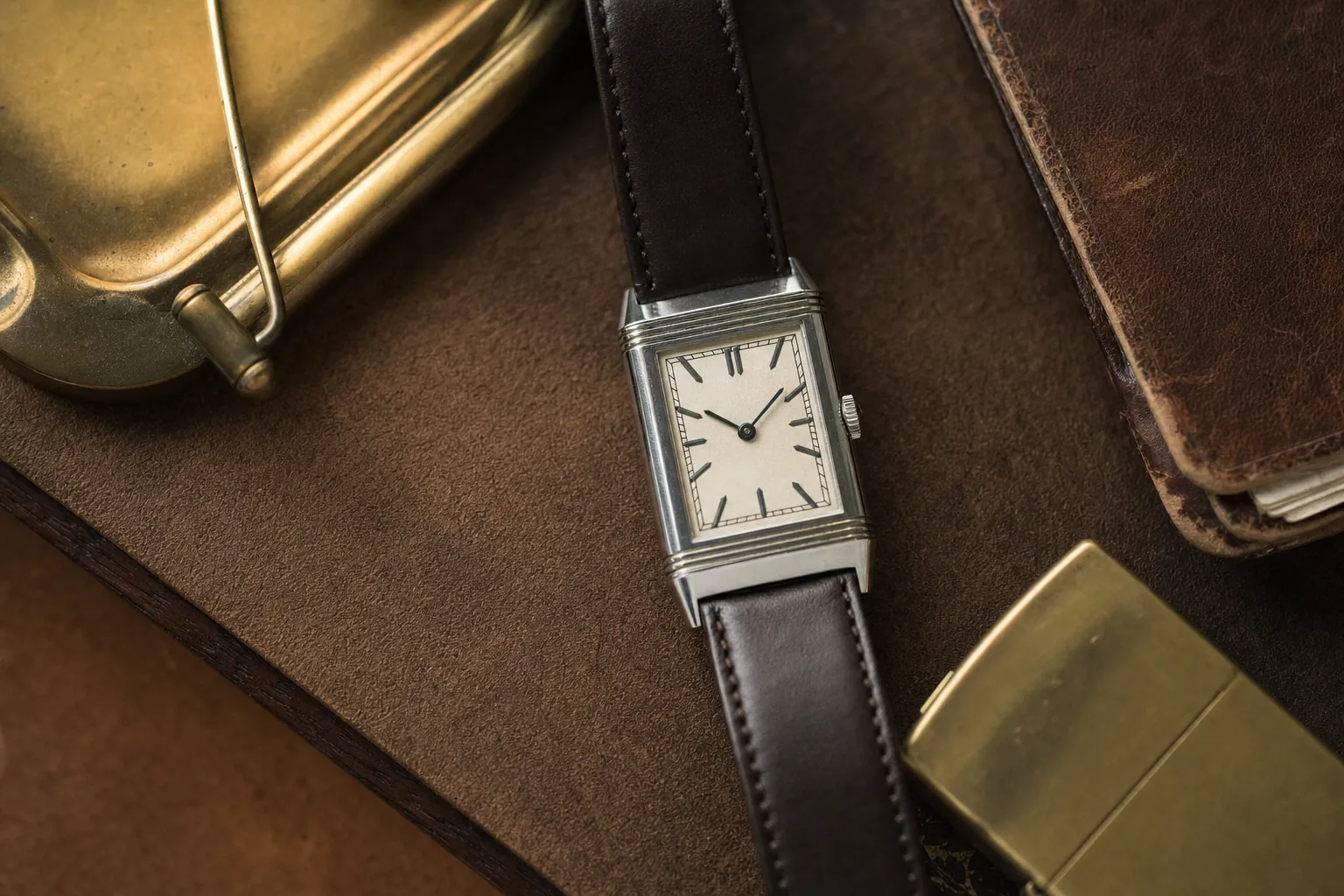
Navigating the landscape of pre-owned Jaeger-LeCoultre Reverso references requires an eye for subtle geometric proportions, mechanical milestones, and case architectures developed across several decades. The period spanning the early 1980s through the late 2000s represents a distinctive era of production, during which the manufacture modernized its swiveling case construction and introduced some of its finest shaped calibers. For discerning collectors, understanding these neo-vintage and discontinued references is the key to finding a well-preserved timepiece that balances historical design with everyday wearability.
Defining the Neo-Vintage Reverso Era
The neo-vintage era of the Reverso broadly begins in the mid-1980s and extends into the late 2000s. Prior to this period, earlier mid-century Reversos featured cases that were susceptible to dust and moisture ingress, often relying on delicate friction fits. In the early 1980s, Jaeger-LeCoultre engineer Daniel Wild redesigned the case architecture from the ground up, introducing a modern multi-part assembly with synthetic seals, spring-loaded ball bearings, and sapphire crystals.
This technical overhaul laid the groundwork for an extraordinary creative resurgence. Between 1985 and 2005, Jaeger-LeCoultre used the Reverso as a showcase for its technical prowess, creating watches that remained strictly mechanical, meticulously hand-finished, and true to classical proportions.
Modern Usability Meets Classic Geometry
Neo-vintage Reversos represent a compelling sweet spot for collectors studying our buying guide. Unlike true vintage models from the 1930s through the 1950s, watches from this era feature modern water-resistant gaskets (typically rated to 30 meters), scratch-resistant sapphire crystals, and robust movement components for which spare parts are still accessible.
At the same time, they predate the oversized case trends of the late 2000s and 2010s. The dials from this period are predominantly finished with traditional silvered guilloché, pad-printed Art Deco Arabic numerals, and heat-blued steel hands. They maintain a sense of restrained elegance that wears seamlessly under a dress cuff.
``` 1980s Case Redesign ──> Introduction of Calibre 822 (1991) ──> Expansion of Complications (Late 1990s) (Modern water-seals) (Standardized rectangular base) (Sun Moon, Memory, Chronographs) ```
Case Sizes Compared: Classique vs. Grande Taille
Understanding the nomenclature and case proportions is essential when browsing pre-owned Jaeger-LeCoultre Reverso references. During the neo-vintage era, two primary case architectures dominated the manual-wind men's catalogue: the Classique and the Grande Taille. Because rectangular watches wear significantly larger than round watches of equivalent diameter, comparing lug-to-lug measurements is critical.
| Case Model | Typical Reference Prefix | Length (Lug-to-Lug) | Width (Excl. Crown) | Thickness | Lug Width |
|---|---|---|---|---|---|
| :--- | :--- | :--- | :--- | :--- | :--- |
| Reverso Classique | Ref. 250.x.xx / 252.x.xx | 38.5 mm | 23.0 mm | 7.1 mm | 17 mm |
| Reverso Grande Taille | Ref. 270.x.xx / 272.x.xx | 42.2 mm | 26.0 mm | 9.5 mm | 19 mm |
| Reverso Gran Sport | Ref. 290.x.xx / 295.x.xx | 43.5 mm | 27.0 mm | 10.5 mm | Integrated |
Proportions of the Reverso Classique
The Reverso Classique retains proportions that mirror mid-century models. Measuring roughly 38.5 mm from lug tip to lug tip and only 23 mm wide, it features an ultra-thin profile near 7 mm. On wrists measuring 6.5 inches or smaller, the Classique offers an authentic vintage presence.
The reference numbers generally begin with 250 (such as Ref. 250.8.86 in stainless steel), typically housing either the manual-wind Calibre 846 or the ultra-thin Calibre 839. A quartz variant, often under reference 252.x.xx, was also produced in volume during the late 1980s and 1990s.
Proportions of the Reverso Grande Taille
Introduced in 1991 to commemorate the 60th anniversary of the model, the Grande Taille (reference series 270.x.xx) expanded the case dimensions to accommodate contemporary tastes without sacrificing its classical Art Deco aspect ratio. At 42.2 mm lug-to-lug and 26 mm across, the Grande Taille creates a flatter, broader footprint on the wrist.
The added case height accommodates thicker movements, including the revered Calibre 822 and various modular complications. For wrists measuring 6.75 inches and above, the Grande Taille has long served as the benchmark proportions for a modern dress watch.
``` Classique: [ 23 mm ] x 38.5 mm L2L (Calibre 846 / 839) Grande Taille:[ 26 mm ] x 42.2 mm L2L (Calibre 822) ```
Calibre 822: The Standard in Rectangular Movements
A major point of distinction in pre-owned Jaeger-LeCoultre Reverso references is whether the watch contains a round movement adapted for a rectangular case, or a dedicated "form" movement shaped specifically to the case interior. Jaeger-LeCoultre is celebrated for the latter, and Calibre 822 stands as the definitive rectangular movement of the modern era.
Mechanical Architecture and Specifications
Introduced in 1991 alongside the Grande Taille case, Calibre 822 was designed entirely in-house by Jaeger-LeCoultre. Unlike mass-market rectangular watches that rely on round base calibers housed inside metal movement holders, Calibre 822 is a tonneau-shaped, manually wound engine engineered to maximize the interior volume of the Reverso chassis.
- Dimensions: 22.6 mm long by 17.2 mm wide; 3.15 mm thick
- Jewel Count: 21 jewels
- Operating Frequency: 21,600 vibrations per hour (3 Hz)
- Power Reserve: Approximately 45 hours
- Regulation: Kif shock protection with a flat balance spring
Longevity and Serviceability
Calibre 822 has remained in continuous production for decades because of its robust architecture. The relatively low beat rate of 21,600 vph decreases long-term wear on the pallet fork and escape wheel teeth. The movement uses traditional bridge architecture rather than a single plate, allowing watchmakers clear access when disassembling the wheel train during an overhaul.
For collectors exploring the shop for mechanical longevity, Calibre 822 represents an exceptional standard of industrial watchmaking. Its generous surface area displays Côtes de Genève stripes, circular graining (perlage) on the baseplate, and chamfered bridge edges.
Notable References: Sun Moon, Memory, and Gran Sport
The late 1990s and early 2000s saw Jaeger-LeCoultre explore high complications, sports designs, and distinct dial architectures within the swiveling case format. Three discontinued references illustrate the creative versatility of this era.
Reverso Sun Moon (Ref. 270.2.63 / 270.3.63)
Produced in the late 1990s and early 2000s, the Reverso Sun Moon is one of the most expressive complicated Reversos ever designed. Housed in the Grande Taille case, it is powered by the manual-wind Calibre 873.
The dial layout provides balanced asymmetry: A running day/night indicator sits between 1 and 3 o'clock. A moonphase subdial integrated with small seconds is located at 6 o'clock. * An 8-day power reserve indicator is situated at 11 o'clock.
The reverse side of the Sun Moon features a sapphire display caseback rather than a solid steel surface, showcasing the finely decorated movement plates, jewels, and twin spring barrels. It was offered primarily in 18k yellow gold (Ref. 270.2.63) and 18k white gold (Ref. 270.3.63), with a very small run in pink gold.
Reverso Memory (Ref. 255.8.82)
The Reverso Memory, introduced in 1998, utilized the smaller Classique case dimensions to house a remarkably clever mechanical complication: a mono-face flyback 60-minute register. Powered by the manual-wind Calibre 862, the front dial displays the standard running hours and minutes against a traditional silvered guilloché dial with blued hands.
When the case is flipped, the reverse reveals a starkly contrasting black dial with a central 60-minute counter and a continuous sweeping second hand. A pusher located at the top right of the swiveling carriage allows the user to reset the 60-minute counter back to zero instantly. Unlike the Duoface models—which track a second time zone across two faces—the Memory relies on a single time-zone movement driving a dedicated timing complication on the reverse.
Reverso Gran Sport (Ref. 290.8.60)
In 1998, Jaeger-LeCoultre released the Gran Sport to take the Reverso back to its active sports-watch origins. This discontinued model broke traditional design conventions:
- Case Construction: A curvier, ergonomically arched case profile measuring 43.5 mm by 27 mm.
- Water Resistance: Increased to 50 meters, aided by an engineered crown seal and secure case cradle locks.
- Movement: The automatic Calibre 960R, beating at 28,800 vph, complete with a date display at 6 o'clock.
- Strap / Bracelet: Factory options included a heavy-link steel bracelet with a micro-adjusting butterfly clasp or a grooved rubber strap with a deployant buckle.
The Gran Sport represents a distinctive late-1990s aesthetic that diverged from dress conventions while preserving the mechanical integrity of the swiveling carriage.
Evaluating Case Backs and Factory Engravings
Because the solid metal reverse of a single-dial Reverso was originally conceived to accept monograms, family crests, or commemorative inscriptions, evaluating case backs is a critical stage in the assessment of pre-owned Jaeger-LeCoultre Reverso references.
``` Case Back Styles: ├── Factory Blank: Flat, brushed, or mirror-polished; unadorned ├── Factory Inscribed: Commemorative releases, limited editions, or lacquer/enamel art └── Aftermarket Monogrammed: Hand-cut or laser-etched by previous owners ```
Blank vs. Personalized Canvases
Many pre-owned examples feature pristine, unblemished case backs, having left the factory with a high-polish finish. These clean canvases allow the next owner to commission their own bespoke engraving or leave the metal in its original state.
Conversely, a significant portion of pre-owned watches bear personalized initials, dates, or custom artwork. An engraving does not inherently diminish the mechanical integrity of the piece, but it does alter the aesthetic appeal depending on your preferences. Factory-commissioned enamel work or original limited-edition engravings, such as those commemorating historic polo clubs or regional anniversaries, are distinct from personal family monograms and should be cataloged carefully.
The Dangers of Inappropriate Polishing
A common issue in pre-owned Reverso models is aggressive metal removal. In an effort to erase an aftermarket engraving, an inexperienced polisher may grind down the flat plane of the case back.
This process often causes: Warped or uneven reflection across the flat reverse. Softened edges along the horizontal fluting (the three iconic horizontal grooves at the top and bottom of the case). * Faint or completely obliterated factory stamps, including the reference number, metal purity hallmarks, serial numbers, and the Jaeger-LeCoultre signature.
When evaluating a case back, inspect the crispness of the three horizontal gadroons and verify that the stamped factory lettering exhibits sharp vertical walls rather than polished, washed-out fonts.
Inspection Checklist for Pre-Owned Reverso Models
A systematic evaluation ensures that both the aesthetic and mechanical components of a pre-owned Reverso operate within original factory specifications. Use this checklist during your inspection:
1. Carriage and Slide Operation Depress the swiveling case gently to slide it along its track. The movement should be smooth, with uniform friction throughout the horizontal travel. Inspect the small spring-loaded ball bearings set into the case chassis. They should retract cleanly and snap into their detents without excessive force. * Verify that the case does not wobble or sit crookedly inside the base carrier once locked into position.
2. Baseplate / Carrier Condition Examine the internal carrier base (the flat surface visible only when the watch case is flipped). Factory finishing typically consists of circular graining (perlage). Look for deep scoring, scratching, or brassing (on gold-plated or base metal pieces), which occurs if dirt or grit becomes trapped between the swiveling case and the cradle.
3. Dial and Hand Alignment Inspect the silvered dial under magnification for signs of moisture damage, such as bubbling lacquer, spotting, or tarnishing around the minute track. Check the blued steel hands for scratches from previous service interventions or oxidation of the chemical bluing. * Confirm that the hands clear the dial markers cleanly, particularly on multi-hand variants like the Sun Moon.
4. Winding Crown and Setting Friction On manual-wind references (Calibres 846, 822, 873), wind the crown fully to gauge mainspring resistance. The winding should feel consistent and firm, terminating in a definitive stop without slippage. Check for stem wobble. Because the crown sits flush against the swiveling carriage, bent winding stems are relatively common if the watch experienced a drop with the carriage pushed open.
Frequently Asked Questions
### What is the case size difference between the Classique and Grande Taille? The Reverso Classique measures approximately 38.5 mm lug-to-lug by 23 mm wide, with a thickness of roughly 7.1 mm. The Reverso Grande Taille expands these dimensions to approximately 42.2 mm lug-to-lug by 26 mm wide, with a thickness of about 9.5 mm. On the wrist, the Classique offers a strictly traditional profile, while the Grande Taille provides a broader presence suited to modern preferences.
### Which movement powers the Reverso Grande Taille? The standard manual-wind Reverso Grande Taille is powered by the in-house Jaeger-LeCoultre Calibre 822. Introduced in 1991, this rectangular form movement operates at 21,600 vibrations per hour and offers a power reserve of approximately 45 hours. Its shaped baseplate and bridge layout are engineered specifically to match the internal geometry of the Grande Taille case.
### Can a pre-owned Reverso with an engraved caseback be polished clean? While light surface etchings can sometimes be polished out, deep monograms cannot be removed without shaving away significant amounts of metal. Aggressive polishing flattens the case geometry, softens the crisp gadroons, and risks erasing serial numbers and factory hallmarks. If an engraving is deep, laser welding to add material followed by precise lapping is required to preserve the original case contours.
### What should you look for when inspecting a pre-owned Reverso slide mechanism? Inspect the track for smooth horizontal transit, ensuring no grit causes binding or deep scratches on the interior circular graining (perlage) of the cradle. Check that the spring-loaded ball bearings deploy correctly and provide a firm click when locking the case into the closed position. Finally, check for lateral play or looseness when the case is locked, which indicates worn chassis components.