What a Luxury Watch Authenticity Certificate Proves
Published August 21, 2026 · Last updated October 17, 2026 · By Lume Wrist Watches Editorial Team
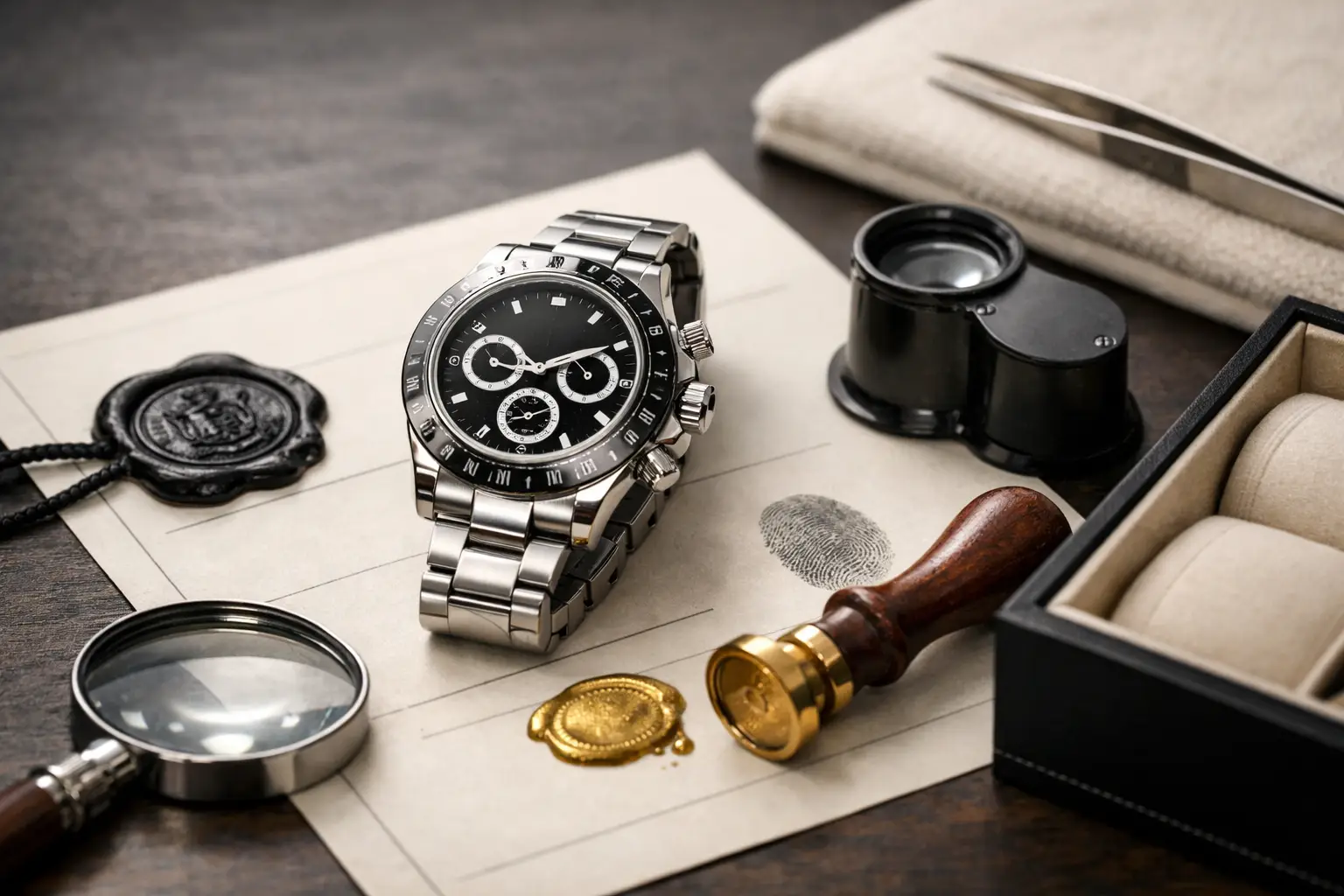
A luxury watch authenticity certificate is not a decorative add-on to a high-value purchase. It is the seller’s written accountability for what was examined, what was found, and what the buyer can reasonably rely on after delivery. For a Rolex, Patek Philippe, Audemars Piguet, Omega, or another established luxury brand, that documentation can materially affect buyer confidence, future service conversations, and resale transparency.
The certificate alone should never be treated as proof without context. Its value depends on the quality of the inspection behind it, the identity of the business issuing it, and the purchase protections that support the transaction. A credible seller pairs authentication with clear condition disclosure, insured shipping, a defined return policy, and warranty coverage.
What an Authenticity Certificate Should Establish
At its most useful, an authenticity certificate confirms that a watch has been examined and represented as an authentic example of its stated brand and reference. It should connect the physical watch to the listing through identifiable details, rather than relying on generic language such as “verified authentic.”
For collectible watches, the strongest documentation typically identifies the manufacturer, model or reference, serial number where appropriate, case material, dial configuration, bracelet or strap, and included accessories. The goal is not simply to state that a watch is genuine. It is to make clear which watch was evaluated and how it was described at the time of sale.
A certificate may also record the watch’s condition. This matters because authenticity and condition are separate questions. A genuine vintage Rolex may have a later service dial, a replacement bracelet, or signs of polishing. A genuine modern Patek Philippe may have complete factory accessories but still show wear on the clasp. These details do not automatically make a watch unsuitable to buy. They do affect how precisely the piece should be represented.
The most useful certificate is therefore specific. It gives the buyer a record that can be retained with the invoice, service documentation, photographs, and any original brand paperwork.
Original Papers and a Luxury Watch Authenticity Certificate
Original papers and an independent or in-house certificate serve different purposes. Brand-issued warranty cards, certificates of origin, archival extracts, and purchase records can support provenance. They may confirm an original sale date, reference, serial number, or retailer relationship. For many collectors, complete original documentation is an important part of a watch’s appeal.
However, original papers are not a substitute for a current inspection. Documents can be incomplete, mismatched, altered, or separated from the watch over decades of ownership. A watch can also be authentic without its original box or papers, particularly when discussing older references or estate acquisitions.
That is where a current authentication certificate becomes relevant. It addresses the watch being sold now, in its current configuration and condition. A responsible review considers the case, dial, hands, movement, bracelet, clasp, engravings, serial and reference markings, and other brand-specific characteristics. The depth of that review varies by model, age, and accessibility of the components, but the seller should be prepared to stand behind the conclusion.
For a buyer, the practical question is not whether one document is inherently better than another. It is whether the documentation, the watch itself, and the seller’s representation all agree.
How In-House Authentication Works
In-house certification should be a disciplined process, not a label applied at the end of a listing. A proper evaluation begins by matching the watch to its stated reference and examining the external details that define it. Case proportions, bezel construction, dial printing, handset, crown, crystal, bracelet codes, clasp markings, and engravings can all provide relevant evidence.
The movement is equally important when inspection is appropriate for the model. Its architecture, finishing, caliber designation, serial conventions, and component layout must align with the watch being represented. High-end brands often use features that require experienced handling and reference knowledge to assess accurately.
Authentication also involves separating acceptable period-correct variation from a material discrepancy. Vintage watches require particular care. Luminous material can age unevenly. Bezels and bracelets may have been replaced during decades of ownership. Factory service components may be genuine yet less desirable to a collector seeking original presentation. These are condition and configuration questions that should be disclosed clearly, not hidden behind a broad authenticity statement.
A credible seller will also review whether the watch has visible damage, performance concerns, or signs that warrant further evaluation. Authentication does not promise that a mechanical watch will never require service. It confirms the seller’s good-faith professional assessment of identity and originality based on the inspection performed.
What a Certificate Cannot Promise
No certificate should be read as a permanent guarantee of every future outcome. Watches can be serviced, modified, damaged, or altered after a sale. A certificate also does not replace proper insurance, routine maintenance, or careful ownership.
It may not establish every element of a watch’s full ownership history, either. Provenance is strongest when a piece is accompanied by consistent records from prior sales, service, and original purchase. In many secondary-market transactions, that complete chain simply is not available. The appropriate response is transparency about what is known, what is included, and what has been independently verified.
Buyers should also be wary of certificates that offer no usable detail. A card with a logo, a vague statement, and no matching watch information has limited practical value. Ask who issued it, whether the seller will provide an invoice describing the exact watch, and what recourse is available if the delivered piece does not match its representation.
Evaluate the Full Purchase Protection
Authentication is one part of a secure purchase, not the entire framework. A high-value watch should be shipped with appropriate insurance and packaging, and the buyer should have a reasonable period to inspect the watch after delivery. A written warranty provides additional assurance for covered mechanical issues that may not be apparent during an initial review.
These safeguards matter because a buyer’s decision is based on more than a certificate. The listing photographs, condition description, included accessories, serial or reference information when disclosed, invoice, and post-purchase terms should reinforce one another. If a seller is confident in a watch, the transaction should be structured to give the buyer time and documentation to confirm that confidence.
Lume Wrist Watches in-house certifies its timepieces and supports qualifying US purchases with free insured shipping, a 30-day return window, and a two-year warranty. Those protections do not change the need for careful buying, but they provide defined recourse that an informal transaction may not offer.
Questions to Ask Before You Buy
Before completing a purchase, ask whether the watch comes with original brand papers, an in-house or third-party authenticity certificate, or both. Confirm that the invoice identifies the brand, reference, and the specific watch being purchased. If the watch has notable condition characteristics, such as a replacement part, service history, polished case, or non-original accessory, request that those details be stated plainly.
It is also reasonable to ask what the return period covers, how the watch will be shipped, and what the warranty includes. Terms should be easy to understand before payment, not introduced after the watch is delivered. For buyers considering a vintage or highly collectible piece, it is especially useful to ask how originality and period-correct components were evaluated.
The answers are often more revealing than the certificate itself. A professional retailer should be direct about the watch’s configuration and confident in the safeguards attached to the sale.
Keep the Documentation Together
Once a watch is delivered, retain the authenticity certificate with the invoice, original papers, service receipts, and a copy of the listing description. Store these materials separately from the watch when possible. If the watch is ever serviced or sold, a complete record helps the next owner understand its history and supports an accurate representation.
A luxury watch is a technical object with a story that develops over time. The right certificate does not replace that story. It gives the buyer a clear, accountable starting point and the confidence to enjoy the watch with its identity properly documented.