Speedmaster Lunar Heritage and NASA Flight Tests
Published August 15, 2026 · Last updated October 21, 2026 · By Lume Wrist Watches
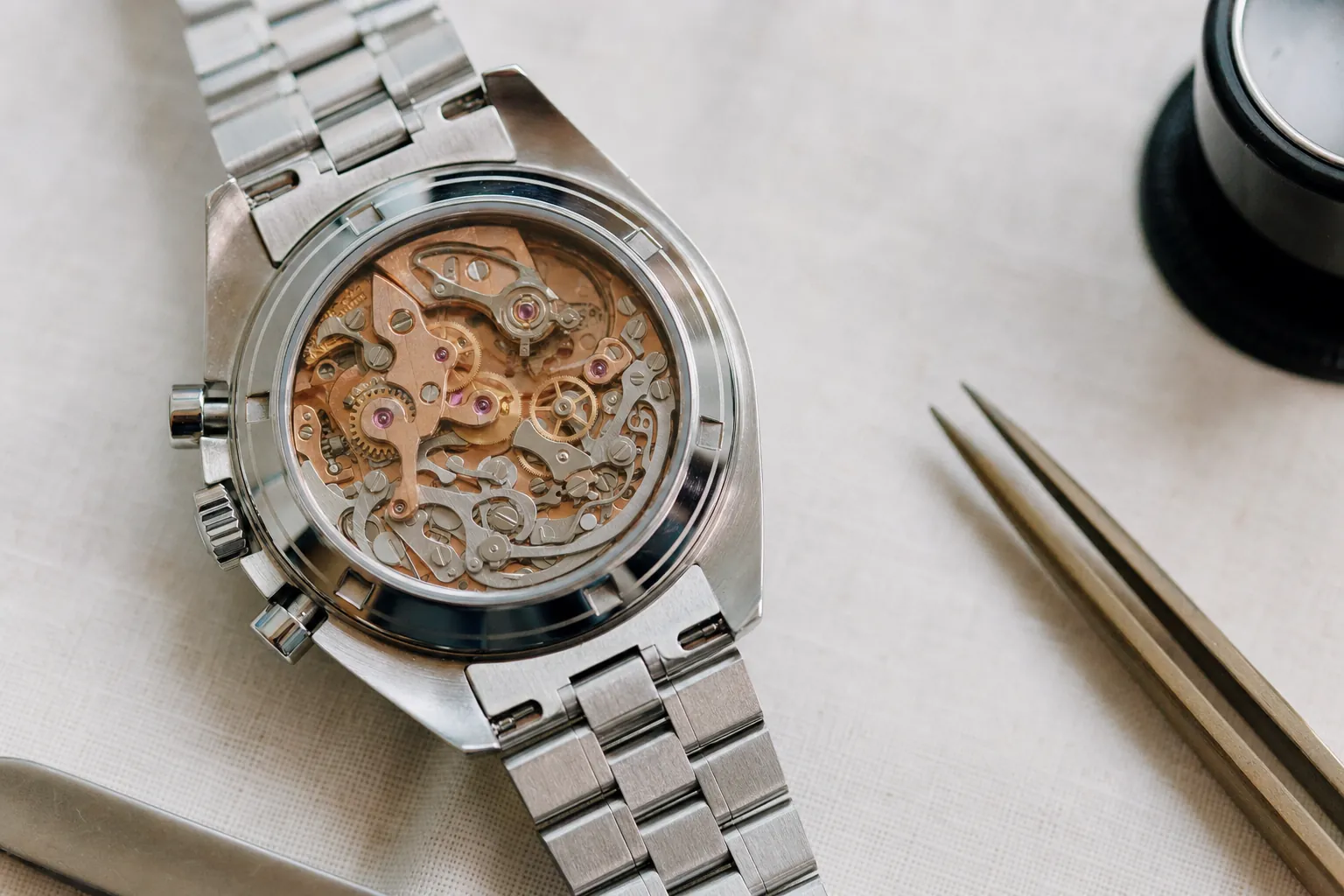
When NASA prepared to send American astronauts into the vacuum of space, wrist-worn timing instruments were treated not as personal accessories, but as mission-critical backup flight hardware. The Speedmaster lunar mission history stands as one of the most thoroughly documented engineering achievements in modern horology. Understanding how this manual-wind chronograph survived extreme thermal swings, violent acoustic vibration, and life-threatening orbital emergencies provides collectors with an authoritative perspective on its functional design.
James Ragan and the 1964 NASA Environmental Qualification Trials
By late 1964, NASA's Manned Spacecraft Center (MSC) in Houston, Texas, was preparing aggressively for the two-man Gemini missions and the ambitious Apollo lunar program that would follow. Astronauts required a backup timing device to supplement onboard panel instruments during orbital maneuvers, retrofire burns, and spacewalks. James H. Ragan, an aerospace engineer assigned to NASA’s Flight Crew Support Division, was tasked with identifying, procuring, and testing chronographs capable of enduring spaceflight.
Prior to Ragan's formal testing program, flight crews had already taken wristwatches into orbit on their own initiative. During the Mercury-Atlas 8 mission in October 1962, astronaut Walter "Wally" Schirra wore his personal Speedmaster reference CK 2998, which functioned reliably in microgravity. Astronaut Gordon Cooper wore another CK 2998 during Mercury-Atlas 9 in 1963. However, NASA operational protocol required institutional equipment qualification rather than reliance on personal crew preferences.
The Procurement Process and Anonymous Sourcing
To prevent manufacturers from submitting specially modified or hand-tuned prototypes, Ragan circumvented standard public procurement channels. In late 1964, he sent a junior engineer to Corrigan’s, a prominent jeweler in downtown Houston, to purchase commercial, off-the-shelf wrist chronographs. Four brands were initially gathered for evaluation: Omega, Rolex, Longines-Wittnauer, and Hamilton.
Hamilton submitted a military-style pocket watch rather than a wrist-worn instrument, leading Ragan to disqualify it immediately for failing to meet the basic physical form factor required for extravehicular activity (EVA). The remaining candidates—an Omega Speedmaster reference ST 105.003, a Rolex Cosmograph reference 6238, and a Longines-Wittnauer chronograph powered by the Valjoux 72—were logged into the MSC laboratories for non-destructive inspection followed by severe environmental testing.
Thermal Extremes and Vibration: Surviving the Flight Testing Protocol
NASA engineers designed testing protocols intended to drive mechanical timepieces to absolute failure. The qualification matrix was constructed around the projected worst-case scenarios inside an unpressurized space capsule and on the airless lunar surface. The testing battery comprised 11 discrete environmental trials administered under laboratory-controlled conditions.
| :--- | :--- |
|---|---|
| High Temperature | 48 hours at 160°F (71°C), followed by 30 minutes at 200°F (93°C) at atmospheric pressure. |
| Low Temperature | 4 hours at 0°F (-18°C) at atmospheric pressure. |
| Temperature-Vacuum | 15 cycles alternating between 0°F (-18°C) and 160°F (71°C) at 10⁻⁶ atmospheres. |
| Relative Humidity | 240 hours at 95% humidity across a temperature range of 68°F to 160°F (20°C to 71°C). |
| Oxygen Atmosphere | 48 hours in 100% pure oxygen at an ambient pressure of 0.35 atmospheres (5.5 psi). |
| Mechanical Shock | Six discrete shocks of 40G acceleration lasting 11 milliseconds across multiple axes. |
| Linear Acceleration | Incremental acceleration from 1G to 7.25G over 333 seconds, peaking at 16G across lateral and longitudinal axes. |
| Decompression | Rapid decompression to 10⁻⁶ atmospheres at 160°F (71°C) for 90 minutes, then 200°F (93°C) for 30 minutes. |
| High Pressure | Exposure to an overpressure of 1.6 atmospheres for a duration of one continuous hour. |
| Vibration | Three cycles of 30 minutes across random frequencies from 5 to 2,000 Hz, with high power spectral density. |
| Acoustic Noise | 130 dB of broad-spectrum acoustic noise from 40 to 10,000 Hz for 30 continuous minutes. |
Failure Modes and Official Certification
During the high-temperature and humidity phases, the competitive candidates encountered fatal mechanical failures. The Rolex Cosmograph stopped running twice during the high-temperature cycle and suffered hands that warped and bound against the dial surface when subjected to high humidity. The Longines-Wittnauer experienced a catastrophic failure during the temperature-vacuum test: its acrylic crystal warped, separated completely from the case bezel, and allowed the main chronograph seconds hand to dislodge from its pinion.
The Omega Speedmaster experienced variations in daily rate under high-temperature extremes, but its movement never stopped operating. Its structural integrity remained intact, its hands moved freely without fouling the dial or subdial registers, and the chronograph mechanism started, stopped, and reset reliably.
On March 1, 1965, James Ragan completed his technical report. Donald K. "Deke" Slayton, NASA’s Director of Flight Crew Operations, signed the official administrative directive designating the Omega Speedmaster as "Flight Qualified for All Manned Space Missions."
Gemini to Apollo: Crew Equipment Integration and Flight Selection
Just three weeks after receiving formal qualification, the Speedmaster joined its first official mission aboard Gemini III on March 23, 1965. Astronauts Virgil "Gus" Grissom and John Young wore Speedmasters on their wrists alongside early mission timers.
The true operational test occurred during Gemini IV in June 1965. Astronaut Edward H. White II executed the first American extravehicular activity, floating outside the Gemini spacecraft for 23 minutes. White wore an Omega reference ST 105.003 mounted over the sleeve of his heavy multi-layered G4C pressure suit using an extra-long nylon Velcro strap designated by NASA part number SEB12100030. The watch was exposed directly to unfiltered solar radiation and the deep cold of orbital shadow without mechanical disruption.
``` NASA Flight-Qualified Configuration: [Speedmaster Mid-Case] └── [Hesalite Crystal / Tension Ring] └── [Solid Screw-Down Caseback & O-Ring Gasket] └── [Standard Spring Bars] └── [NASA Spec SEB12100030 Velcro Band] ──> Over A7L Spacesuit Forearm ```
Transition to Apollo Hardware
As NASA progressed toward the Apollo program, astronaut equipment evolved to match the severe environments of lunar exploration. The watch configuration transitioned from the straight-lug reference ST 105.003 to the references ST 105.012 and ST 145.012. These later references introduced the asymmetrical 42mm case geometry featuring integrated crown guards and wider pusher housings to shield delicate exterior controls during cabin movement and lunar surface EVAs.
When Apollo 11 landed on the Sea of Tranquility on July 20, 1969, Neil Armstrong left his Speedmaster inside the Lunar Module Eagle to serve as a backup instrument for a malfunctioning electronic mission timer. Edwin "Buzz" Aldrin stepped onto the lunar surface wearing his reference ST 105.012 strapped over his A7L space suit, making it the first watch worn on the Moon. Those exploring Omega Speedmaster models today will note that this historic moonwalk permanently cemented the model’s identity as the Moonwatch.
Critical Timing on Apollo 13: Manual Burn Execution in Orbit
While the Speedmaster performed flawlessly on Apollo 11 and Apollo 12, its most critical operational performance occurred in April 1970 during the ill-fated Apollo 13 mission. Approximately 200,000 miles from Earth, oxygen tank number two inside the Service Module exploded, causing tank number one to fail and crippling the spacecraft’s electrical generation and life-support systems.
Astronauts James Lovell, John "Jack" Swigert, and Fred Haise were forced to abandon the Command Module Odyssey and retreat into the Lunar Module Aquarius, using it as an orbital lifeboat. To conserve limited battery power required for final atmospheric entry, the crew shut down nearly all electronic systems, including the primary guidance and navigation computer.
The 14-Second Lunar Module Descent Engine Burn
Because the explosion had diverted the spacecraft from a free-return trajectory, the crew faced drifting past Earth into deep space or entering the atmosphere at an unrecoverable angle. A manual mid-course trajectory correction was required. The crew had to ignite the Lunar Module’s Descent Propulsion System (DPS) engine for precisely 14 seconds to alter their entry path into the landing corridor.
Without an automated guidance computer, the operation required total manual coordination: Astronaut Jack Swigert used his wrist-worn Omega Speedmaster to time the burn down to a fraction of a second. Commander Jim Lovell manually fired the descent thrusters and physically aligned the spacecraft using visual crosshairs oriented against the Earth’s terminator line (the boundary between night and day). * Lunar Module Pilot Fred Haise monitored the cabin pressure and thruster alignment indicators.
Swigert counted down and timed the burn on his chronograph. The engine was cut off at exactly 14 seconds. The maneuver successfully placed the spacecraft back onto a safe trajectory, and the crew splashed down safely in the South Pacific Ocean on April 17, 1970.
``` Manual Reentry Alignment Sequence (Apollo 13): [Guidance Computer: OFF] ├── Directional Reference: Earth Terminator Line (Eyeball alignment by Lovell) ├── Propulsion Control: Manual DPS Throttle Actuation └── Time Base: Omega Speedmaster Chronograph (Timed by Swigert to 14.0 seconds) ```
In October 1970, the Apollo 13 crew presented Omega with the Silver Snoopy Award. This award, featuring the Charles M. Schulz cartoon character dressed in a spacesuit, represents the highest civilian honor bestowed by NASA flight crews for outstanding service to human spaceflight safety.
Project Alaska: Engineering Prototypes for Deep Space Conditions
Even as the standard Speedmaster proved itself across multiple Apollo flights, Omega worked closely with NASA to anticipate even harsher thermal conditions. In 1969, Omega’s research director, Pierre Chopard, launched a classified internal project code-named "Project Alaska." The initiative took its name from the extreme cold environments the watches were engineered to survive.
The Thermal Shield and Titanium Casework
The primary objective of Project Alaska was to produce an instrument capable of withstanding the direct unfiltered heat of lunar noon—where surface temperatures exceed 250°F (120°C)—as well as the shadow temperatures that plunge below -200°F (-130°C).
The Alaska I prototype featured two major innovations: 1. A Removable Outer Thermal Shield: Omega machined a circular case out of forged aluminum, finished with a bright red anodic oxidation coating. The red anodized aluminum provided a thermal barrier, reflecting radiant infrared heat away from the movement while protecting the case from physical abrasion. 2. A Pure Titanium Inner Case: The Alaska I was one of the earliest wristwatches ever manufactured from solid titanium. Titanium was chosen for its exceptional strength-to-weight ratio, structural resistance to thermal shock, and low magnetic permeability.
To enhance legibility inside the red thermal shield, Omega fitted the Alaska prototypes with stark white dials treated with reflective zinc oxide coatings, paired with distinctive "capsule" or "rocket-shaped" hands for the chronograph minutes and hours subdials. Subsequent iterations, such as Alaska II (developed in the early 1970s), returned to a modified standard stainless-steel case architecture while retaining the red anodized heat shield.
Although NASA ultimately found the standard-production Speedmaster sufficient for the remaining Apollo lunar landings, the lessons learned from Project Alaska profoundly shaped Omega’s metallurgy, gasket chemistry, and case construction methods for decades to come.
Flight-Qualified Case Design: Purpose-Built Details for Extravehicular Activity
The physical design of the classic Moonwatch is often praised for its aesthetic balance, yet every detail of its exterior architecture was honed to satisfy strict aerospace utility. Discerning collectors perusing our comprehensive watch buying guide will find that the technical specifications of the case directly mirror NASA’s operational demands.
The Twisted-Lug Case and Pushers
Introduced on reference ST 105.012 in 1964, the asymmetrical 42mm case introduced the famous "lyre" or twisted lugs. Crucially, the right side of the case flank was widened to create integrated shoulders that recessed the winding crown and chronograph pushers. In the cramped quarters of the command module or airlock, standard straight-lug cases left pushers exposed to shearing forces if struck against instrumentation panels or hatch coamings.
The pushers themselves were designed with broad surface caps and deep internal gaskets, allowing pressurized space gloves to actuate the chronograph mechanism without slipping. Because the pushers were not screw-down mechanisms, astronauts could engage the timer instantly during EVA operations without tedious manual unlocking.
Hesalite Crystal Integration
Perhaps the most deliberate engineering decision made by NASA during qualification was the strict insistence on a domed Hesalite (polymethyl methacrylate) crystal instead of mineral glass or synthetic sapphire. While sapphire offers exceptional surface hardness and scratch resistance, it possesses brittle crystalline failure characteristics:
- Shatter Characteristics: Under heavy impact or extreme differential pressure, sapphire shatters catastrophically into thousands of microscopic, razor-sharp shards.
- Microgravity Hazard: In a zero-gravity spacecraft cabin, free-floating crystal fragments create severe health risks, as astronauts could inhale the shards or suffer ocular trauma. Glass dust can also penetrate delicate electronics and short-circuit switchgear.
- Hesalite Resilience: Hesalite is an amorphous thermoplastic. When struck with extreme force, it deforms or cracks without shattering into loose debris.
The crystal was secured inside the bezel using an internal steel tension ring that mechanically expanded the crystal lip outward against the steel case wall. Under internal cabin depressurization, this configuration ensured that the differential pressure would press the Hesalite tighter into the case rebate rather than popping it outward into space.
Frequently Asked Questions
### Which Speedmaster reference did NASA officially qualify for spaceflight in 1965? NASA officially qualified the Omega Speedmaster reference ST 105.003 on March 1, 1965. This reference featured a symmetrical straight-lug case, standard baton hands, and the manual-wind Calibre 321 movement. It was subsequently worn on the exterior of a spacesuit during the Gemini IV spacewalk by astronaut Edward H. White II.
### What environmental tests did NASA subject the Speedmaster to during qualification? NASA subjected candidate chronographs to 11 discrete environmental stress tests designed to induce total mechanical failure. These included 48 hours at 160°F followed by 200°F heat exposure, low-temperature deep freezing at 0°F, 15 continuous temperature-vacuum cycles, 240 hours of relative humidity, and high-intensity random vibration up to 2,000 Hz. The watches were also exposed to explosive decompression, an ambient pressure of 1.6 atmospheres, 40G mechanical shocks, and 130 decibels of continuous acoustic noise.
### How did astronaut Jim Lovell use the Speedmaster during the Apollo 13 mission? During Apollo 13, Jim Lovell relied on the Speedmaster to manually execute a critical 14-second burn of the Lunar Module’s Descent Propulsion System engine. While Jack Swigert precisely timed the 14-second interval on his chronograph, Lovell manually controlled the spacecraft's attitude by aligning the spacecraft window crosshairs with the Earth's terminator line. This timing maneuver corrected their orbital trajectory and ensured safe atmospheric reentry after onboard computers were powered down.
### What was the purpose of Omega's Alaska Project prototypes? The Alaska Project was an internal research and development program initiated by Omega in 1969 to create the ultimate deep-space watch for NASA. The prototypes utilized massive removable outer heat shields made of red anodized aluminum to protect the watch from intense thermal radiation and extreme temperature swings. They also pioneered the use of pure titanium case manufacturing and high-contrast reflective white dials to survive long-duration exploration.
### Why did NASA select Hesalite crystal instead of sapphire for extravehicular activity? NASA selected Hesalite, a specialized acrylic material, because it does not shatter into hazardous fragments when subjected to violent physical impact or sudden pressure drops. Synthetic sapphire crystal, while highly scratch-resistant, can break into microscopic, razor-sharp shards that would float freely in zero gravity. In an enclosed spacecraft cabin, floating glass dust poses fatal risks of inhalation, ocular injury, and electronic short circuits.