Preowned Rolex Guide for Confident Buyers
Published September 20, 2026 · Last updated October 17, 2026 · By Lume Wrist Watches Editorial Team
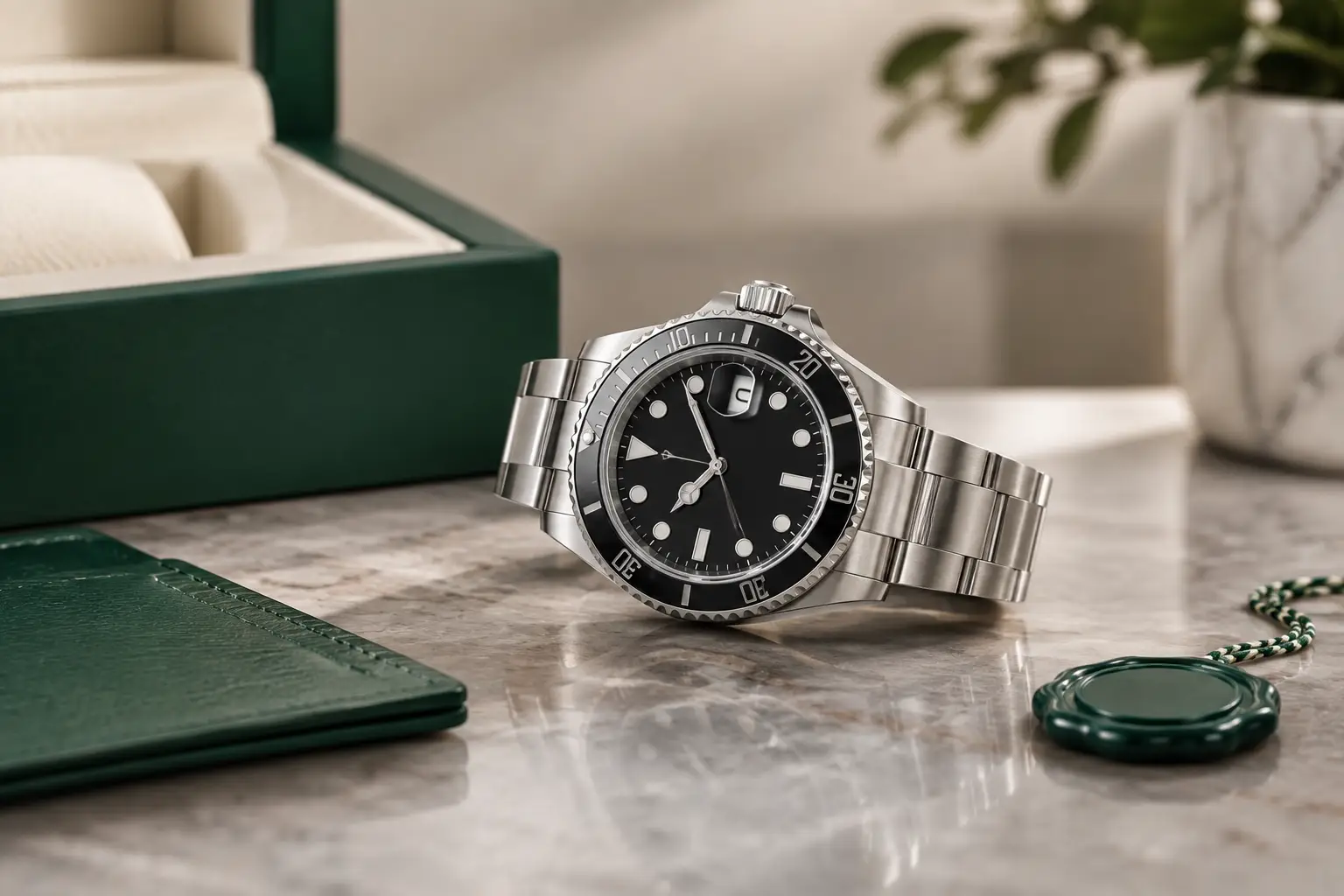
A Rolex purchase becomes more complicated the moment the watch is no longer new. A desirable reference, a convincing set of photographs, and a familiar model name are not enough to establish what you are actually buying. This preowned Rolex guide focuses on the details that protect a buyer: authenticity, configuration, condition, provenance, and the retailer’s accountability after delivery.
Start With the Exact Rolex Reference
“Submariner,” “Datejust,” and “GMT-Master II” describe families, not a complete watch specification. Within each family, the reference number identifies meaningful differences in case dimensions, movement generation, bezel material, dial configuration, bracelet, and production period. Two watches that appear nearly identical can have materially different characteristics.
Before comparing listings, define the reference you want and why. A buyer seeking a daily-wear Datejust may prioritize case size, dial color, bracelet condition, and whether the watch has a smooth or fluted bezel. A collector considering a discontinued GMT-Master II may care more about the original configuration, production-era details, and included accessories. The right choice depends on how you intend to wear and enjoy the watch, not simply what is most recognizable.
Ask for clear confirmation of the reference number and full configuration. Product descriptions should identify the model accurately rather than relying on broad labels. This gives you a reliable basis for evaluating condition and comparing watches responsibly.
Authenticity Is More Than a Serial Number
A preowned Rolex should be evaluated as a complete object. The movement, case, dial, hands, bezel, crown, bracelet, clasp, and reference-specific details all need to align with the watch being represented. Authentication is not a single visual check, and serial information alone does not prove that every component is correct for the piece.
A disciplined retailer should inspect the watch in-house before offering it for sale. That process should assess the movement and its operation, examine external components, and confirm the watch’s overall consistency with the stated reference. It should also identify whether condition or replacement history affects the listing description.
Buyers should be cautious of vague language such as “appears authentic” or listings that provide only stock images. High-quality images of the actual watch matter because they allow you to review the dial, case profile, bracelet, clasp, bezel, and included items. They do not replace professional inspection, but they are part of a transparent presentation.
Originality and Correctness Are Different Questions
A watch can be authentic while still requiring careful consideration of its components and condition. A Rolex may have received manufacturer service parts during its lifetime, for example. Depending on the model and the buyer’s priorities, that may be entirely appropriate, or it may be relevant to a collector who prefers a specific period-correct configuration.
The practical question is whether the watch is described accurately. A buyer should know what is present, what has been serviced when known, and whether the piece remains consistent with the retailer’s stated configuration. Clear disclosure is more valuable than assumptions based on a few photographs.
Read Condition Beyond the Listing Grade
Condition is one of the most subjective parts of the preowned market. Terms such as “excellent” or “very good” can be useful shorthand, but they should be supported by close images and a specific description. Look beyond superficial shine. A polished case can look attractive while also showing softened edges, altered proportions, or reduced definition around the lugs and bezel.
Examine the case lines, bezel condition, crystal, dial, hands, bracelet stretch, clasp function, and visible scratches. On models with ceramic bezels, inspect images for chips or damage. On older references, pay attention to whether dial and hand aging appears coherent. For any watch, the bracelet deserves close attention because it is both a major comfort factor and a meaningful part of the complete configuration.
Wear should be expected on a preowned luxury watch. The important distinction is between honest, disclosed wear and damage or alteration that is hidden by imprecise descriptions. A buyer seeking an everyday Rolex may reasonably accept light signs of use. A buyer pursuing a highly specific collectible reference may place a higher value on sharp case geometry and period-appropriate details. Neither approach is wrong, but they call for different standards.
Understand Service History and Mechanical Readiness
A Rolex is a mechanical instrument, and its outward condition does not tell the full story. Ask whether the watch has been inspected for function and whether service history is available. If prior service documentation accompanies the watch, it can provide useful context, though its absence is not automatically a reason to dismiss a piece.
What matters most is that the retailer has assessed the watch before sale and stands behind its mechanical condition. Timekeeping, winding, setting functions, date change where applicable, and water-resistance expectations should be considered as part of the inspection process.
Water resistance deserves particular care. A Rolex with a screw-down crown and a water-oriented design may have been built for demanding conditions, but age, gasket condition, prior opening, and service history all matter. Do not assume a preowned watch is ready for swimming or diving unless the seller explicitly confirms its current water-resistance status. If water use is central to how you plan to wear the watch, ask the question before purchase.
Box and Papers Add Context, Not Automatic Proof
Original box and papers are desirable additions, especially for collectors, but they should not be treated as a substitute for authentication. Accessories can support a watch’s provenance and completeness, yet the watch itself must stand up to professional examination.
Conversely, a Rolex without its original box or papers is not inherently problematic. Many legitimate watches have been separated from their original accessories over decades of ownership, moves, gifts, and estate transitions. The trade-off is straightforward: accessories may matter more to some buyers, while a properly authenticated and accurately described watch remains the essential requirement.
When papers are included, confirm that their details correspond to the watch. When they are not included, focus on the retailer’s in-house certification, description quality, and purchase protections. This is a higher-value approach than assigning certainty based on packaging alone.
Choose a Seller With Clear Post-Purchase Accountability
The transaction itself is part of the watch’s value proposition. A luxury timepiece should be shipped with appropriate care, and the buyer should understand what happens if the watch does not meet the stated description or develops a covered mechanical issue after purchase.
Before committing, review the seller’s authentication process, return policy, warranty terms, and shipping procedures. These details should be easy to find and written plainly. A return window gives you time to inspect the watch in person, confirm fit and appearance, and ensure it meets your expectations. A warranty provides added confidence that the retailer will address covered mechanical concerns after the sale.
For US buyers, insured shipping is especially significant. A high-value watch should not be handled like an ordinary parcel. Confirm how it will be shipped, whether it is fully insured in transit, and what delivery procedures apply. For international orders, shipping arrangements and any applicable local import requirements should be clarified in advance.
At Lume Wrist Watches, preowned Rolex watches are in-house certified and offered with free insured US shipping, a 30-day return window, and a two-year warranty. Those safeguards do not replace a buyer’s own review of the specific watch, but they create a clearer, more accountable purchase process than an informal transaction.
Ask Questions Before the Watch Is on Your Wrist
A good retailer should welcome precise questions. Request clarification when the reference, condition, accessories, service information, or shipping terms are not clear. You are not being difficult by asking for a closer image of a clasp, confirmation of bracelet links, or an explanation of a condition note. You are conducting appropriate due diligence on a significant purchase.
The strongest preowned Rolex purchase is rarely the one made fastest. It is the one where the model suits your preferences, the watch is accurately represented, and the seller has put meaningful protections behind the transaction. When those elements are in place, you can focus on the reason Rolex ownership matters in the first place: wearing a finely engineered watch with confidence for years to come.