Tudor Black Bay vs Rolex Submariner Specs and Fit
Published July 28, 2026 · Last updated October 21, 2026 · By Lume Wrist Watches
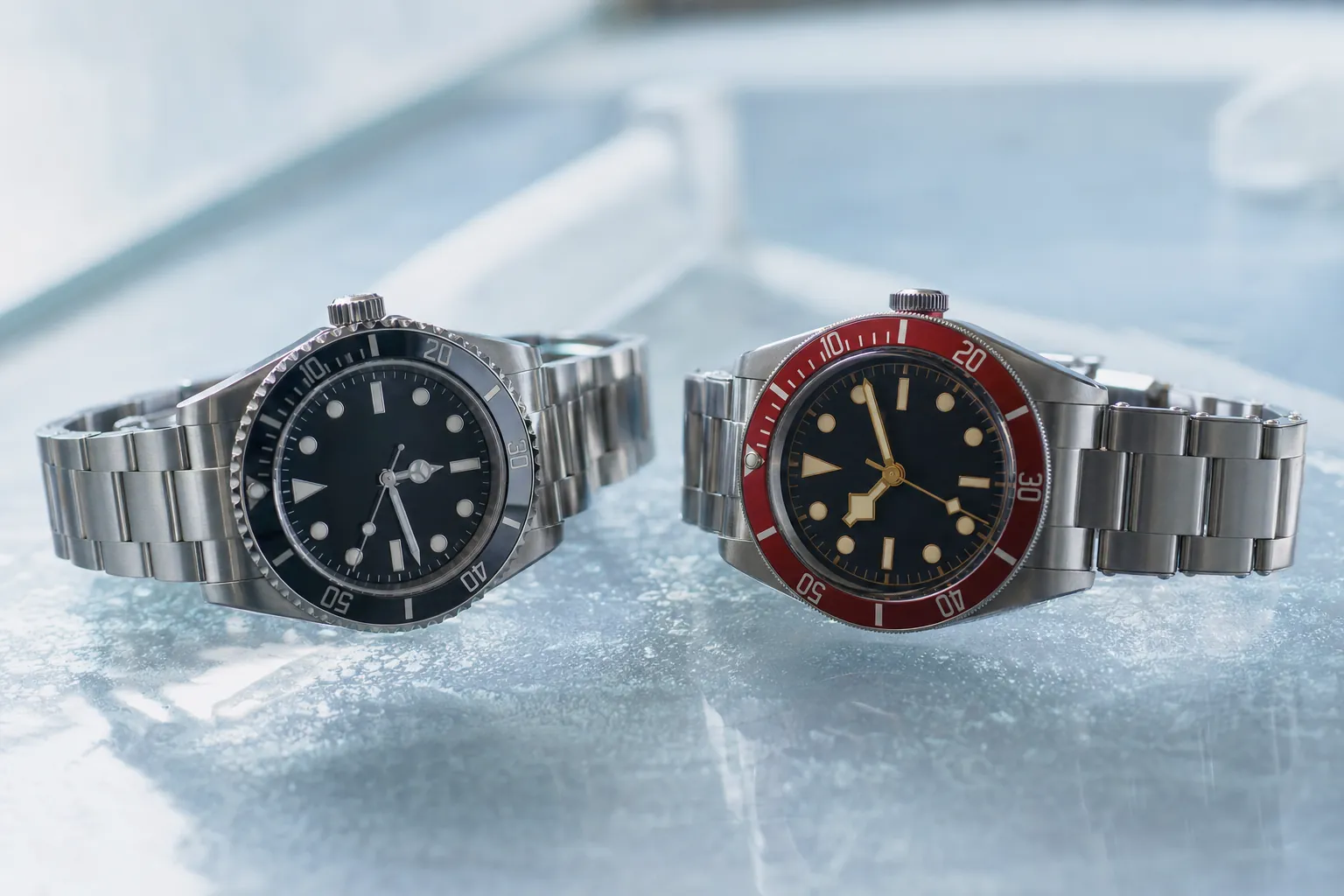
When evaluating two of the most iconic dive watches in modern horology, paper specifications tell only part of the story. The mechanical execution, wrist silhouette, and daily wearability of the Rolex Submariner and the Tudor Black Bay diverge significantly once strapped to an actual wrist. For prospective collectors and daily wearers, understanding how these timepieces balance millimeters, bevels, and micro-adjustments is critical to choosing the watch that best complements their anatomy.
Case Thickness and Slab-Sided Profile Comparison
Evaluating Tudor Black Bay vs Rolex Submariner dimensions requires looking beyond nominal case diameters to the vertical architecture of their mid-cases. While modern references of both models share a stated 41mm diameter, they distribute their mass through entirely distinct industrial philosophies.
``` +---------------------------+----------------+-----------------+---------------+----------------+ | Model Reference | Case Diameter | Total Thickness | Lug-to-Lug | Lug Width | +---------------------------+----------------+-----------------+---------------+----------------+ | Rolex Submariner 124060 | 40.5 mm | 12.3 mm | 47.6 mm | 21 mm | | Rolex Submariner 114060 | 40.0 mm | 12.5 mm | 48.0 mm | 20 mm | | Tudor Black Bay 79230 | 41.0 mm | 14.8 mm | 50.0 mm | 22 mm | | Tudor Black Bay 7941A1A0 | 41.0 mm | 13.6 mm | 49.0 mm | 21 mm | | Tudor Black Bay 58 79030 | 39.0 mm | 11.9 mm | 47.7 mm | 20 mm | +---------------------------+----------------+-----------------+---------------+----------------+ ```
The Rolex Oyster Profile
The modern Submariner ref. 124060 achieves an exceptionally trim vertical stance of approximately 12.3mm. Rolex accomplishes this by nesting its Calibre 3230 deep into the center of the case, allowing the caseback to sit slightly recessed into the fleshy part of the wrist.
The case flanks of the Submariner are subtly curved, sweeping inward from the bezel toward the caseback. This design eliminates visual bulk. When viewed from the side, the polished case wall measures only about 5.5mm tall, with the rest of the height absorbed by the sloped bezel ring and domed caseback. Combined with downward-sweeping lugs, the Submariner wraps tightly against the forearm, maintaining a low center of gravity.
The Tudor Slab-Sided Architecture
The standard Black Bay 41—most notably the second-generation ref. 79230 powered by manufacture Calibre MT5602—measures roughly 14.8mm thick. Unlike the Submariner, Tudor chose an unyielding, vertical mid-case profile with perfectly flat, polished flanks.
This slab-sided construction makes the Black Bay wear visibly taller than its dimensions suggest. The polished vertical wall stands roughly 7.5mm high, meaning the watch does not conceal any of its heft beneath the bezel line. While this gives the piece exceptional tool-watch character and vintage presence, it creates friction when sliding under tailored shirt cuffs.
Tudor addressed this wrist stance in third-generation Master Chronometer releases (such as ref. 7941A1A0), slimming the total height down to approximately 13.6mm. This reduction came from redesigning the caseback integration and bezel assembly. While still visually taller than the Submariner, the newer references reduce side-wall bulk and improve cuff clearance.
Bezel Mechanics: Aluminum Insert vs. Cerachrom Ceramic
The sensory experience of interacting with a dive watch bezel often defines daily ownership. Between these two sibling brands, the approach to bezel design reveals completely different tactile philosophies and manufacturing targets.
Tactile Click and Resistance Profiles
The Rolex Submariner utilizes a 120-click unidirectional bezel operating on three spring-loaded ball bearings mounted into the case perimeter. Turning a modern Cerachrom bezel produces an ultra-smooth, damp, acoustic feedback often compared to the combination dial of a high-end vault.
The bezel knurling on the Submariner features deep, machine-cut teeth that offer grip under wet conditions without feeling sharp to bare fingers. It exhibits zero backwards play; each click locks into position with micrometric precision.
The Tudor Black Bay implements a 60-click unidirectional ratcheting mechanism. Its tactile action is intentionally mechanical, rigid, and notched. Each rotation delivers an assertive metallic snap that resonates through the case.
Tudor machines the bezel teeth with a vintage coin-edge profile, reminiscent of 1950s references. While the 60-click track requires slightly more initial rotational torque than the Submariner, it provides an analog, utilitarian feedback loop that appeals to traditional tool-watch purists.
Material Longevity and Light Interaction
Rolex introduced Cerachrom ceramic bezels to the Submariner line to combat environmental wear. The insert is virtually scratchproof, impervious to ultraviolet fading, and features engraved graduations coated in micro-thin layers of platinum via PVD deposition. Under direct sunlight, Cerachrom reflects bright light with a glassy, polished sheen.
The standard Black Bay lineup relies on anodized aluminum inserts. Aluminum produces a flat, matte-satin finish that diffuses light rather than reflecting it, fitting the vintage-inspired aesthetic of the Tudor collection.
While aluminum can scratch or dent upon hard impact and will gradually oxidize over decades of UV exposure, many enthusiasts prefer this susceptibility to aging over the permanent, modern gloss of ceramic.
Dial Details: Gilt and Snowflake vs. Maxi Dial Layout
Both dials descend from mid-century military and civilian underwater diving roots, yet their modern executions create distinctly different wrist personalities.
``` +-------------------------+---------------------------------+----------------------------------+ | Feature | Tudor Black Bay | Rolex Submariner | +-------------------------+---------------------------------+----------------------------------+ | Crystal | High-domed sapphire | Flat sapphire with AR underside | | Handset | Angular Snowflake | Mercedes hour, pencil minute | | Hour Marker Surrounds | Rose-gilded or polished steel | 18k white gold | | Luminous Pigment | Super-LumiNova (Green glow) | Chromalight (Blue glow) | | Text Finish | Gilt-tone or muted white print | Crisp white glossy transfer | +-------------------------+---------------------------------+----------------------------------+ ```
Handset Legibility and Proportions
The Black Bay uses the iconic Snowflake handset, created in 1969 for the Marine Nationale. The broad diamond-shaped hour hand covers substantial surface area, maximizing low-light visibility. However, because the hour hand diamond matches the width of the minute hand's lumed section, quick orientation reading relies heavily on the diamond's position relative to the center pinion.
The Rolex Submariner relies on the time-tested Mercedes handset, featuring an open, three-pointed star inside the circular hour hand. The contrast between the rounded Mercedes head and the slender, tapered minute hand prevents any legibility confusion during nighttime operation or split-second glances.
Lume Application and Markers
Rolex equips modern Submariners with its proprietary Chromalight compound, emitting an electric blue glow that charges rapidly and maintains legibility across prolonged dark intervals. The markers themselves are larger "Maxi" plots framed in non-tarnishing 18k white gold, giving the dial an unmistakable contemporary luxury finish.
Tudor implements Swiss Super-LumiNova, historically glowing in a traditional green hue. On vintage-inspired models, the markers feature rose-gold plated or warm gilt-toned borders set against a finely textured, domed matte-black dial plate. The dial curvature interacts with the outer perimeter of the domed sapphire crystal, producing optical distortions at extreme angles that mimic mid-century acrylic crystals.
Clasp Engineering: Tudor T-Fit vs. Rolex Glidelock
A dive watch can have exceptional case proportions, but without a finely engineered clasp, balance on the wrist quickly falls apart. Micro-adjustability transforms real-world wearability across changing seasons and ambient temperatures.
Rolex Glidelock: The Gold Standard
Introduced on modern ceramic Submariners, the Rolex Glidelock clasp remains one of the benchmark bracelet adjustment systems in the luxury watch industry.
The mechanism operates via an integrated toothed rack hidden within the solid clasp cover: Provides 20mm of total adjustment travel. Operates in 2mm incremental steps. Requires no tools; the wearer simply flips up the locking lever link and slides the bracelet end along the interior track. Houses an internal dual-pivot deployant arm that locks down with positive mechanical snap closure.
Because the Glidelock track is tucked smoothly within the clasp, the exterior remains sleek and clean. The 2mm increments allow for a tailored fit throughout the day, accommodating wrist swelling caused by heat or physical activity.
Tudor T-Fit: Modern Rapid Micro-Adjustment
For years, standard Black Bay bracelets relied on traditional spring-bar adjustment holes drilled into the clasp interior, requiring a toothpick or spring-bar tool to resize. Tudor revolutionized this experience with the introduction of its proprietary T-Fit clasp, first seen on specialized references and now standard on contemporary Master Chronometer Black Bay models.
The T-Fit system utilizes a spring-loaded carriage mounted within the clasp that glides along five distinct notches: Provides 8mm of tool-free micro-adjustment. Operates by tilting the bracelet up at a 45-degree angle to disengage the internal detent. * Houses ceramic ball bearings within the clasp closure mechanism, ensuring smooth tactile resistance and minimizing friction wear over years of cycling.
While the T-Fit offers less total travel distance than the Glidelock (8mm versus 20mm), 8mm is more than sufficient for normal daily wear outside of fitting over a thick neoprene exposure suit. The T-Fit clasp is slightly more compact in length than the Glidelock, making it sit more comfortably along the underside of narrower wrists.
Weight Distribution and Everyday Wrist Presence
Real-world comfort depends less on absolute gram weight and more on weight distribution. When comparing the Tudor Black Bay vs Rolex Submariner dimensions, the interplay between bracelet taper and case center of gravity dictates how the watches settle against the forearm.
``` +---------------------------+-------------------+-----------------+-----------------------+ | Model Reference | Approximate Mass | Bracelet Width | Visual Wrist Impact | +---------------------------+-------------------+-----------------+-----------------------+ | Rolex Submariner 124060 | ~155 grams | 21 mm to 16 mm | Balanced, wide stance | | Rolex Submariner 114060 | ~153 grams | 20 mm to 16 mm | Boxy, top-heavy | | Tudor Black Bay 79230 | ~175 grams | 22 mm to 18 mm | Substantial, tall | | Tudor Black Bay 7941A1A0 | ~160 grams | 21 mm to 16 mm | Streamlined, balanced | | Tudor Black Bay 58 79030 | ~142 grams | 20 mm to 16 mm | Light, retro-compact | +---------------------------+-------------------+-----------------+-----------------------+ ```
Bracelet Taper and Center of Gravity
The modern Rolex Submariner 124060 introduced a 21mm lug spacing that aggressively tapers down to 16mm at the clasp. This wide-to-narrow geometry anchors the watch case flat against the dorsal plane of the wrist. Because the case is barely 12.3mm thick, the watch maintains a low, stable center of gravity. Even when worn slightly loose, the Submariner resists rotational slipping around the wrist bone.
By contrast, an older in-house Black Bay 41 (ref. 79230) pairs a 175-gram fully linked weight with a 14.8mm tall case and a 22mm bracelet tapering down to only 18mm. With much of the watch's physical mass positioned high in the slab-sided steel chassis, the piece can feel top-heavy unless adjusted precisely. Wearers with rounded wrist anatomy often notice the watch shifting side-to-side during active movement.
The newer 7941A1A0 references address this by introducing a more dramatic taper down to a 16mm clasp, effectively anchoring the thinner 13.6mm case head firmly against the skin. For shoppers browsing through our pre-owned luxury watch buying guide, paying close attention to case thickness relative to bracelet taper is essential when predicting how comfortably a watch will wear over an eight-hour workday.
Water Resistance Ratings and Real-World Utility
While both designs are dive-engineered tool watches, their environmental depth limits reflect slightly divergent engineering specifications.
The Rolex Submariner features an ISO-rated depth limit of 300 meters (1,000 feet). To guarantee this barrier, Rolex equips the watch with its proprietary Triplock winding crown. The Triplock system includes five micro-synthetic gaskets: two inside the crown tube, two within the winding stem mechanism, and one visible gasket nestled inside the screw-in cap. This creates a secure, fail-safe hermetic seal against pressure, sand, and saltwater intrusion.
The Tudor Black Bay features an ISO-rated depth limit of 200 meters (660 feet). While technically lower than the Submariner, 200 meters vastly exceeds the depths encountered during recreational scuba diving, which rarely surpasses 40 meters.
Tudor protects the movement using a screw-down crown with internal dual-gaskets. Earlier references feature an exposed, colored anodized aluminum crown tube collar that coordinates with the bezel insert. In contrast, modern references sit flush against the case wall, mirroring traditional dive watch architecture. For daily water activities, desk diving, lap swimming, and offshore use, the mechanical utility of both systems is functionally identical.
Frequently Asked Questions
### How does the case thickness of the Black Bay 41 compare to the Submariner 124060? The Rolex Submariner ref. 124060 measures roughly 12.3mm thick, featuring a curved mid-case that slopes down toward the wrist. The standard Tudor Black Bay 41 ref. 79230 measures approximately 14.8mm thick with vertical, slab-sided polished flanks. Even the newer Master Chronometer Black Bay models, which have been reduced to 13.6mm, wear noticeably taller on the wrist than the Submariner.
### What are the mechanical differences between Tudor T-Fit and Rolex Glidelock clasps? The Rolex Glidelock system relies on a toothed rack set inside the clasp frame, providing 20mm of tool-free travel in precise 2mm sliding increments. Tudor's T-Fit mechanism utilizes a sprung carriage with ceramic ball detents that slides smoothly between five preset stops, providing 8mm of total adjustment. While the Glidelock offers a wider adjustment span for wet suits, the T-Fit features a slightly shorter, lower-profile clasp footprint.
### Why does the standard Black Bay use an aluminum bezel while the Submariner uses Cerachrom? Rolex developed proprietary Cerachrom ceramic inserts to make their dive watches impervious to scratching, UV fading, and environmental discoloration over time. Tudor intentionally utilizes anodized aluminum inserts across its flagship Black Bay lines to retain the warm light refraction and vintage aesthetic characteristic of historic dive models from the 1950s. The material choices reflect Rolex's focus on high-tech permanence versus Tudor's heritage-driven design ethos.
### Which watch wears smaller on a wrist under seven inches? The Rolex Submariner 124060 wears smaller and flatter on wrists under seven inches due to its slim 12.3mm profile, shorter 47.6mm lug-to-lug span, and pronounced 21mm-to-16mm bracelet taper. The Black Bay 41's taller case flanks and longer 50mm lug-to-lug span can cause lug overhang on narrower wrists. Collectors with sub-seven-inch wrists seeking Tudor proportions that match or wear smaller than a Submariner should evaluate the Black Bay 58 or Black Bay 54 lines.