How to Verify Luxury Watch Papers Before You Buy
Published September 16, 2026 · Last updated October 17, 2026 · By Lume Wrist Watches Editorial Team
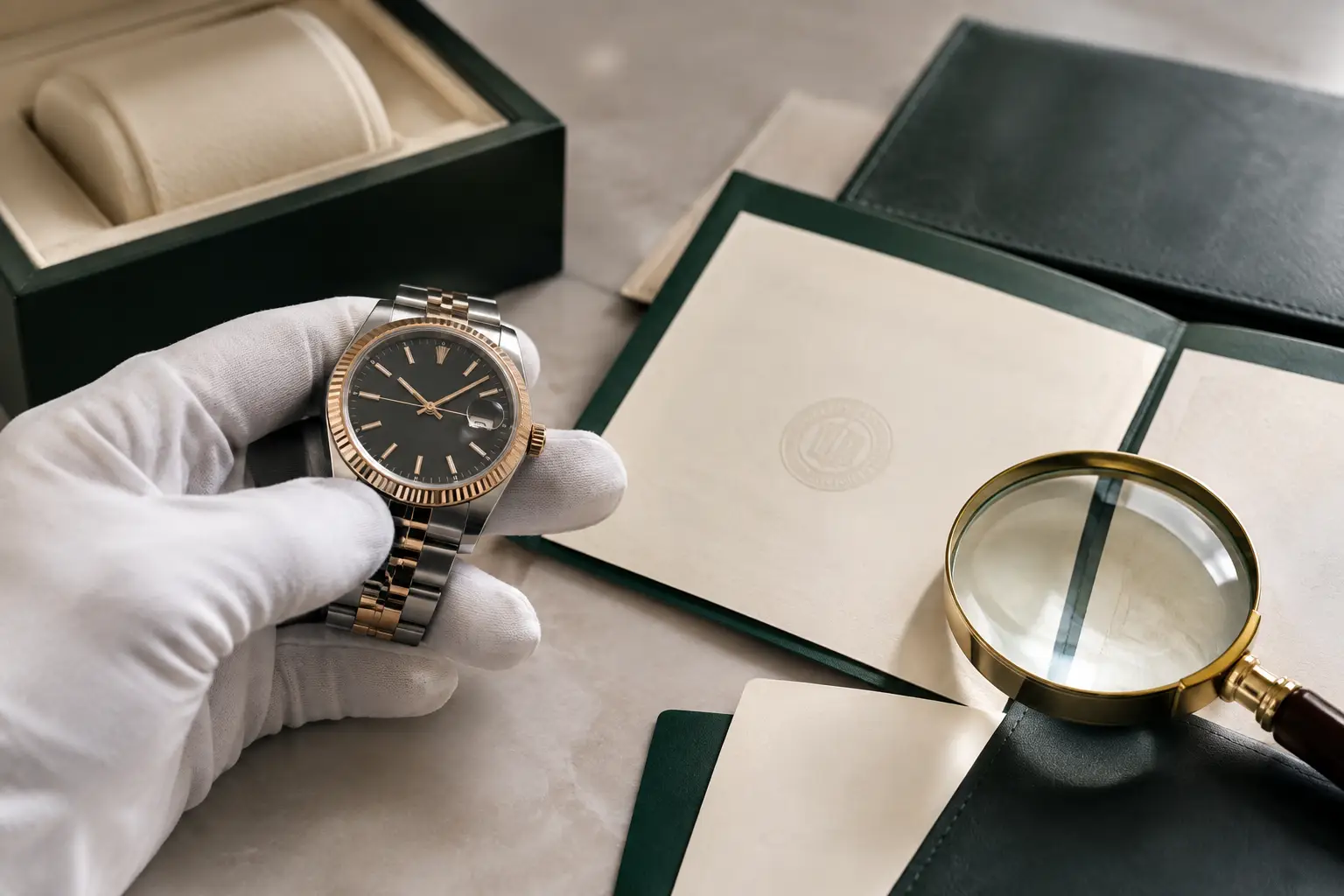
A warranty card, certificate, or original sales document can add meaningful confidence to a pre-owned watch purchase. But to verify luxury watch papers properly, buyers must treat the documents as one part of a larger authentication review. Papers should support the watch's identity, reference, and history - not substitute for a professional examination of the timepiece itself.
For collectors considering Rolex, Patek Philippe, Audemars Piguet, Omega, and other high-value brands, the details matter. A correct-looking card with mismatched watch information is a concern. A watch without papers is not automatically inauthentic. The goal is to establish a clear, consistent record before committing to a significant purchase.
How to Verify Luxury Watch Papers
Start by identifying exactly what is being presented. “Papers” is a broad term in the luxury-watch market. Depending on the brand, model, and era, it may refer to a warranty card, certificate of origin, chronometer certificate, original purchase receipt, service documentation, or an archival extract. A presentation box, booklet, hangtag, and bezel protector may be desirable accessories, but they are not proof of authenticity on their own.
Modern watches often include a branded warranty card containing a reference number, serial number, purchase date, and selling retailer information. Earlier examples may have paper certificates, punched guarantee papers, or booklets with handwritten or stamped details. The document format should make sense for the brand and production period of the watch.
A card from a later generation paired with an earlier watch may require further explanation. It could reflect a replacement document, a service-related record, or a simple listing error. It should never be dismissed as a minor detail without documentation from a credible source.
Match the reference number first
The reference number identifies the model configuration. It should align with the watch being offered, including its case material, intended dial family, bracelet or strap configuration where applicable, and generation.
For example, a reference associated with a stainless-steel sports watch should not be paired with a watch that presents as a precious-metal variant without a clear, verifiable explanation. Some references cover multiple dial options or production transitions, so a match is not always absolute proof. It is, however, the first practical test of whether the papers and watch belong together.
A seller should be able to state the reference clearly and consistently in the listing, invoice, and supporting documentation. Vague wording such as “similar reference” or an unexplained inconsistency deserves scrutiny.
Confirm serial information where available
The serial number is one of the strongest links between a watch and its papers. Where a brand includes serial data on its warranty documentation, compare that information directly with the serial number associated with the watch.
The location of a serial number differs by manufacturer and production era. On some watches it may be engraved between the lugs, on the rehaut, on the caseback, within movement records, or in another manufacturer-specific location. A professional inspection may be necessary when a number is difficult to access without removing a bracelet or opening the case.
Serial-number visibility can vary. A dealer may reasonably withhold the complete number from a public listing for security reasons, but a serious buyer should receive confirmation that the watch and papers match before the transaction is finalized. Partial serial disclosure can be appropriate during an initial inquiry. It should not become a substitute for full verification in the purchase process.
Assess Whether the Documents Fit the Watch's Era
Luxury brands update their warranty cards, paper certificates, printing conventions, and retailer documentation over time. A convincing verification process considers whether the paperwork fits the period in which the watch was produced and sold.
That does not mean every watch must have a perfectly predictable set. A watch can sit in dealer inventory before sale. It may have been serviced years later. It may have been originally sold in another market. Older watches may have incomplete sets simply because booklets, receipts, and packaging were lost over decades of ownership.
What matters is whether the explanation is plausible and whether the available documents are internally consistent. Review the printed format, brand marks, date fields, model information, and retailer details together. One isolated detail may have an innocent explanation. Several inconsistencies point to a larger provenance issue.
Read dates with context
The date on a warranty card generally reflects retail activation or original sale, not necessarily the watch’s exact production date. This distinction is especially relevant with discontinued references and watches sold after an extended period in inventory.
A date that appears later than expected is not automatically a problem. However, a date that conflicts with the card style, reference generation, or known production period should prompt a closer review. The same is true of handwritten dates, missing retailer information, or unusually altered-looking fields.
Avoid making a judgment from one date alone. Compare it against the watch’s serial range where relevant, its visible generation cues, the seller’s stated history, and any service records.
Treat Original Papers as Provenance, Not Proof by Themselves
Original papers can strengthen desirability and resale liquidity, particularly for collectible references. They may help establish a clearer ownership timeline and can provide confidence that the watch has remained together with its original documentation. Yet papers alone do not authenticate a watch.
Documentation can be separated from a watch over time. It can also be mistakenly reunited with the wrong watch. For that reason, a buyer should never rely solely on a photograph of a warranty card or certificate when evaluating a high-value purchase.
The watch itself must be assessed for correct construction, movement, dial, case, bracelet, engraving, and serial information. Condition should be evaluated with equal care. A genuine watch with polished case lines, replacement components, moisture damage, or an undisclosed service history may be less appropriate for a collector than the papers initially suggest.
This is where an authenticated, in-house certified offering provides a more disciplined purchase path. The documents are reviewed alongside the physical watch rather than being treated as a standalone sales feature.
Ask for Clear Documentation Before Payment
A reputable seller should be prepared to provide high-resolution images of the relevant papers and enough detail to evaluate their relationship to the watch. For privacy and security, some information may be partially obscured in public-facing materials, but the core identity of the piece should be addressed directly during the transaction.
Ask whether the warranty card or certificate matches the watch’s reference and serial number. Confirm whether the documents are original to the watch, later-issued records, or accompanying paperwork from a prior owner. If there is a gap in the history, request a straightforward explanation rather than assuming a complete set means complete provenance.
For a watch described as “full set,” clarify what that phrase includes. In most cases, it refers to the watch, original box, warranty card or certificate, and related booklets or accessories. It does not necessarily mean an original sales receipt, complete service history, or every item supplied at the first retail sale.
A clear invoice should also identify the watch by brand, model, and reference. It should state the seller’s return terms and warranty coverage. These protections matter because verification continues after delivery: the buyer needs a defined process if the watch does not match its description.
Know When Missing Papers Are Acceptable
Many excellent vintage and pre-owned luxury watches are offered without original papers. This is common for watches that have changed hands over many years, inherited pieces, and models whose original documentation was never retained. A no-papers watch may still be entirely authentic and highly collectible.
The trade-off is provenance. Without matching original documentation, a buyer should place greater weight on professional authentication, the seller’s written description, condition reporting, and purchase protections. The absence of papers may also affect future marketability, depending on the brand, rarity, age, and collector demand for the particular reference.
Conversely, papers should not cause a buyer to overlook concerns with the watch itself. The stronger purchase is the one where the physical watch, records, condition description, and seller accountability all agree.
Protect the Purchase After Verification
Verification should lead to a purchase process designed for a high-value item. Keep copies of the listing, invoice, correspondence, and all documents supplied with the watch. When it arrives, inspect the reference, condition, accessories, and paperwork against the agreed description before removing tags or altering the watch.
For US buyers, free insured shipping, a 30-day return window, and a 2-year warranty provide practical safeguards beyond the initial review. They create recourse if the watch is not as represented and offer continued support after delivery - considerations that matter as much as the presence of a card or certificate.
The right papers can make a luxury watch more complete. The right verification process makes the purchase more secure.