How to Inspect Luxury Watch Condition Before You Buy
Published August 31, 2026 · Last updated October 17, 2026 · By Lume Wrist Watches Editorial Team
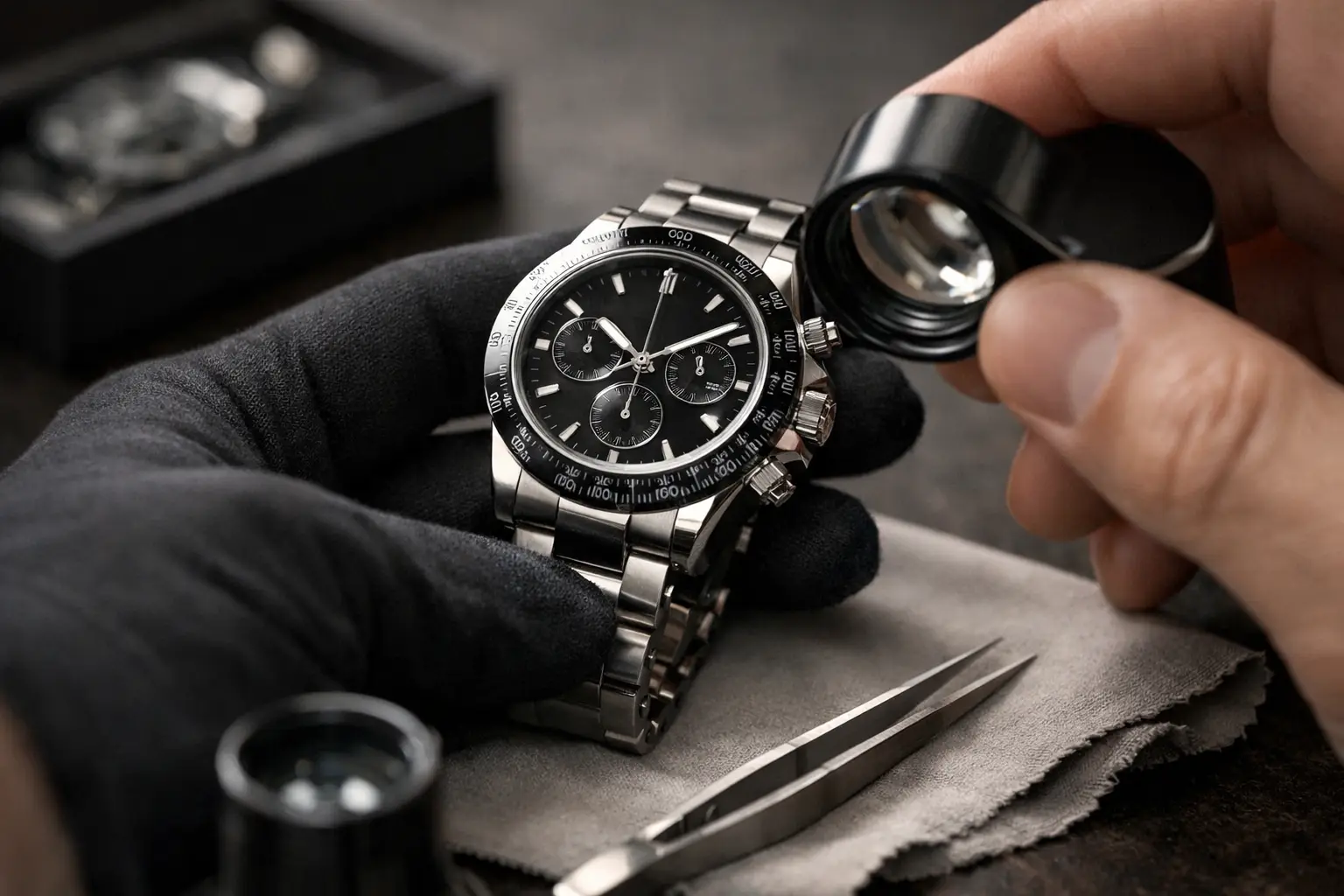
A luxury watch can look excellent across a conference table and still reveal costly issues in close-up photographs. A softened case edge, stretched bracelet, replacement dial, or overdue movement service can materially change both the ownership experience and the watch’s long-term desirability. Knowing how to inspect luxury watch condition gives you a clearer basis for comparing listings and deciding whether a particular example deserves further consideration.
Condition is not a single grade. It is the combined state of the case, bracelet, dial, hands, crystal, movement, and supporting documentation. The right standard also depends on the reference, its age, and what matters to you. A vintage Omega with honest wear may be more compelling than an aggressively refinished example, while a modern Rolex or Patek Philippe is often expected to present with sharper, more uniform surfaces.
How to Inspect Luxury Watch Condition Before Purchase
Begin with complete, high-resolution photographs taken in direct and angled light. A single front-facing image cannot show the features that matter most. Request views of the bezel, lugs, case sides, crown, caseback, clasp, bracelet links, dial, and movement where appropriate. For a complicated watch, clear images of the calendar, chronograph, or other functions are equally useful.
A reliable condition review asks two separate questions: Is the watch structurally sound and mechanically healthy? And is its appearance consistent with its age, reference, and stated history? Cosmetic wear is not automatically a problem. Undisclosed alterations, weak performance, or a condition description that does not match the watch are the concerns that require attention.
Read the case shape, not just the finish
The case is one of the most revealing areas of a luxury watch. Light scratches on polished surfaces can be normal signs of careful ownership. What deserves closer scrutiny is excessive polishing. Repeated refinishing can round the lugs, soften the transition between brushed and polished surfaces, and reduce the crisp geometry that defines a reference.
On a Rolex sports model, look at the symmetry and thickness of the lugs, the clarity of the bezel teeth, and the definition of the crown guards. On an Audemars Piguet Royal Oak, inspect the sharp facets and the consistency of the satin brushing. A Patek Philippe dress watch may have more delicate surfaces, but its case lines should still look deliberate rather than blurred.
Do not assume that an unpolished watch is always preferable. An untouched case with deep dents may require more consideration than a carefully refinished watch completed by a qualified specialist. The key is transparent disclosure. The seller should be able to describe visible wear, refinishing, and repairs without relying on vague phrases such as “excellent condition” alone.
Check the bracelet, clasp, and fit points
A bracelet often carries the clearest evidence of daily use. Look for scratches on polished center links, wear on clasp edges, and looseness between links. Some degree of flex is expected on older bracelets, especially vintage pieces. Severe stretch, however, can indicate worn pins or internal link wear and may affect both comfort and future service needs.
Examine the connection between the bracelet and case. The end links should sit correctly, with no unusual gaps or instability. Check the clasp for clean closure and correct engraving or hallmarks where applicable. On leather straps, inspect the underside, stitching, holes, and buckle. A worn strap is straightforward to replace, but it should be accurately represented in the overall condition assessment.
If the watch is supplied with additional links, confirm that they are included before purchase. Proper fit matters, particularly for integrated-bracelet watches where sizing options are more limited.
Study the dial, hands, and crystal under magnification
The dial is often the most important originality component. Look for spotting, moisture marks, uneven printing, damaged luminous material, or signs that the dial has been refinished. On vintage watches, patina can be desirable when it is even and consistent with the rest of the piece. On a modern watch, discoloration or irregular lume can point to damage or prior intervention.
Hands should match the dial in style, finish, and age. Mismatched luminous color, corrosion, or handsets that do not correspond to the reference deserve clarification. This does not mean every replacement component is unacceptable. A manufacturer-installed service hand may be entirely appropriate, particularly on a watch intended for regular wear. It does affect originality, though, and should be documented accurately.
Inspect the crystal from several angles. Surface marks on acrylic crystals are common and may be correct for an older reference. Sapphire crystals are more resistant to scratches, but chips around the edge, especially near the bezel, should be disclosed. Check whether the crystal is clear and whether the date magnification, where present, is properly aligned.
Inspect Luxury Watch Condition Beyond Cosmetics
A beautiful exterior cannot confirm movement health. The watch should wind smoothly, set correctly, and perform its functions as intended. For a time-only mechanical watch, ask about timekeeping and the date change. For a chronograph, confirm that the start, stop, reset, and subdial functions operate correctly. For a perpetual calendar or annual calendar, function testing is especially valuable because repairs can be more specialized.
Service history adds useful context, but it is not a substitute for current evaluation. A recent service may reduce near-term maintenance concerns, yet the quality and scope of that service matter. Conversely, an older service record does not automatically mean the movement is failing. Mechanical watches have different service needs depending on age, use, water exposure, and complication.
Water resistance should be handled carefully. A screw-down crown and a published factory rating do not prove that a pre-owned watch remains water-resistant today. Gaskets age, seals can fail, and prior case opening can affect performance. If water resistance is important to your intended use, ask whether the watch has been pressure tested recently and avoid assumptions based on the model alone.
Confirm what is original and what has been replaced
A luxury watch may contain replacement components from a prior service. Some are routine, such as gaskets, mainsprings, or crystals. Others have a greater effect on collectibility, including dials, hands, bezels, bracelets, and external case parts.
The appropriate standard depends on your purpose. A buyer seeking a daily-wear Rolex may reasonably prioritize reliability and clean presentation. A collector pursuing a specific vintage reference may place much greater value on period-correct components and documented provenance. Neither approach is inherently better, but the listing should make the distinction clear.
Box and papers can support a watch’s history, especially when serial information, dates, and reference details align. They should never be treated as the only evidence of authenticity or condition. The watch itself must be evaluated, including its identifying details, construction, and movement where applicable.
Evaluate the seller’s process, not only the watch
A condition description has more value when it is backed by a clear inspection process and defined post-purchase protections. Before committing, understand how the watch was authenticated, whether it was examined in-house, what is covered under warranty, and how returns are handled. These details matter because certain issues are only apparent once the watch is in your hands.
For US buyers, insured shipping and a reasonable return window create practical protection during a high-consideration purchase. A warranty can also provide confidence around covered mechanical issues after delivery, though you should review its terms rather than assuming it covers accidental damage, water exposure, or normal cosmetic wear.
At Lume Wrist Watches, timepieces are in-house certified and offered with free insured US shipping, a 30-day return window, and a two-year warranty. Those safeguards are designed to complement careful pre-purchase review, not replace it.
Inspect the Watch Promptly After Delivery
When your watch arrives, inspect it before removing tags or making any alterations. Compare the piece against the listing photographs and written description. Verify the reference and serial details where visible, confirm that the included box, papers, links, and accessories match the order, and test the stated functions with care.
Pay particular attention to four areas:
- The case, bezel, and bracelet should match the disclosed level of wear.
- The dial, hands, and crystal should appear consistent with the listing images.
- The crown, date, chronograph, or other stated functions should operate properly.
- The supplied documentation and accessories should correspond to what was represented.
A thoughtful inspection does not require you to reject normal signs of ownership. It allows you to distinguish honest wear from overlooked details and to select a watch whose condition fits the way you plan to enjoy it. The strongest purchase is not necessarily the most pristine example. It is the one whose condition, originality, service needs, and protections are clearly understood before it becomes yours.