Watch Buyer Document Checklist for Safe Purchases
Published October 4, 2026 · Last updated October 17, 2026 · By Lume Wrist Watches Editorial Team
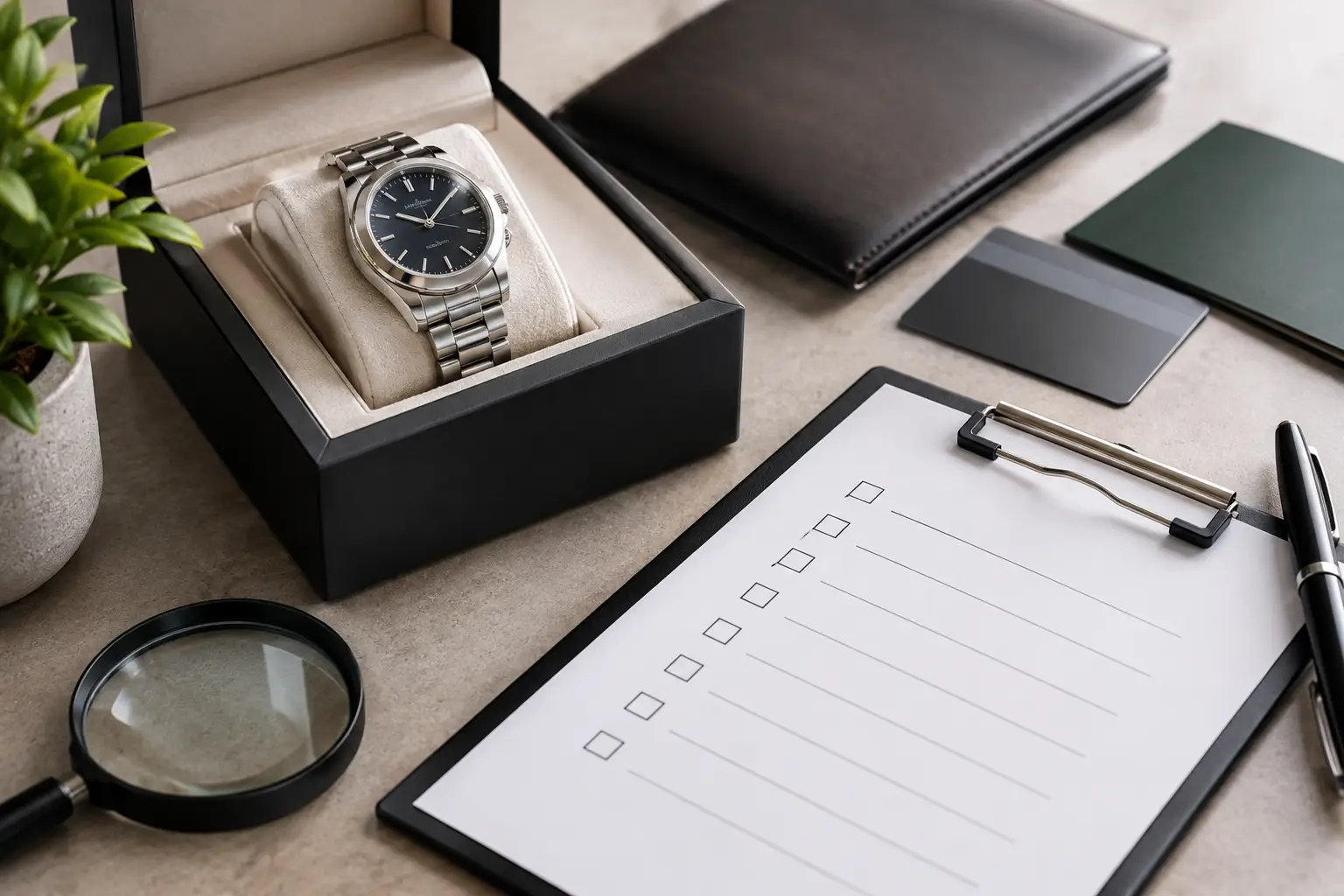
A luxury watch can look correct in photographs and still leave material questions unanswered. A proper watch buyer document checklist gives you a clear record of what the seller represents, what is included, and what protection applies if the watch arrives differently than described. For a Rolex, Patek Philippe, Audemars Piguet, Omega, or another high-value reference, paperwork is not an accessory to the transaction. It is part of the due diligence.
Documents alone do not establish authenticity. A box, card, or receipt can be separated from a watch, altered, or associated with the wrong piece. But when documentation is paired with professional inspection, a detailed condition record, and written purchase protections, it gives the buyer a far more secure basis for proceeding.
Watch Buyer Document Checklist Before You Pay
Before funds are sent, ask the seller to identify the exact watch being offered and provide the documents that support its condition, provenance, and sale terms. The goal is not to collect paper for its own sake. It is to make sure the watch, the listing, and the seller’s obligations all align.
1\. A detailed sales invoice
The invoice should identify the seller, buyer, transaction date, purchase amount, and the watch with enough specificity to avoid ambiguity. At minimum, look for the manufacturer, model or reference number, and serial number where appropriate. The invoice should also state whether the watch is pre-owned and list the included accessories, such as its box, papers, manuals, extra links, or service materials.
A vague line item such as “luxury watch” is not sufficient for a substantial purchase. The invoice becomes your core ownership record, and its description should match the timepiece delivered. Keep a digital copy in a secure folder and retain the original purchase confirmation.
2\. The original warranty card or papers, if included
Original brand papers can add useful context to a watch’s history. They may show the original point of sale, date of sale, reference, or serial number. Their value varies by brand, age, and collecting category. For some modern references, a complete set can be a meaningful factor in collector appeal. For a vintage watch, original papers may be uncommon and should not be treated as a requirement.
Check that any printed reference and serial information is consistent with the watch. Also examine whether the card is dated, named, stamped, or otherwise completed. A blank card is not automatically a concern, but it should be accurately described rather than presented as stronger provenance than it provides.
Most importantly, do not mistake original papers for an authenticity guarantee. They are supporting evidence. A professional authentication process and a seller willing to stand behind the watch remain more consequential.
3\. A written authenticity and certification statement
Ask how the seller authenticated the watch and whether that determination is documented. A credible retailer should be able to explain the scope of its inspection in plain terms: verification of the reference and configuration, movement assessment where applicable, inspection of case and dial details, and review of serial information when accessible.
There is a difference between a seller repeating what a prior owner claimed and a seller accepting responsibility for the watch it sells. Written in-house certification creates a clearer chain of accountability. It tells you that the retailer has evaluated the piece rather than merely facilitating a sale between private parties.
For complicated watches, vintage pieces, or examples with unusual configurations, ask direct questions. Is the dial period-correct? Has the bracelet been replaced? Are the hands, bezel, crown, or clasp consistent with the stated model? The right answer may be that a component was replaced during service. What matters is candid disclosure and a price that reflects the watch’s actual configuration, not an assumption that every part must be original to be worth buying.
4\. A condition report with current photographs
Condition language should be specific. “Excellent” is subjective unless the seller explains what it means. Request recent, high-resolution photographs of the dial, case sides, lugs, bezel, crystal, bracelet, clasp, caseback, and any areas with wear or damage. For mechanical watches, ask whether the functions have been tested, including date change, chronograph operation, bezel action, or other complications relevant to the model.
A useful condition report addresses more than cosmetic marks. It should disclose polishing, bracelet stretch, corrosion, moisture damage, dial degradation, replaced components, and crystal condition when known. If a watch has been polished, that is not necessarily a reason to walk away. The trade-off is that excessive polishing can soften original case lines and reduce appeal to collectors who prioritize unaltered geometry.
Photographs should depict the actual watch for sale, not a stock example of the same reference. If the images do not allow you to evaluate the watch properly, request more before committing.
5\. Service records and timing information
Service paperwork can clarify when the watch was last maintained and what work was performed. It may show whether the movement received a full overhaul, whether water-resistance components were replaced, and whether parts were exchanged. This is especially useful with older watches, complicated movements, and pieces intended for frequent wear.
Service records are helpful, but a lack of them does not automatically disqualify a watch. Many pre-owned watches change hands without their complete service history. In that situation, ask the retailer what functional assessment it completed and whether there is a warranty covering mechanical performance.
Timing results deserve context. A watch’s expected performance depends on its movement, age, configuration, and whether it is vintage or modern. A seller should not imply laboratory precision where it is unrealistic. Instead, look for clear communication about the watch’s tested operation and the protection available if an undisclosed mechanical issue emerges.
Documents That Protect the Transaction Itself
A watch may be authentic and accurately described, yet the purchase can still carry avoidable risk if delivery, returns, and warranty coverage are unclear. These documents and policies should be reviewed before payment, not after the package arrives.
Written return terms
Read the return policy in full. Confirm the return window, the condition required for a return, and whether the watch must be shipped back with every item originally included. Ask how return authorization works and who bears responsibility for insured return transit.
A return policy is most meaningful when it is practical to use. It should give a buyer adequate time to inspect the watch upon delivery without relying on informal assurances made in messages or calls. Do not remove tags, resize a bracelet, wear the watch extensively, or alter its condition until you understand the seller’s eligibility requirements.
Warranty documentation
The seller’s warranty should state its duration, what mechanical defects it covers, and the exclusions that apply. Normal wear, accidental damage, water exposure beyond the watch’s condition or rating, and unauthorized work are commonly treated differently from a covered mechanical failure.
Do not assume a manufacturer warranty transfers with every pre-owned watch or remains active based solely on the date shown on a card. A retailer-backed warranty can be valuable because it identifies the party responsible for addressing a covered issue after the sale. At Lume Wrist Watches, in-house certified timepieces are supported by a two-year warranty, giving buyers a defined point of recourse beyond the delivery date.
Insured shipping and delivery confirmation
For a high-value watch, shipping terms should be explicit. Confirm that transit is fully insured, how the package will be tracked, whether an adult signature is required, and what to do if the box appears damaged or tampered with. Use a delivery address where someone can receive the shipment securely.
For US buyers, free insured shipping should still be documented in the order confirmation. Save the tracking information, photograph the package if there is visible damage, and inspect the contents promptly after delivery. If anything is inconsistent, notify the seller before wearing or modifying the watch.
Organize Your Buyer File After Delivery
Once the watch is in hand, create a single digital folder containing the invoice, listing description, photographs, certification materials, warranty terms, return policy, shipping confirmation, and all service paperwork. Photograph the serial number when appropriate and record the bracelet link count, included accessories, and the watch’s condition on arrival.
This file helps if you need warranty service, choose to insure the watch, or eventually sell it. It also prevents a common problem in collecting: papers, extra links, and service receipts being stored separately until their association with the watch is no longer clear.
A disciplined watch buyer document checklist does not remove every variable from a pre-owned purchase. It does make the seller’s representations testable, preserves your ownership record, and gives you a clearer path if the watch requires attention. When the paperwork, inspection, shipping protections, return terms, and warranty all support the same transaction, you can focus on the reason for buying the watch in the first place: enjoying a timepiece you can own with confidence.