Watch Provenance: What Protects Its Value?
Published August 29, 2026 · Last updated October 17, 2026 · By Lume Wrist Watches Editorial Team
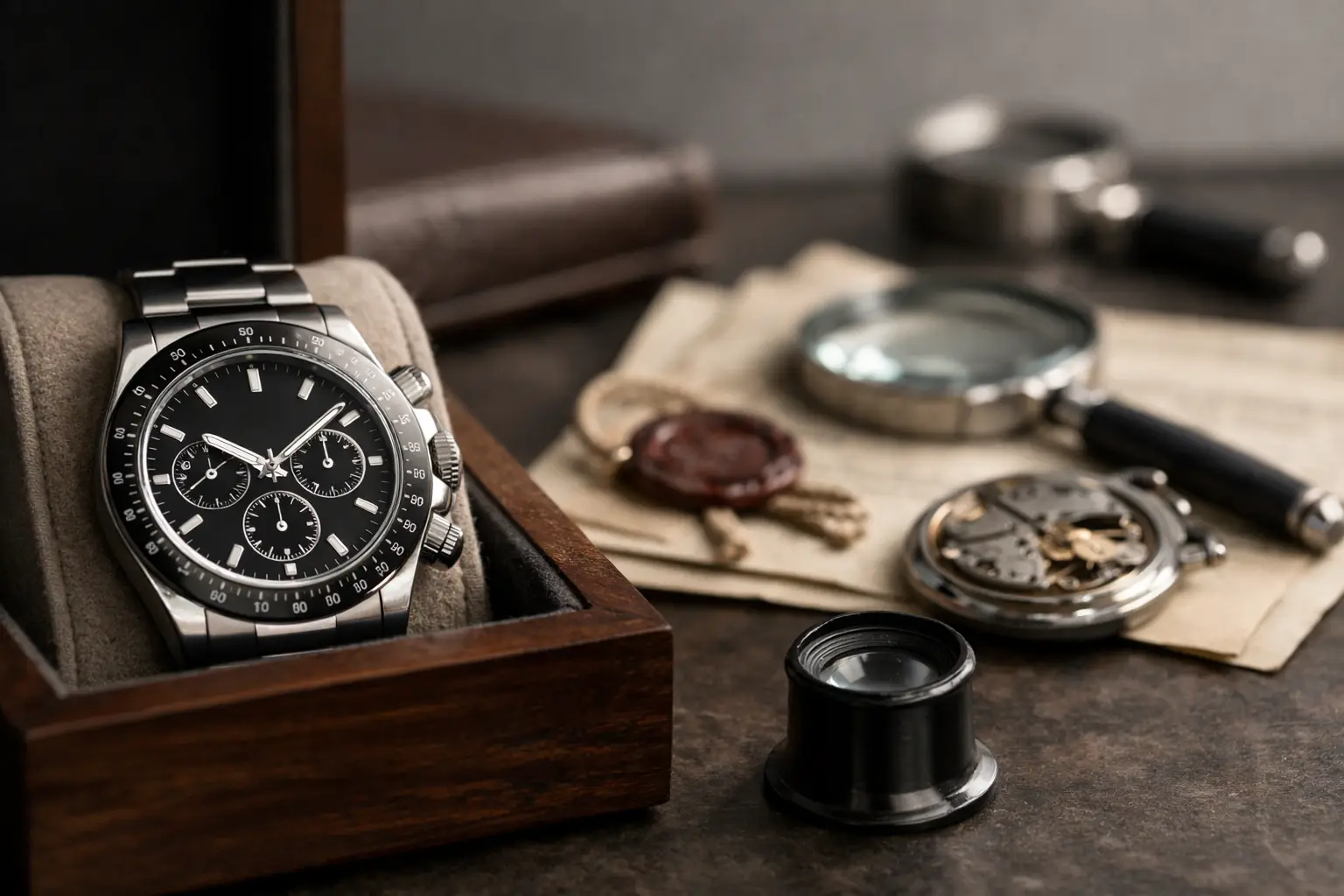
A vintage Rolex Submariner can have the correct reference, a convincing dial, and a strong overall presentation - yet still raise questions that a few clear records could answer. That is the practical value of watch provenance. It gives a buyer a documented view of where a timepiece has been, how it has been maintained, and whether the watch in hand aligns with its stated history.
For collectors and first-time luxury buyers alike, provenance is not a decorative extra. It is part of the evidence used to assess authenticity, originality, condition, and confidence in a high-value purchase. The stronger the paper trail, the fewer assumptions a buyer must make.
What Watch Provenance Actually Means
Watch provenance is the documented history of a specific timepiece. Depending on the watch, it may include its original purchase paperwork, service records, prior auction or dealer documentation, ownership history, and supporting materials such as the original box, manuals, hang tags, or chronometer certificates.
It is useful to separate provenance from authentication. Authentication asks whether the watch is genuine and whether its components are consistent with the reference. Provenance asks what can be known about that particular example over time. A watch may be authentic without having a complete documented history. Conversely, a complete-looking set of papers should never replace a careful inspection of the watch itself.
For a modern Patek Philippe, Audemars Piguet, Rolex, or Omega, provenance may begin with an original dated card or certificate and continue through authorized service documentation. For older watches, the record can be less linear. A decades-old watch may have changed hands privately, lost its original paperwork, or received service long before digital records were common. In those cases, quality of evidence matters more than an expectation of perfection.
Why Provenance Matters to Luxury Watch Buyers
A luxury watch is a mechanical object with a history of use. Provenance helps put that history into context. It can clarify whether a watch was regularly serviced, whether its bracelet and accessories belong with the piece, and whether changes visible today are consistent with its age and stated condition.
It also supports more precise comparisons between examples of the same reference. Two watches can appear similar in photographs but differ materially in their accompanying documentation, service history, case condition, or component originality. Those differences can affect collector appeal and may influence how comfortable a buyer feels owning the watch over time.
This does not mean that an original box and papers automatically make one watch preferable to another. A complete set is valuable supporting evidence, but the timepiece remains the primary object of review. A watch with excellent case geometry, correct components, and a documented recent service may be more compelling than a neglected example with a full accessory set. The right balance depends on the model, era, condition, and the buyer's priorities.
Provenance Helps Explain Condition
Condition descriptions are more useful when supported by history. Service receipts may identify work performed on the movement, crystal, crown, bracelet, or other components. They can also help distinguish routine maintenance from more substantial restoration.
That distinction matters because service is not inherently negative. Mechanical watches require care. A properly performed service can support reliable operation and preserve the enjoyment of ownership. However, collectors may want to understand whether visible changes, such as replaced hands, dial work, case refinishing, or bracelet repairs, occurred during that process. Good documentation allows for a more informed conversation.
Provenance Can Strengthen Identity Checks
Matching serial and reference information is a meaningful part of evaluating a watch, where applicable. Original documentation that corresponds to those details can provide additional support. Yet paperwork is only one element of a proper review. Serial placement, engraving quality, movement configuration, dial details, case construction, and period-correct features should all be evaluated in context.
Buyers should be cautious of simple claims such as “full set” when no explanation accompanies them. Ask what is included, whether documents are original to the watch, whether the serial or reference information aligns, and whether the seller has inspected the piece in-house. Clear answers are more valuable than vague assurances.
What a Strong Provenance File Can Include
The best records vary by watch, but a credible provenance file often contains several types of evidence rather than a single document. Original purchase materials can establish an early point in the watch's history. Service records can add detail about care and maintenance. Prior sales documentation may help establish continuity when a watch has moved through known collections or professional dealers.
For particularly collectible examples, period photographs, archive extracts, correspondence, and original retailer documentation may add context. These materials are most useful when they can be tied directly to the watch through identifying details, dates, or a coherent chain of ownership.
Accessories also deserve a measured approach. Original boxes, papers, manuals, and tags are desirable because they contribute to completeness, especially for recent references. Still, accessories can become separated from watches, and items that appear period-correct are not automatically original to a specific watch. They should be assessed as supporting pieces, not treated as conclusive proof on their own.
Where Provenance Has Limits
Not every exceptional watch has exhaustive records. Family-owned watches may have spent years in a drawer with little documentation. Older sports watches were often worn daily rather than preserved as future collectibles. A missing card or receipt should not disqualify a watch if its authenticity, condition, and component consistency can be evaluated confidently.
At the same time, incomplete provenance should be reflected honestly in the buying decision. A seller should describe what is known, identify what is included, and avoid filling gaps with speculation. “Previously owned by a notable collector” has little practical meaning without documentation that supports the claim.
Documentation can also contain inconsistencies. Names may be misspelled, service paperwork may describe only part of the work performed, and older records may use terminology that differs from current reference conventions. These are not always fatal issues, but they warrant careful review. A credible retailer will treat discrepancies as questions to investigate, not details to overlook.
How to Review Watch Provenance Before You Buy
Start by asking for a complete accounting of what accompanies the watch. Confirm whether it includes an original warranty card or certificate, box, manuals, service records, and any additional supporting documents. If the watch is described as recently serviced, ask when the work was completed and what information is available about it.
Next, compare the documents to the watch rather than reviewing them in isolation. Dates should make sense for the model. Reference and serial information should align where those details are provided. The stated condition should be consistent with the watch's apparent age, use, and service history.
Then consider the seller's process. A high-value purchase calls for more than a promising description and a few photos. Ask whether the watch has been authenticated and inspected in-house, whether the retailer stands behind the condition description, and what protections apply after delivery. Free insured US shipping, a defined return window, and warranty coverage each address a different part of the transaction risk.
Finally, be clear about your own priorities. A collector pursuing a rare, historically significant reference may place considerable weight on original accessories and documented ownership. A buyer seeking a contemporary daily-wear Rolex or Omega may reasonably prioritize in-house certification, mechanical condition, and after-sale protection. Neither approach is wrong, provided the watch is represented accurately.
Provenance and a Protected Purchase Process
Provenance provides evidence, but the purchase process determines how well that evidence is put to work. An in-house certified watch should be evaluated for authenticity and consistency before it is offered for sale. Its documentation should be identified clearly, and condition should be described without overstating what the records prove.
That level of discipline matters because watches are often purchased at a distance. Detailed information, insured shipping, a 30-day return window, and a two-year warranty give buyers practical recourse if the watch does not meet the stated expectations. For US buyers, Lume Wrist Watches combines those safeguards with in-house certification so the decision does not depend solely on a seller's account of a watch's past.
A watch's history will rarely be perfectly complete, especially after decades of ownership. The goal is not a flawless story. It is a credible one, supported by documentation, professional inspection, and a retailer prepared to stand behind the timepiece after it reaches your wrist.