What In-House Watch Certification Should Cover
Published August 27, 2026 · Last updated October 17, 2026 · By Lume Wrist Watches Editorial Team
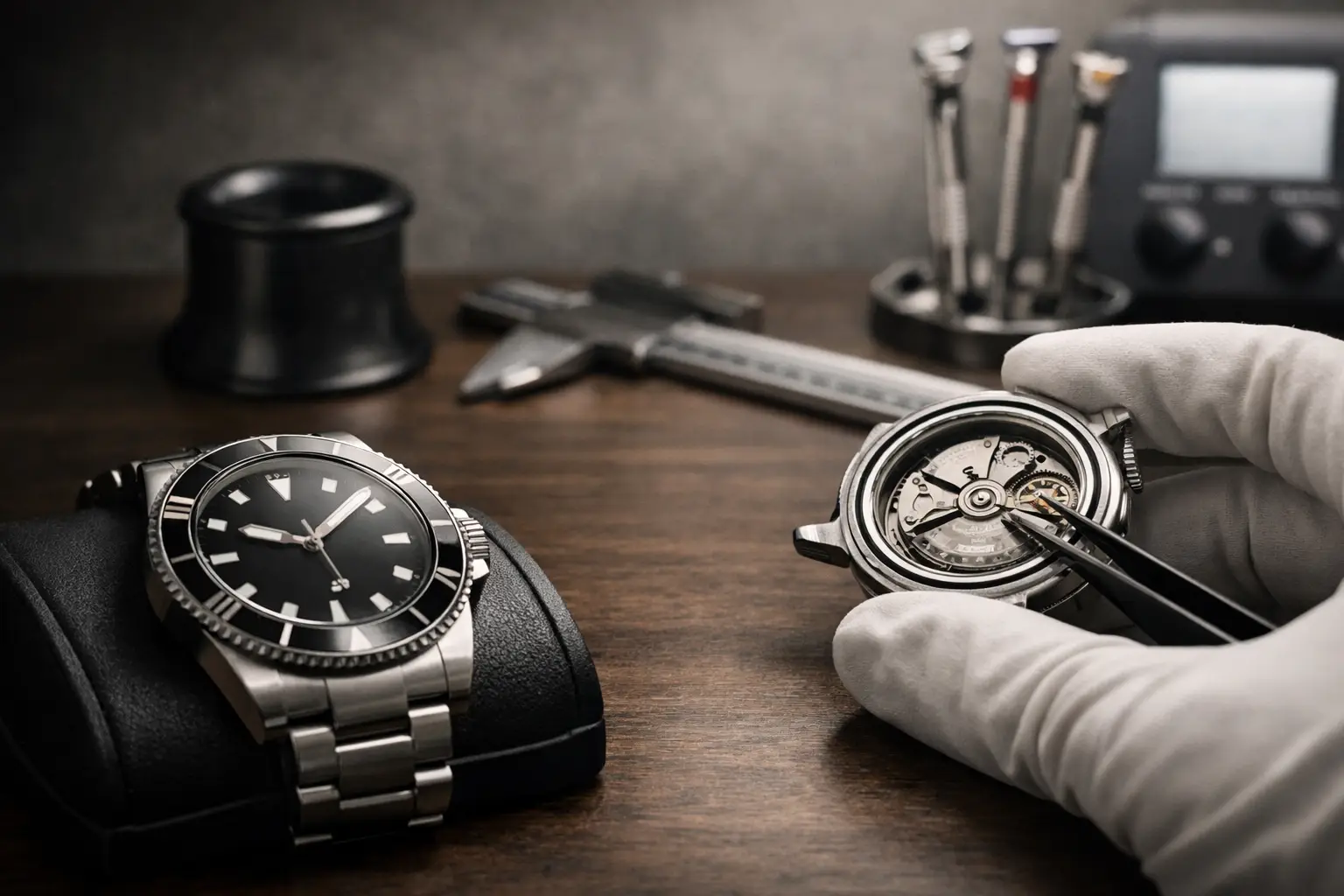
A luxury watch can look correct in a listing and still leave meaningful questions unanswered. Is the watch authentic? Are the dial, hands, bezel, bracelet, and movement appropriate to the reference? Has the movement been tested? Is the stated condition consistent with what will arrive at your door? An in house watch certification is designed to address those questions before a high-value timepiece changes hands.
For buyers considering Rolex, Patek Philippe, Audemars Piguet, Omega, and other established manufacturers, certification is not simply a label. Its value depends on the scope of the inspection, the dealer’s accountability for the description, and the protections that remain after delivery.
What In-House Watch Certification Means
In-house watch certification is a dealer’s professional review of a watch before it is offered for sale. The retailer evaluates the piece using its own inspection process and represents the watch as authenticated and approved for sale. It is distinct from a manufacturer-issued certificate, a brand archive extract, or service paperwork from an authorized service center.
That distinction matters. A manufacturer document can support a watch’s history, but it does not necessarily describe its current operating condition. Conversely, a dealer’s in-house certification should speak to the specific watch being sold now: its identity, its observable configuration, its condition, and its basic function at the time of inspection.
There is no single industry-wide checklist that every retailer follows under the phrase “in-house certified.” Buyers should therefore evaluate the substance behind the claim. A serious certification process should be clear about what was reviewed and should be paired with a return policy and warranty that give the seller a continuing stake in the transaction.
Authentication Is More Than Checking a Serial Number
The central purpose of certification is authentication, but authentication is rarely one isolated test. Luxury watches are systems of components, and the strongest review considers whether those components make sense together.
A proper assessment typically begins with the case, reference details, serial or identifying markings where applicable, and the overall construction of the watch. The dial, hands, bezel, crystal, crown, bracelet, clasp, and movement deserve individual attention. On collectible references, details such as typography, finishing, luminous material, case geometry, and period-correct components can materially affect both desirability and value.
Some watches have replacement parts from legitimate service work. That does not automatically make them unsuitable. It does mean the listing should accurately describe what is present. A service replacement dial, later bracelet, or polished case may be appropriate for a buyer who prioritizes daily wear, while a collector pursuing a highly original example may make a different decision. Certification should support an informed decision, not conceal those distinctions behind a broad statement of authenticity.
Documentation can strengthen confidence, particularly when original papers, service records, or purchase accessories accompany the watch. However, paperwork should be treated as supporting evidence rather than the sole proof of authenticity. Papers can be lost, separated from a watch, or subject to their own verification questions. The watch itself remains the primary object of inspection.
Condition Review Protects Against Listing Surprises
Condition is one of the most subjective areas of the pre-owned luxury watch market. Terms such as “excellent” or “mint” can mean different things to different sellers. A useful certification process turns broad condition language into an accountable description of the actual piece.
The case should be evaluated for polishing, wear, dents, scratches, and the preservation of original lines. On a Rolex sports model, for example, the shape and definition of the lugs can influence how collectors assess the watch. On an Audemars Piguet Royal Oak, the sharp transitions and finishing of the case and bracelet require close attention. On a Patek Philippe dress watch, the quality of the dial and case finish may be more consequential than a light mark that would be less notable on a daily-worn tool watch.
Bracelet condition also deserves more than a passing mention. Stretch, link wear, clasp function, screw condition, and the number of links included can affect fit, presentation, and future ownership. For watches supplied on leather or rubber straps, buyers should understand whether the strap is original, its remaining condition, and whether the buckle is included.
High-resolution photographs remain essential, but they are not a substitute for an in-person review. Images can flatten scratches, conceal wear at certain angles, and make a heavily polished case appear sharper than it is. Certification adds value because it places professional accountability behind the condition description.
Mechanical Testing Should Be Part of the Conversation
A watch can be authentic and still need attention. Mechanical certification should therefore include meaningful functional review, not just cosmetic inspection.
At a minimum, a buyer should expect the dealer to assess core functions relevant to the reference. That may include winding, setting, timekeeping behavior, date change, chronograph operation, bezel function, and bracelet or clasp operation. Water resistance is a separate and more specialized question. Unless it is expressly stated that a particular watch has been pressure-tested and is suitable for water exposure, buyers should not assume it is water-ready simply because the original model was designed that way.
Testing also has limits. A pre-owned mechanical watch can perform appropriately at inspection and later require service, especially if its prior maintenance history is incomplete. That is why a warranty matters. Certification establishes that the watch met the dealer’s standards when sold; warranty coverage provides a defined path if a covered mechanical issue emerges after purchase.
What Buyers Should Confirm Before Purchasing
The strongest luxury-watch purchase process combines certification with clear written terms. Before committing, confirm the scope of what the retailer is representing and what protections apply after the sale.
Look for clarity on these points:
- Whether the watch is described as authentic and in-house certified
- The stated condition of the case, dial, bracelet, crystal, and movement
- The watch’s included accessories, such as box, papers, links, or service records
- The return window and any conditions that apply to returns
- The warranty length, covered components, and process for making a claim
- Shipping method, insurance coverage, and signature requirements
These details are especially important when comparing a structured retailer with an informal private transaction. A private seller may offer a compelling story about a watch’s provenance, but the buyer often assumes the practical risk of authentication, payment, transit, and post-sale mechanical issues. A retailer that certifies its inventory and provides defined purchase protections is making a more concrete commitment.
Certification and Warranty Serve Different Purposes
It is tempting to treat certification and warranty as interchangeable, but they address different parts of the transaction. Certification is the seller’s assessment before sale. A warranty is the seller’s support after sale, subject to its stated terms.
The combination is more meaningful than either element alone. Certification helps a buyer proceed with confidence that the watch has been professionally reviewed. A warranty recognizes that luxury watches are intricate mechanical objects and establishes accountability beyond the day of delivery. A return period gives the buyer time to inspect the watch personally and ensure it meets expectations.
For a US buyer, secure shipment is part of that same protection framework. Free insured US shipping and a 30-day return window reduce two common points of friction in a remote luxury purchase: concern over transit loss and concern that a watch will not match the listing once viewed firsthand. Lume Wrist Watches pairs its in-house certified timepieces with free insured US shipping, 30-day returns, and a two-year warranty, giving buyers a defined process before and after delivery.
The Right Standard Depends on the Watch and the Buyer
Not every collector needs the same level of originality, and not every watch should be judged by the same criteria. A modern Omega intended for regular wear may be an excellent choice with documented service components and light refinishing. A vintage Patek Philippe or early Rolex purchased for collecting may call for a more exacting review of original dial, handset, bezel, and case details.
The right question is not whether a watch is “perfect.” It is whether its identity, condition, configuration, and functionality have been represented accurately enough for your purpose. In-house certification is most valuable when it provides that clarity, supports it with real purchase protections, and gives you a responsible party to contact after the watch is on your wrist.