Timegrapher Readings: Counterfeit Movement Guide (2026)
Published November 8, 2026 · Last updated November 8, 2026 · By Lume Wrist Watches
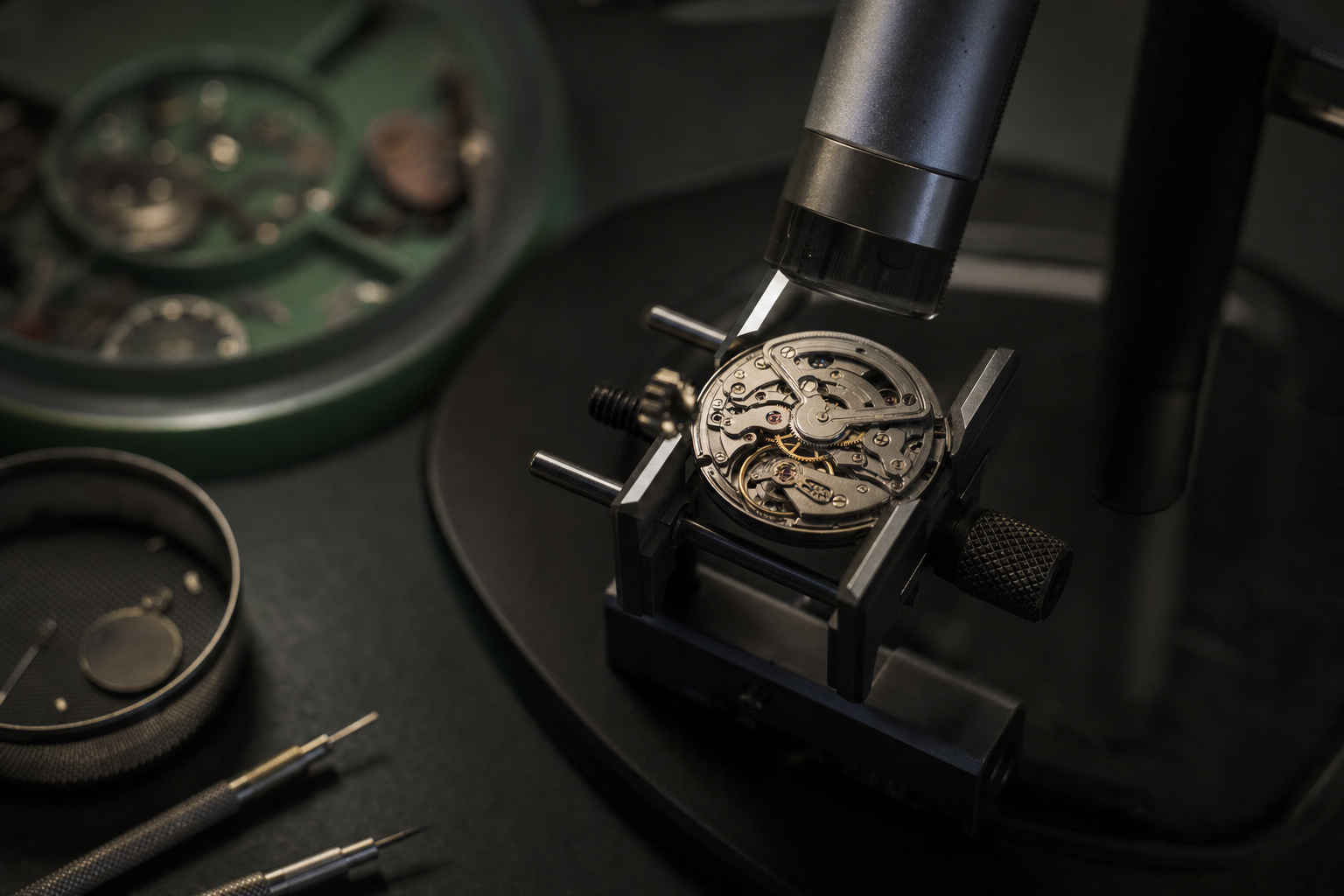
Using timegrapher readings to detect counterfeit movements provides an incontrovertible acoustic window into a watch's mechanical integrity. While modern "superclone" movements visually replicate bridge architectures and free-sprung balances, their acoustic diagnostics fail under multi-position testing. By analyzing rate deviation, balance amplitude, beat error, and trace stability on a timing machine like a Witschi or Weishi, an authenticator can isolate telltale signatures: erratic trace dispersion, mismatched lift angle responses, unstable positional deltas, and beat rates inconsistent with genuine manufacture calibers.
Visual finishing has advanced to unprecedented levels, making external inspection only one layer of modern defense. For complete verification across the dial, crystal, and case, collectors consult our Watch Authentication & Provenance: The Lume Wrist Watches Guide. However, when distinguishing genuine calibers from high-tier counterfeit clones, the microphone never lies.
---
The Reference at a Glance: Production Calibers, Lift Angles, and Acoustic Profiles
A mechanical timegrapher listens to the internal escapement through a sensitive piezoelectric microphone. It captures three distinct impacts per half-oscillation: the roller jewel striking the pallet fork horn, the impulse face of the escape wheel tooth sliding across the pallet jewel, and the locking face striking the pallet stone.
To interpret these signals accurately, an authenticator must program the exact lift angle—the angle of rotation through which the balance wheel travels while in contact with the impulse jewel. Setting an incorrect lift angle skews amplitude calculations significantly. Because counterfeiters frequently drop modified off-the-shelf Chinese movements (such as Dandong, Shanghai, or Seagull bases) into replica cases, their physical balance geometries differ fundamentally from authentic high-horology calibers.
``` Genuine Rolex Caliber 3235: Lift Angle = 55° (36°–38° for special co-axials) | 28,800 vph Generic ETA 2824 Clone (Asia 2824): Lift Angle = 50° | 28,800 vph Dandong 3135 Superclone: Lift Angle = 52° | Unstable impulse trace Omega Co-Axial 8800/8900: Lift Angle = 38° | 25,200 vph (Distinctive 3-beat rhythm) ```
When cross-referencing acoustic data with visual checks—such as checking cyclops clarity through our Watch Crystal Authentication: Complete 2026 Verification Guide—a timegrapher reading confirms whether the movement under the hood possesses true manufacture pedigree.
---
Full Specification Table: Genuine Calibers vs. Counterfeit Movement Metrics
The diagnostic boundaries below represent standard workshop observations across fully wound movements at 20°C–23°C (room temperature). A genuine manufacture caliber displays minimal positional variation, tight amplitude stability, and a razor-straight line trace.
| Movement / Caliber Profile | Nominal Beat Rate (VPH) | Native Lift Angle (°) | Acceptable Dial-Up Amplitude | Maximum 5-Position Delta | Acceptable Beat Error | Typical Acoustic Trace Profile |
|---|---|---|---|---|---|---|
| :--- | :--- | :--- | :--- | :--- | :--- | :--- |
| Genuine Rolex 3135 | 28,800 (4 Hz) | 52° | 275° – 315° | ≤ 4 sec/day | ≤ 0.3 ms | Crisp, solid parallel lines; dead flat |
| Dandong/VS 3135 Clone | 28,800 (4 Hz) | 52° | 240° – 285° | 12 – 25 sec/day | 0.4 – 1.2 ms | Scattered dots ("snow"); wavering line |
| Genuine Rolex 3235 | 28,800 (4 Hz) | 55° (or 53°) | 250° – 290° | ≤ 3 sec/day | ≤ 0.2 ms | Smooth, tight, uniform parallel lines |
| Shanghai 3235 Clone | 28,800 (4 Hz) | 52°–55° | 210° – 260° | 15 – 35 sec/day | 0.5 – 1.8 ms | Significant positional drop; uneven spacing |
| Genuine Omega 8900 (Co-Ax) | 25,200 (3.5 Hz) | 38° | 260° – 300° | ≤ 3 sec/day | ≤ 0.2 ms | Sharp, clean, low-acoustic noise profile |
| Modified Asian Clone (Omega deco) | 28,800 (4 Hz) | 50° | 220° – 270° | 15 – 30 sec/day | 0.6 – 1.5 ms | Incorrect beat rate (4Hz vs 3.5Hz); erratic |
| Genuine ETA 2824-2 (Top/Chronometer) | 28,800 (4 Hz) | 50° | 270° – 310° | ≤ 5 sec/day | ≤ 0.3 ms | Clean linear track; stable across positions |
| Counterfeit Sea-Gull 2824 Clone | 28,800 (4 Hz) | 50° | 230° – 275° | 10 – 22 sec/day | 0.4 – 1.0 ms | Slight wandering; variable rate drift |
These acoustic metrics are essential when evaluating high-value pieces in our our authenticated collection. If a movement's architecture appears genuine but its acoustic data shows high beat error and wild positional variance, it demands complete teardown analysis.
---
Production Timeline and Movement Variations: The Evolution of Clone Escapements
The sophistication of counterfeit calibers has advanced rapidly over the past two decades. Understanding movement history helps buyers detect which generation of counterfeit technology might be lurking beneath the dial.
``` [Early 2000s: Low-Tier Asian 21J] └── 21,600 vph, loud tick, massive beat errors (>2.0 ms), no aesthetic resemblance.
[2010–2017: Decorated Plate Era] └── Standard ETA 2824/2836 or Miyota clones fitted with fake bridge plates; telltale 28,800 vph masquerading as 21,600 or 25,200 vph movements.
[2018–2022: "Superclone" Architecture (VR/SH Series)] └── Visual clone calibers (e.g., VR3135). Cloned geometry, but using conventional curb pins and regulator arms disguised as free-sprung balances.
[2023–2026: True Functional Clones (VS/Dandong)] └── Custom escapements mimicking genuine balances; require specialized timegrapher analysis to catch balance spring friction and material deficiencies. ```
### 1. The Low-Beat / Incorrect Beat Rate Era (Pre-2015) Historically, spotting fakes was straightforward. Fraudsters placed cheap 21,600 vph (3 Hz) movements inside watches that should run at 28,800 vph (4 Hz). A quick reading on a timing machine immediately exposed a frequency of 21,600 or 18,000 vph. Today, this discrepancy is still common in low-tier counterfeits, but high-end superclones match native frequencies perfectly.
### 2. Decorated Base Movements (2015–2020) Counterfeiters later used reliable workhorse calibers (such as the Seagull ST2130 or Hangzhou 6300, both ETA 2824 clones) and glued non-functional decorative plates over them. When placed on a timegrapher, an experienced watchmaker immediately spots anomalies: A watch masquerading as an Omega Co-Axial Master Chronometer (which runs at 25,200 vph) registers at 28,800 vph on the machine. Setting the lift angle to an authentic Omega caliber's 38° yields an absurd amplitude reading (such as 160° or 380°), proving that an incorrect escapement geometry is inside the case.
### 3. Clone Calibers and Customized Escapements (2020–2026) Modern superclones—such as Dandong 3135, VS3235, and customized 4130 chronograph movements—replicate the original gear train layout. To catch these, read our comprehensive breakdown on Identifying Superclone Movements: 2026 Reference Guide. These movements boast native beat rates and attempt to replicate genuine lift angles. However, their physical materials (uncompensated balance alloys, inferior balance springs, and rough escapement pallet stones) cannot produce a clean, stable timegrapher reading across all five testing positions.
---
Wearing Experience and Bench Testing Dynamics: Real-World Diagnostic Protocols
Bench testing an automatic or manual-wind watch involves systematic acoustic observation across multiple physical positions. Counterfeiters cannot replicate the tight tolerances of brands found in our Rolex collection or Omega collection.
``` [ 1. Dial Up (DU) ] ──> Base amplitude benchmark [ 2. Dial Down (DD) ] ──> Checks pivot balance & endshake │ ▼ [ 3. Crown Up (CU) ] ──> High friction position [ 4. Crown Down (CD) ] ──> Primary wear orientation [ 5. Crown Left (CL) ] ──> Vertical gravity stress ```
### Interpreting the Timegrapher Trace When analyzing the visual output on a screen, look for these specific indicators:
- Parallel, Clean Lines: A genuine, fully wound luxury movement produces two parallel, sharply defined lines of dots across the display. The distance between the lines reflects the beat error (ideally 0.0 ms to 0.2 ms).
- The "Snow" Effect (Acoustic Scatter): Counterfeit movements often suffer from poorly polished pallet jewels, rough impulse pins, or balance staff pitting. On a timegrapher screen, this appears as scattered dots hovering around the main traces. This "noise" indicates that the microphone is picking up secondary impacts, bounce, or friction.
- Wave Patterns and Trace Curvature: A trace that rises and falls in cyclical waves over 30 to 60 seconds points to an eccentric escapement wheel or an uneven gear train arbor. While genuine calibers undergo rigorous dynamic poise adjustments, clone components rarely receive this level of finishing.
- Positional Delta (The Ultimate Tell): A counterfeit movement may run within +2 sec/day Dial-Up. However, rotate the microphone carriage to Crown Down (the standard resting position while walking) or Crown Up, and a clone will often drop 15 to 35 seconds per day, shedding 50° to 70° of balance amplitude. Genuine luxury calibers generally maintain positional deltas within 3 to 6 seconds per day.
Whether examining a high-end dress piece or a modern everyday sport watch, physical wear and real-world precision align closely with bench readings. For example, testing entry-level Swiss precision—such as a Tissot Tissot Ballade T156.408.11.043.00 Blue Dial Stainless Steel with its silicon balance spring or a Longines Longines Conquest L3.720.4.92.6 Blue Dial Stainless Steel—reveals exceptionally tight positional stability that counterfeiters struggle to mimic even in five-figure replica executions.
---
Diagnostic Equipment Tiers, Movement Grades, and Market Value Impacts
Using timegraphers to authenticate movements requires understanding both the capabilities of your equipment and the market dynamics of counterfeit calibers. An authenticator inspecting pieces in major centers—such as buyers acquiring luxury watches in New York or collectors sourcing luxury watches in California—should know what equipment best reveals counterfeit anomalies.
### Equipment Classes and Detection Capabilities Consumer-Grade Testers (e.g., Weishi 1000 / 1900): Market cost runs approximately $150 to $300. Excellent for confirming beat rates (e.g., 21,600 vs 28,800 vph), identifying high beat errors (>0.8 ms), and observing basic positional amplitude drops. However, their microphones lack the gain control needed to filter out ambient room noise or analyze low-amplitude micro-escapements. Professional Diagnostic Stations (e.g., Witschi Watch Expert G4, Chronoscope X1): Market cost ranges from $3,500 to upwards of $8,000. These lab-grade systems allow custom acoustic frequency analysis, variable microphone sensitivity, and instantaneous delta calculations across six motorized positions. They can isolate the faint acoustic profile of an authentic silicon hairspring from an aftermarket steel substitute.
``` [Clone Tier 1: Low-grade Japanese/Chinese base] ──> Easily spotted on Weishi ($180) [Clone Tier 2: ETA clone with decorative plate] ──> Exposed by Lift Angle/VPH mismatch [Clone Tier 3: Custom Dandong/SH Superclones] ──> Requires Multi-Position Delta Analysis ```
Authenticity issues decimate secondary market value. While a genuine reference commands top-market pricing in our trade network, an unoriginal escapement or counterfeit caliber strips a watch of its horological value. Furthermore, an altered movement often points to other authenticity red flags, which is why we also verify dial work using our guide on Spotting Redials: Full Reference Guide and Buyer's Checklist and inspect bracelet hardware via our guide on Authenticating Watch Bracelets & Clasp Codes: 2026 Guide.
When exploring the secondary landscape across the United States—including collectors seeking luxury watches in Florida—insisting on verified diagnostic performance is the strongest safeguard for your capital.
---
Authentication Checklist: Step-by-Step Timegrapher Diagnostic Protocol
Follow this rigorous diagnostic checklist whenever verifying a mechanical watch movement:
- [ ] Step 1: Fully Wind the Movement
- Wind the watch manually 40 to 50 turns. Timegrapher readings taken on a depleted mainspring yield artificially low amplitudes and erratic rates, clouding diagnostic conclusions.
- [ ] Step 2: Program Correct Reference Parameters
- Look up the caliber's exact factory specifications. Input the true lift angle (e.g., 52° for Rolex 3135; 55° for Rolex 3235; 38° for Omega Co-Axial 8800/8900).
- [ ] Step 3: Measure Base Position (Dial-Up)
- Allow the trace to stabilize on the screen for at least 30 seconds.
- Check beat rate: Does it match the factory specification precisely?
- Check beat error: Is it under 0.3 ms? (Values over 0.6 ms on a supposedly pristine modern luxury watch indicate poor quality control or an unpoised clone balance).
- Check amplitude: Is it healthy (generally 270°–310° for modern calibers)?
- [ ] Step 4: Check for Escapement "Snow"
- Examine the screen for scattered dots around the main dual traces. Dots indicate pallet stone friction, pivot wear, or improper jewel clearances typical of unrefined clone assemblies.
- [ ] Step 5: Run Multi-Position Testing (Minimum 3 Positions: DU, CD, 6H/CL)
- Measure Dial-Up, Crown-Down, and Crown-Left.
- Calculate the Delta: Subtract the lowest rate from the highest rate. If the delta exceeds 8 to 10 seconds per day on a modern COSC or Superlative Chronometer-rated watch, inspect the movement further.
- Watch the amplitude drop: If amplitude falls by more than 45° to 60° when moving from Dial-Up to vertical positions, the escapement tolerances point to an imitation balance assembly.
- [ ] Step 6: Listen for Knocking (Rehousing)
- If amplitude exceeds 325°–330° and the trace splits into erratic jagged lines, the impulse pin is striking the outside of the pallet fork (knocking). In fakes, this often stems from improper mainspring barrel dimensions.
To discover genuine, chronometer-accurate models across independent and historic houses, review our guide to Beyond the Big Four: Essential Luxury Watch Maisons to Know in 2026 or study the real-world performance of icons like the Omega Seamaster Buyers Guide for Confident Buyers.
---
Frequently Asked Questions
### Can a counterfeit watch movement be regulated to show a perfect 0 sec/day timegrapher reading? Yes. Counterfeiters and secondary sellers can easily adjust the regulator arm or balance screws to achieve a flat 0 sec/day reading in a single position (typically Dial-Up). However, this adjustment is superficial; as soon as the watch is rotated into vertical positions (such as Crown-Down or Crown-Up), an unrefined clone movement will experience significant rate shifts and amplitude drops.
### What happens if I test a counterfeit watch with the wrong lift angle entered into the machine? Entering the wrong lift angle does not affect the measured beat rate (vph) or beat error (ms), but it will produce an incorrect amplitude calculation. If a counterfeit watch contains an ETA clone with a 50° lift angle, but you enter the 55° lift angle of a genuine Rolex 3235, the timegrapher will calculate an artificially elevated amplitude reading. Always confirm the movement's true base architecture before relying on amplitude diagnostics.
### Why do Omega Co-Axial movements require a specific lift angle and timegrapher setup? Omega's proprietary Co-Axial escapement utilizes a radial impulse mechanism that requires far less sliding friction than a conventional Swiss lever escapement. Consequently, its lift angle is significantly lower—typically between 36° and 38°. If an Omega Co-Axial is tested at the standard lever escapement setting of 52°, the timegrapher will display an inaccurate, massively inflated amplitude reading well over 340°.
### Does high beat error always mean a movement is fake? Not necessarily. High beat error (over 0.5 ms) simply means that the balance wheel does not swing equally in both directions from its resting center point. While vintage genuine watches can develop beat error over time and simply require regulation, modern luxury watches from top manufactures leave the factory adjusted to 0.0–0.2 ms. An exceptionally high beat error on a modern, supposedly pristine watch is a strong warning sign of an unadjusted counterfeit caliber or severe mechanical shock.
### Can a timegrapher detect whether a balance hairspring is genuine silicon or steel? A standard timegrapher cannot directly identify hairspring composition, but it reveals the spring's mechanical performance under external influence. Genuine silicon balance springs (such as Rolex Syloxi or Omega Si14) exhibit near-zero magnetic susceptibility, remarkable positional delta consistency, and unique terminal curve behaviors. If a watch marketed with a silicon hairspring shows erratic rate shifts when exposed to subtle electromagnetic fields on the bench, the spring is an alloy counterfeit.
---
Contact Lume Wrist Watches
At Lume Wrist Watches, every timepiece in our inventory undergoes extensive multi-position acoustic analysis, physical movement verification, and provenance auditing. Our specialists utilize precision timing systems to verify that every watch delivers genuine chronometric performance.
Whether you are acquiring a certified timepiece, requesting our tailored concierge sourcing service, or looking to sell your watch to us, our team is here to assist you.
- Corporate Office: 18 East 48th Street, Suite 1503, New York, NY 10017
- Telephone: +1 (332) 285-2190
- Email: sales@lumewrist.com
- Operating Hours: Monday – Friday, 9:00 AM – 7:00 PM ET | Closed Saturday & Sunday
Schedule a consultation directly through our contact page or browse our current curated inventory on our shop.
---
Final Thoughts
Counterfeiters continue to replicate dials, cases, and bridge engravings with increasing precision. Yet, they remain bound by the physical realities of mass-market movement manufacturing. Precision balance poising, jewel tolerances, and escapement geometries require meticulous hand-finishing and high-grade alloys that counterfeiters simply cannot reproduce at scale.
A timegrapher is an indispensable tool in modern horological authentication. By taking careful multi-position readings, verifying lift angles, and spotting trace scatter, you can look past aesthetic mimicry and confirm the authentic heartbeat of a fine timepiece. Explore our authenticated collection at Lume Wrist Watches to discover thoroughly inspected luxury timepieces verified through expert mechanical diagnostics.