Annual Calendar vs Perpetual Calendar: Which in 2026?
Published October 22, 2026 · Last updated October 23, 2026 · By Lume Wrist Watches
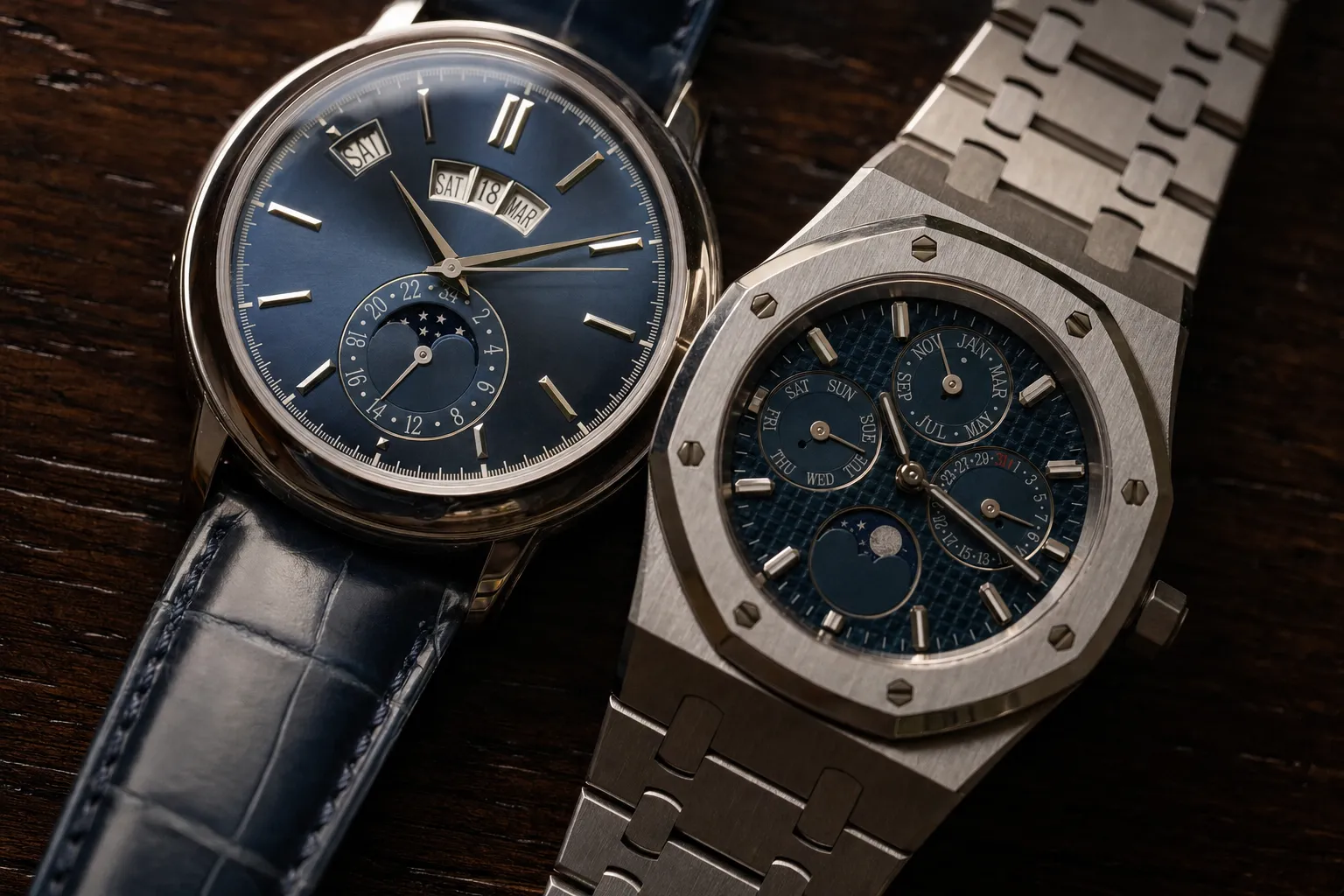
An annual calendar mechanically tracks months with 30 and 31 days but requires manual correction once per year on March 1st. In contrast, a perpetual calendar (quantième perpétuel) factors in the 28 days of February and the four-year leap-year cycle, running continuously without intervention until March 1, 2100. If you seek mechanical ingenuity, daily wearability, and sub-$40,000 access to high-tier calendar watchmaking, buy an annual calendar. If you demand heirloom status, grand complication prestige, and true set-and-forget mechanical memory across decades, invest in a perpetual calendar.
Calendar watches represent one of the crowning triumphs of modern and classical horology. To make an informed decision when evaluating our authenticated collection, you must understand how these complex mechanisms function beneath the dial, how they wear on the wrist, and how secondary market values behave in 2026.
---
Verdict Summary: Annual Calendar vs Perpetual Calendar
The fundamental distinction between an annual calendar and a perpetual calendar lies in mechanical memory. A standard date complication assumes every month has 31 days, necessitating five manual adjustments a year. In 1996, Patek Philippe engineered the first modern annual calendar with the reference 5035 (Caliber 315 S QA), inventing an intermediary complication utilizing a rotary wheel program that accounts for months with 30 and 31 days. Its sole blind spot is the transition from February to March, requiring its wearer to advance the date once annually.
The perpetual calendar, mastered in pocket watches by Thomas Mudge in 1762 and adapted to wristwatches by Patek Philippe in 1925, solves the February anomaly through an intricate 48-month program wheel or satellite Maltese cross gearing. As explored in our deep-dive into horology's grand complications, the perpetual calendar is classified as high-art mechanical engineering. It computes the 1,461-day cycle of three standard years and one leap year entirely through gear ratios, requiring zero human intervention until 2100—when the Gregorian calendar omits a leap year to reconcile solar time.
While perpetual calendars command higher entry points, prestige, and collector reverence, annual calendars provide exceptional daily resilience, modern styling, and significantly lower servicing overhead.
---
Side-by-Side Specification Table
Below is a technical comparison of how these two mechanical calendar systems compare across engineering, daily ergonomics, and financial commitment:
| Specification / Feature | Annual Calendar (AC) | Perpetual Calendar (QP) |
|---|---|---|
| :--- | :--- | :--- |
| Manual Interventions | 1 per year (March 1st) | 0 until March 1, 2100 |
| Invented for Wristwatch | 1996 (Patek Philippe Ref. 5035) | 1925 (Patek Philippe Ref. 97975) |
| Mechanical Component Count | ~300 to 380 total movement parts | ~370 to 570+ total movement parts |
| Underlying Mechanism | Rotary program wheel / sliding pinions | 48-month program cam or grand levier system |
| Leap Year Display | No | Yes (I–IV, L, or 1–4 indicator) |
| Typical Case Thickness | 11.0 mm – 14.5 mm | 8.5 mm – 13.0 mm (varies by base caliber) |
| Setting Vulnerability | Low to moderate; often forward-only | High; risk of broken levers between 8 PM–4 AM |
| Average Service Cost | $1,200 – $2,200 | $2,200 – $4,500+ |
| Entry Secondary Market Price | $8,500 – $20,000 (Steel/Pre-owned) | $22,000 – $45,000+ (Precious metals/Steel) |
| Leading Archetypes | Patek Philippe 5205G, Rolex Sky-Dweller | Patek Philippe 3940/5320G, AP Royal Oak 26574ST |
---
Design and Wearability Compared
Dial architecture defines the visual personality of both complications. Because an annual calendar is engineered for daily practicality, watchmakers frequently prioritize scannability.
### Dial Displays and Legibility The iconic Patek Philippe Reference 5205 demonstrates quintessential modern annual calendar architecture: three instantaneous aperture windows curved along the upper dial arc displaying day, date, and month, leaving the lower sector open for a 24-hour subsidiary dial and moon phase. Similarly, the Rolex Sky-Dweller incorporates the ingenious SAROS system, communicating the month through twelve discrete apertures orbiting the hour indices—a design triumph balancing high complications with sports-watch durability.
In contrast, perpetual calendars favor classical, high-density symmetry. Traditional references like the Patek Philippe 3940 or 5140 utilize a three-subdial register layout: Subdial at 9 o'clock: Day of the week paired with a 24-hour indicator. Subdial at 3 o'clock: Month paired with the four-year leap year cycle. * Subdial at 6 o'clock: Date hand sweeping around an integrated moonphase disk.
Modern perpetual calendars, such as the Audemars Piguet Royal Oak Perpetual Calendar (Ref. 26574ST), expand this dial real estate further by incorporating an outer 52-week chapter ring with a dedicated central pointer hand. For collectors navigating choosing the right watch for your life, the visual density of a QP delivers immediate connoisseurship, while an annual calendar reads with the instant clarity demanded of an executive daily watch.
### Case Thickness and Wrist Presence Interestingly, perpetual calendars are frequently thinner than annual calendars. Because the perpetual calendar mechanism was developed during the mid-20th century, top-tier manufactures built them atop ultra-thin base movements. Patek Philippe’s legendary Caliber 240 Q measures just 3.88 mm in total thickness thanks to a 22k gold off-center micro-rotor, allowing references like the 3940 or 5140 to slip under a tailored cuff at under 9 mm of total case height.
Annual calendars, by contrast, frequently utilize full-rotor automatic movements stacked with modular gear trains. A Rolex Sky-Dweller (Caliber 9002) stands at approximately 14 mm in height, offering robust water resistance and commanding wrist presence, but sacrificing the svelte silhouette of an ultra-thin dress perpetual calendar. If your daily attire leans toward structured tailoring, ultra-thin QP references remain difficult to beat; for dynamic lifestyles requiring sportier heft, the annual calendar is unmatched.
---
Movement and Accuracy Compared
The mechanical choreography separating these movements comes down to gear geometry, energy consumption, and the architecture of the calendar mechanism itself.
### The Mechanics of the Annual Calendar When Patek Philippe developed Caliber 315 S QA in the mid-1990s, the goal was simplification. Rather than relying on traditional multi-lever setups that were fragile to assemble, engineers designed a gear system driven by wheels with varying numbers of teeth corresponding to the differing lengths of 30- and 31-day months. When the calendar advances at the end of April, June, September, and November, a specialized rocker mechanism senses the 30-day cam and drives the date disc forward two positions—skipping the 31st directly to the 1st.
Because this layout lacks a physical mechanical memory for February's 28 or 29 days, the mechanism naturally treats February as a 30-day month. On February 28th, the watch will advance to February 29th (in a leap year) or February 30th (requiring correction to March 1st). This minor manual reset takes less than twenty seconds using recessed case pushers.
### The Mechanics of the Perpetual Calendar A traditional perpetual calendar solves February via a grand lever (grand levier) coordinating with a 48-month program wheel. This wheel features 48 distinct notches cut along its circumference, representing a full four-year cycle of 48 months. Standard 31-day months feature no notch; 30-day months have shallow notches; normal 28-day Februaries feature deep notches; and leap-year Februaries (29 days) have an intermediate notch depth.
At midnight on the final day of the month, the grand lever drops into the notch. The depth of the drop mechanically determines how many teeth the date wheel must advance before daybreak. On February 28th of a standard year, the deep notch allows the lever to sweep across four calendar teeth instantaneously, advancing the date from 28 directly to 1.
Alternative systems exist, such as the groundbreaking synchronized gear train pioneered by Kurt Klaus for the IWC Da Vinci in 1985 (Caliber 79261). Klaus eliminated external case pushers entirely, linking the calendar indications so that advancing the crown advances the date, month, year, and moonphase in total synchronization.
### Power Reserve, Winding, and Setting Hazards Maintaining continuous power is critical for both calibers, making an understanding of power reserves, hairsprings, and accuracy essential. Allowing a perpetual calendar to stop running poses an operational headache. While setting an annual calendar requires only a fast reset via the crown or case pushers, resetting a stopped perpetual calendar involves navigating danger zones.
On traditional perpetual calendars, manually adjusting the indicators between 8:00 PM and 4:00 AM can bend delicate selector levers or shear the calendar drive pins while gears are actively engaged. If your QP lacks synchronized crown adjustment, you must cycle the hands forward or carefully press flush-mounted case pushers in a strict manufacturer-dictated sequence. For collectors who rotate pieces regularly, pairing your perpetual calendar with a reliable watch winder—or opting for models with crown-synchronized adjustments—is mandatory.
---
Price and Value Retention Compared
When evaluating high complications through an investment and market lens—as detailed in our luxury watch investment and market guide—annual and perpetual calendars inhabit distinctly different price brackets.
### Entry and Secondary Market Pricing On the secondary market, annual calendars offer one of the most accessible entry points into prestigious haute horlogerie. Entry-Level Complications: Highly respected steel references from IWC or pre-owned neo-vintage Patek Philippe references (such as the early yellow gold Ref. 5035) trade within market ranges of $12,000 to $22,000. Modern Icons: Popular contemporary models like the white gold Patek Philippe 5205G or the rose gold 5396R typically change hands between $35,000 and $48,000 depending on condition and box/papers provenance. * Steel Luxury Sports: Stainless steel Rolex Sky-Dwellers (Ref. 326934) trade as approximate market observations between $17,000 and $21,000 on the secondary market.
Perpetual calendars carry a substantial premium reflecting their historical status as a grand complication: Neo-Vintage QPs: Classic neo-vintage models such as the Patek Philippe 3940J or IWC Da Vinci Perpetual Calendar Ref. 3750 in yellow gold can be acquired from approximate market observations between $15,000 (for IWC) to $38,000–$45,000 (for Patek Philippe). Modern Heavyweights: Contemporary iterations like the Patek Philippe 5320G hover between $65,000 and $82,000, while hyper-desirable integrated-bracelet sports perpetuals—such as the Audemars Piguet Royal Oak Perpetual Calendar in stainless steel (Ref. 26574ST)—routinely command between $85,000 and $115,000 on the secondary market.
### Servicing and Long-Term Ownership Costs Routine maintenance must factor into your total cost of ownership. Overhauling a mechanical perpetual calendar requires master watchmakers certified in high complications. Servicing a perpetual calendar typically incurs manufacturer fees ranging from $2,200 to $4,500+ every five to seven years, often requiring several months at the manufacture’s restoration atelier. Annual calendars utilize modular or standardized architectures that make servicing significantly more accessible, typically running $1,200 to $2,000 per cycle.
Before finalizing an acquisition, verifying that a piece retains authentic factory dial finishes is crucial; review our technical checklist on spotting redialed watches and dial refinishing to safeguard against altered vintage calendars.
---
Who Should Buy Which — Three Clear Buyer Profiles
Choosing between an annual calendar and a perpetual calendar depends on your wearing habits, mechanical preferences, and lifestyle. Here are three collector profiles to guide your choice in 2026:
### 1. The Daily Executive: Buy the Annual Calendar If you want a high-complication wristwatch that transitions seamlessly from corporate boardrooms to casual weekend wear, choose an annual calendar. You value horological sophistication but refuse to baby your watch. Adjusting the date once a year on March 1st represents an enjoyable, tactile tradition rather than an inconvenience. Ideal selections include: Rolex Sky-Dweller (Ref. 326934 / 336934) with Saros annual calendar and Ring Command bezel. Patek Philippe Annual Calendar (Ref. 5205G or 5396G) for timeless high-horology aesthetics.
### 2. The Legacy Collector: Buy the Perpetual Calendar If you view your collection as an intergenerational archive, purchase a perpetual calendar. You appreciate the mathematical poetry of a mechanical computer tracking leap-year eccentricities into the 22nd century. You wear your watches deliberately, keep them on winders when stored, and demand the horological distinction that only a true grand complication commands. Ideal selections include: Patek Philippe Perpetual Calendar (Ref. 3940, 5140, or 5320G). Audemars Piguet Royal Oak Perpetual Calendar (Ref. 26574ST or 26574OR).
### 3. The Complication Connoisseur on a Value Budget If you appreciate classical dial layouts, complete calendar tracking, and fine Swiss finishing but want to keep your investment well under $10,000, look beyond the annual vs perpetual binary. A complete calendar with moonphase—which tracks date, day, month, and lunar cycles but requires manual correction on all five 30-day months—offers dramatic aesthetic presence. Outstanding options include: The Longines Longines Master Collection Moonphase L2.909.4.78.3 Silver Dial. Classic sport and dress alternatives like the Omega Omega Constellation 1202.10.00 Champagne Dial Steel & Yellow Gold or the legendary Omega Omega Speedmaster Moonwatch Professional 42mm Steel Black Dial.
---
Frequently Asked Questions
### What happens to a perpetual calendar in the year 2100? In the year 2100, standard perpetual calendars will require a single manual date correction. Under the Gregorian calendar system, century years divisible by 100 are not leap years unless they are also divisible by 400. Because 2100 is not a leap year, standard 48-month program cams will mistakenly advance from February 28 to February 29 instead of March 1, requiring an authorized watchmaker or owner to advance the mechanism manually.
### Can you damage a perpetual calendar by setting it at midnight? Yes. Adjusting a perpetual calendar’s indicators via quick-set pushers while the calendar advancement gears are engaged—typically between 8:00 PM and 4:00 AM—can snap delicate jumper springs or bend the actuating levers. Always ensure the time is set to the lower hemisphere of the dial (e.g., 6:00 AM or 6:30 PM) before utilizing recessed pushers to adjust dates, months, or moon phases.
### Why are annual calendars sometimes thicker than perpetual calendars? Annual calendars are predominantly designed as modern daily sports and dress watches utilizing thick automatic base movements with added modular calendar plates. Conversely, many historic perpetual calendars are built using bespoke, integrated ultra-thin calibers—such as the Patek Philippe Caliber 240 Q or Audemars Piguet Caliber 5134—specifically engineered with micro-rotors to preserve an ultra-slim profile.
### Does an annual calendar track moon phases accurately? Yes. When an annual calendar features a moon phase complication, the lunar mechanism operates independently from the calendar disc system. Standard moon phase mechanisms utilize a 59-tooth gear driving two alternating moons across a 29.5-day synodic month, accumulating just one day of error every 2 years, 7 months, and 27 days, while high-precision lunar trains remain accurate for 122 years.
### Can I wind and set an annual calendar forwards and backwards? Most traditional annual calendars allow crown setting of the time in both directions, but the date, day, and month pushers advance in one forward direction only. However, modern engineering feats—such as the Rolex Sky-Dweller or Ulysse Nardin calendar systems—permit bidirectional adjustment of the date and local time forward and backward directly through the crown without risking mechanical damage.
---
Contact Lume Wrist Watches
At Lume Wrist Watches, we specialize in curated, authenticated luxury timepieces from top Swiss manufactures. Every timepiece that enters our inventory undergoes rigorous inspection by our master watchmakers, backed by our in-house team independent authentication.
Whether you are acquiring your first complication, utilizing our concierge sourcing service to secure a rare perpetual calendar, or looking to sell your watch to us, our team is dedicated to horological excellence.
We provide insured delivery across the United States, serving collectors seeking luxury watches in New York, clients buying luxury watches in California, and connoisseurs shopping for luxury watches in Florida.
- Email: sales@lumewrist.com
- Phone: +1 (332) 285-2190
- Corporate Office: 18 East 48th Street, Suite 1503, New York, NY 10017
- Operating Hours: Monday – Friday: 9:00 AM – 7:00 PM ET · Closed Saturday & Sunday
To view our complete line of timepieces or submit an inquiry, visit our contact page or browse our authenticated collection.
---
Final Thoughts
The choice between an annual calendar and a perpetual calendar represents a balance between modern mechanical utility and transcendent horological prestige. The annual calendar is a triumph of 20th-century ingenuity, offering 364 days of hands-off accuracy in an accessible, wearable package. The perpetual calendar remains an undisputed pinnacle of classical fine watchmaking, translating astronomical time onto your wrist without interruption across generations.
Ready to find your next milestone timepiece? Explore our authenticated collection today and discover the world’s most sought-after calendar complications.