Testing Precious Metal Weight & Hallmarks in Watches
Published October 20, 2026 · Last updated October 21, 2026 · By Lume Wrist Watches
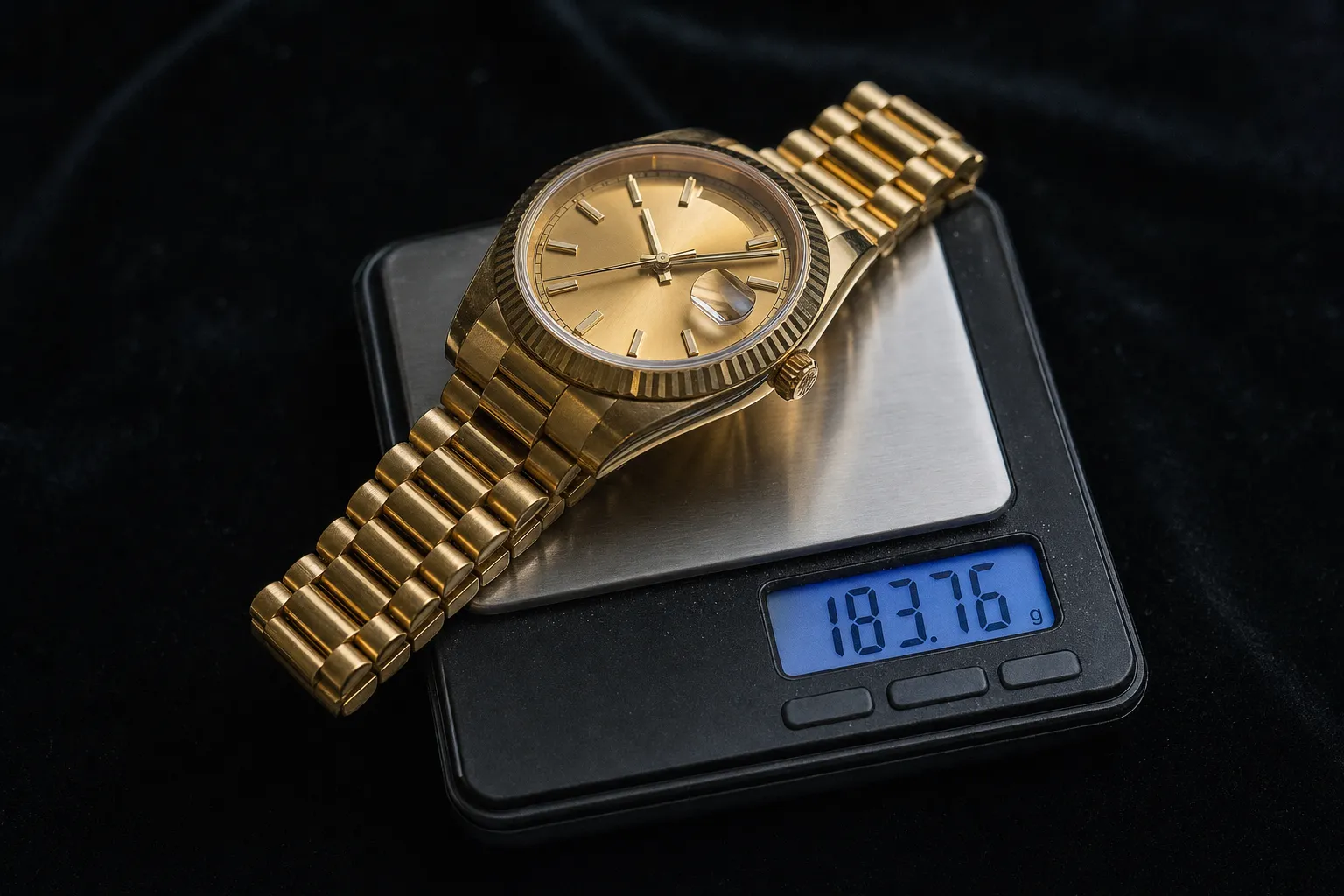
Authenticating precious metal timepieces requires verifying mass, specific gravity, and official Swiss assay hallmarks to ensure a case is genuine solid gold or platinum rather than gold-plated base metal or a tungsten-weighted counterfeit. Because gold (19.32 g/cm³) and platinum (21.45 g/cm³) possess physical densities nearly double that of steel, precision scales and microscopic hallmark inspections remain the most conclusive non-destructive defenses against sophisticated fakes. At Lume Wrist Watches, every precious metal timepiece undergoes strict metallurgical evaluation before joining our collection.
Navigating high-end horology demands a rigorous understanding of metallurgy. In this comprehensive guide, we explore the historic transition of Swiss assay markings, non-destructive scientific analysis techniques, and practical weight verification protocols used by expert authenticators.
---
Why Precious Metal Authentication Matters
Precious metal timepieces represent the pinnacle of horological status, artistry, and financial value. Whether housing an ultra-thin dress movement or powering an executive sports watch, 18k yellow, white, and rose gold, along with 950 platinum, occupy a distinguished tier above standard stainless steel. For collectors, understanding metallurgical authenticity is critical because modern counterfeiters now fabricate cases using dense alloy cores, thick heavy plating, or laser-sintered fake hallmarks.
``` +---------------------------------------------------------+ | METALLURGIC AUTHENTICATION PILLARS | +---------------------------------------------------------+ | 1. Volumetric Mass & Specific Gravity (Archimedes) | | 2. Micro-Morphology of Official Assay Office Stamps | | 3. Non-Destructive Spectrometry (XRF & Ultrasonic) | | 4. Mechanical Wear Characteristics & Patina Integrity | +---------------------------------------------------------+ ```
A solid gold case cannot be judged purely on visual aesthetics. The tactile heft, structural resonance, and metallurgical purity must align with factory specifications. As explored in our comprehensive pillar guide to Watch Authentication & Provenance: The Lume Wrist Watches Guide, forensic inspection must span from internal movement architecture to the exact alloy chemistry of the exterior casework.
---
Brand History and Defining Milestones with Dates
Official state regulation of precious metals in watchmaking stretches back centuries, establishing a verifiable trail of metallurgical milestones:
- 1880 (The Swiss Precious Metals Control Act): Standardized statutory hallmarks across Swiss cantons. The head of Helvetia was mandated to certify 18k (0.750) gold, while a standing grouse designated 14k (0.585) gold.
- 1914: Introduction of the ibex mark to certify 950 platinum cases across Swiss manufacturing hubs.
- 1933: Refinement of regional assay office symbols; small letter identifiers were added alongside the primary mark (e.g., "G" for Geneva, "B" for Biel, "C" for La Chaux-de-Fonds).
- August 1, 1995 (The Unified Swiss Precious Metals Act): The historic Helvetia and animal figures were retired for newly minted watches. The Head of a Saint Bernard dog became the mandatory universal Swiss standard hallmark for all precious metal alloys (gold, platinum, palladium, and silver), accompanied by a distinct purity stamp.
- 2000s–Present: Introduction of computerized micro-milling and laser ablation by top manufactures, making hallmark analysis under high optical zoom essential for detecting flat, laser-etched counterfeits.
Understanding these chronological milestones prevents authenticators from misidentifying era-appropriate marks. For example, finding a Saint Bernard hallmark on a vintage 1970s watch indicates an aftermarket replacement case.
---
Every Hallmark and Assay Stamp Explained, with Signature Signifiers
Swiss law strictly regulates how watch cases, casebacks, buckles, and bracelets display metallurgical purity. Knowing what hallmarks correspond to specific alloys and production eras is crucial for verifying authenticity.
``` +-----------------------------------------------------------------------------------------+ | SWISS ASSAY HALLMARK DIRECTORY | +-------------------+---------------------+-----------------------+-----------------------+ | ALLOY SPECIFICATION| PRE-1995 SWISS MARK | POST-1995 SWISS MARK | COMMON MILLesimal MARK| +-------------------+---------------------+-----------------------+-----------------------+ | 18k Gold (750/1000)| Helvetia Bust | Saint Bernard Dog | "750" inside Scales | | 14k Gold (585/1000)| Grouse (Coq de Bruyère)| Saint Bernard Dog | "585" inside Scales | | Platinum (950/1000)| Ibex Head | Saint Bernard Dog | "950" or "Pt950" | | Sterling Silver | Duck / Grouse | Saint Bernard Dog | "925" inside Scales | +-------------------+---------------------+-----------------------+-----------------------+ ```
### Modern Swiss Standards (Post-1995) On all Swiss timepieces produced after August 1, 1995, collectors must identify two distinct primary marks:
- The Common Responsibility Mark (Maker's Mark): Encased inside a specific geometric cartouche identifying the casemaker registered with the Central Office for Precious Metal Control.
- The Official National Assay Mark: The profile head of a Saint Bernard. Under 10x or 40x magnification, authentic Saint Bernard marks reveal crisp fur texture and a miniature cantonal letter (such as "G" for Geneva) struck into the lower jaw.
- The Purity Mark (Millesimal Fineness): Stamped as numbers denoting parts per thousand—"750" for 18k gold or "950" for platinum—frequently set within a scales-of-justice outline.
### Distinctive French and European Import Marks Certain vintage pieces destined for international delivery feature secondary regional stamps. Classic French imports carry the Eagle's Head for 18k gold or the Dog's Head for platinum. The Key hallmark was traditionally applied in Geneva for gold cases manufactured for export. To uncover deeper physical telltales across cases, explore our guide to Forensic Techniques: Detecting Fake Luxury Watches in 2026.
---
Physical Testing: Density, Specific Gravity, and Non-Destructive Calibers
Visual hallmarks are only half the authentication equation. Modern super-clones occasionally incorporate genuine cloned casebacks or counterfeit laser-engravings on weighted tungsten alloys. To separate solid gold from plated tungsten, watchmakers employ specific gravity and spectrometric testing.
| Material Alloy | Density (g/cm³) | Magnetic Attraction | XRF Detectable Surface Layer | Common Counterfeit Application |
|---|---|---|---|---|
| :--- | :--- | :--- | :--- | :--- |
| 18k Yellow Gold | 15.20 – 15.60 | Zero | Uniform 75.0% Au | Gold-plated base brass |
| 18k White Gold | 14.70 – 15.20 | Zero | Uniform 75.0% Au + Pd/Cu | Steel / plated white brass |
| 950 Platinum | 20.00 – 21.45 | Paramagnetic/Zero | Uniform 95.0% Pt | Stainless steel weighted |
| Tungsten (Base) | 19.25 – 19.30 | Slight / Paramagnetic | Micro-layer Au coating | Heavy core clad fakes |
| 316L Stainless Steel | 7.90 – 8.00 | Non-magnetic to weak | 0% Au / High Fe-Cr | Budget counterfeit casework |
### 1. Specific Gravity Testing (Archimedes' Principle) By measuring a bare case's dry weight on an analytical scale (accurate to 0.001g) and dividing it by its displaced water volume (submerged weight differential), watchmakers compute its exact physical density. $\text{Specific Gravity} = \frac{\text{Weight in Air}}{\text{Weight in Air} - \text{Weight in Water}}$ Because an 18k gold alloy yields a density of ~15.5 g/cm³, a steel or brass case coated in heavy gold plate immediately fails this test with a specific gravity under 9.0 g/cm³.
### 2. X-Ray Fluorescence (XRF) Spectroscopy XRF analyzers fire primary X-rays into the watch alloy, measuring secondary fluorescent X-rays to establish exact elemental percentages without scratching the metal. An authentic Rolex collection Day-Date case will register ~75% pure gold alloyed with copper, silver, or palladium, immediately exposing low-karat counterfeits or gold-plated brass.
### 3. Ultrasonic Thickness Gauging Because tungsten matches the specific gravity of gold closely (~19.3 g/cm³), sophisticated counterfeiters machine tungsten cores wrapped in thick 18k gold foils. Ultrasonic transducers emit sound waves through the metal. Sound travels through gold at roughly 3,240 m/s, but speeds up through tungsten to over 5,100 m/s. Any internal material boundary creates an instant acoustic echo, exposing clad fabrications.
To discover how watchmakers inspect movements alongside case metallurgy, review our analysis of Movement Inspection: What a Watchmaker Looks For in 2026.
---
Price Tiers Today: Weight Value vs. Market Realities
Precious metal watches carry prices driven by two distinct forces: intrinsic scrap melt value and collector market premiums. Understanding these tiers helps buyers identify suspiciously underpriced offerings.
- Entry-Tier Precious Metals ($6,000 – $14,000): Vintage dress models from historic houses (such as vintage Omega or classic rectangular dress watches), smaller mid-size references, or neo-vintage 18k models on leather straps. Intrinsic gold content typically represents $2,500 to $4,500 of the total valuation.
- Core-Tier Solid Gold Sports & Executives ($18,000 – $48,000): Signature icons like the Rolex Day-Date 36/40, Cartier watches in solid rose or yellow gold, and solid-gold chronographs with matching gold bracelets. An 18k bracelet alone can contain 70 to 110 grams of alloy.
- Grail Tier & High Complications ($55,000 – $250,000+): Heavy platinum timepieces like the Patek Philippe timepieces Grand Complications or solid gold Audemars Piguet Royal Oaks. Platinum variants demand substantial premiums due to the difficulty of machining 950 platinum and its exceptional mass.
---
What to Check Before Buying Pre-Owned Precious Metal Watches
When purchasing pre-owned luxury timepieces, apply this practical authentication checklist:
- Examine Lug Recesses and Spring Bar Holes: Counterfeit gold plating wears away fastest in high-friction zones. Check where the bracelet end-links or leather straps rub against the case. Any silvery or brassy base metal peeking through indicates plating.
- Verify Edge Sharpness on Hallmarks: Authentic Swiss hallmarks are struck using hardened steel punches or high-definition mechanical tools. Fake stamps often feature rounded, acid-etched gutters or shallow, blurry laser burns. Utilize UV Light & Microscopic Analysis: Hidden Watch Authentication Clues to evaluate stamp margins.
- Confirm Bracelet Reference Numbers: Check that bracelet clasp codes, end-link stamps, and hallmarking match the case alloy. Counterfeiters often install genuine gold-plated vintage clasps onto counterfeit links, as detailed in our guide on Service Parts, Franken-Watches & Disclosure in Luxury Watch Authentication.
- Audit the Overall Mass: A solid 18k gold sports watch with bracelet rarely weighs less than 180 to 220 grams depending on links. If an 18k reference weighs 130 grams, base metals are present.
- Cross-Reference Serial Registries: Confirm the serial and reference stamps match factory configurations by reviewing our analysis of Serial Number Lookups vs Registry Verification: 2026 Guide.
---
Current Authenticated Stock at Lume Wrist Watches
At Lume Wrist Watches, every luxury watch is verified using strict metallurgical, aesthetic, and mechanical testing protocols. Explore select models from our curated inventory:
- Longines Longines Avigation BigEye L2.816.1.93.2 Titanium Blue Dial: A modern marvel in lightweight Grade 5 titanium, demonstrating how modern aerospace metals contrast sharply with high-density golds.
- de Grisogono de Grisogono Instrumento Doppio CR N1 Chronograph Silver Dial Steel: A complex, dual-faced mechanical timepiece showcasing distinct case architecture and sharp hallmark-grade engravings.
- Wittnauer Wittnauer Professional 238T (7004A) Black Dial Burgundy Bezel: A celebrated vintage chronograph illustrating period-correct caseback stamps, factory case bevels, and vintage steel patina.
Explore our authenticated collection, review specific historic icons across all featured maisons, or visit Authentication at Lume Wrist Watches to learn more about our verification process. For broader market trends, read our comprehensive Luxury Watch Investment & Market Guide: Navigating 2026.
---
Client Logistics Across the United States
Lume Wrist Watches provides high-value insured delivery throughout the country. Explore our full reach with luxury watches delivered to all 50 states.
Every order is backed by our in-house team independent authentication and transparent shipping & delivery practices. Need assistance building a personalized portfolio? Utilize our dedicated concierge sourcing service, coordinate private viewing appointments, or sell your watch to us directly.
---
Frequently Asked Questions
### How can I tell if a gold watch is real without scratching it? Non-destructive methods include analytical weight checks, specific gravity displacement tests, and portable X-ray Fluorescence (XRF) spectrometry. XRF analyzers determine the exact elemental breakdown of the outer metal layers without damaging the case finish. Additionally, inspecting assay stamps under 20x magnification reveals whether hallmarks are authentically struck rather than acid-etched.
### What does the Saint Bernard hallmark mean on a watch? Introduced on August 1, 1995, the Saint Bernard dog profile is the universal Swiss standard hallmark certifying that a watch case meets official Swiss legal fineness for precious metals (18k gold, 950 platinum, palladium, or 925 silver). It replaced regional historic hallmarks, such as the Helvetia bust for 18k gold.
### Can counterfeiters fake the weight of solid gold watches using tungsten? Tungsten has a density (~19.25 g/cm³) nearly identical to pure gold, allowing counterfeiters to produce replicas that feel heavy in hand. However, authenticators detect tungsten cores using ultrasonic thickness gauges, which measure sound wave velocity, and precision benchtop scales, as 18k watch gold is an alloy (~15.5 g/cm³) rather than pure 24k gold.
### Where are precious metal hallmarks located on luxury watches? Hallmarks are traditionally stamped behind the lugs, on the exterior or interior caseback, inside the deployant clasp blades, and sometimes on the case flank. On high-end Swiss references, you will find millesimal purity numbers (e.g., "750"), the Swiss national assay stamp (Saint Bernard or Helvetia), and the registered casemaker’s responsibility mark.
### Does platinum feel heavier than white gold on the wrist? Yes, platinum is significantly denser and heavier than 18k white gold. Standard 950 platinum has a density of roughly 21.45 g/cm³, whereas 18k white gold ranges between 14.7 and 15.2 g/cm³. Even in identical case dimensions, a platinum watch will feel 30% to 40% heavier than its 18k gold counterpart.
---
Contact Lume Wrist Watches
Lume Wrist Watches is committed to horological transparency, absolute authenticity, and client service. We welcome clients to our Manhattan office by appointment or invite direct inquiries regarding our collection.
- Email: sales@lumewrist.com
- Phone: +1 (332) 285-2190
- Office: 18 East 48th Street, Suite 1503, New York, NY 10017
- Hours: Monday – Friday, 9:00 AM – 7:00 PM ET | Closed Saturday & Sunday
To schedule a consultation or inquire about our authentication protocols, visit our contact page or browse our shop. Payments are accepted via major card or bank wire only.
---
Final Thoughts
Precious metal timepieces balance mechanical horology with intrinsic material value. Because modern counterfeiting techniques continue to advance, verifying hallmarks, density, and metallurgy is an indispensable step in luxury watch authentication. Understanding these physical details ensures your investment remains secure. When you are ready to acquire an authenticated precious metal timepiece, explore our shop to browse our carefully vetted collection.